Episode Transcript
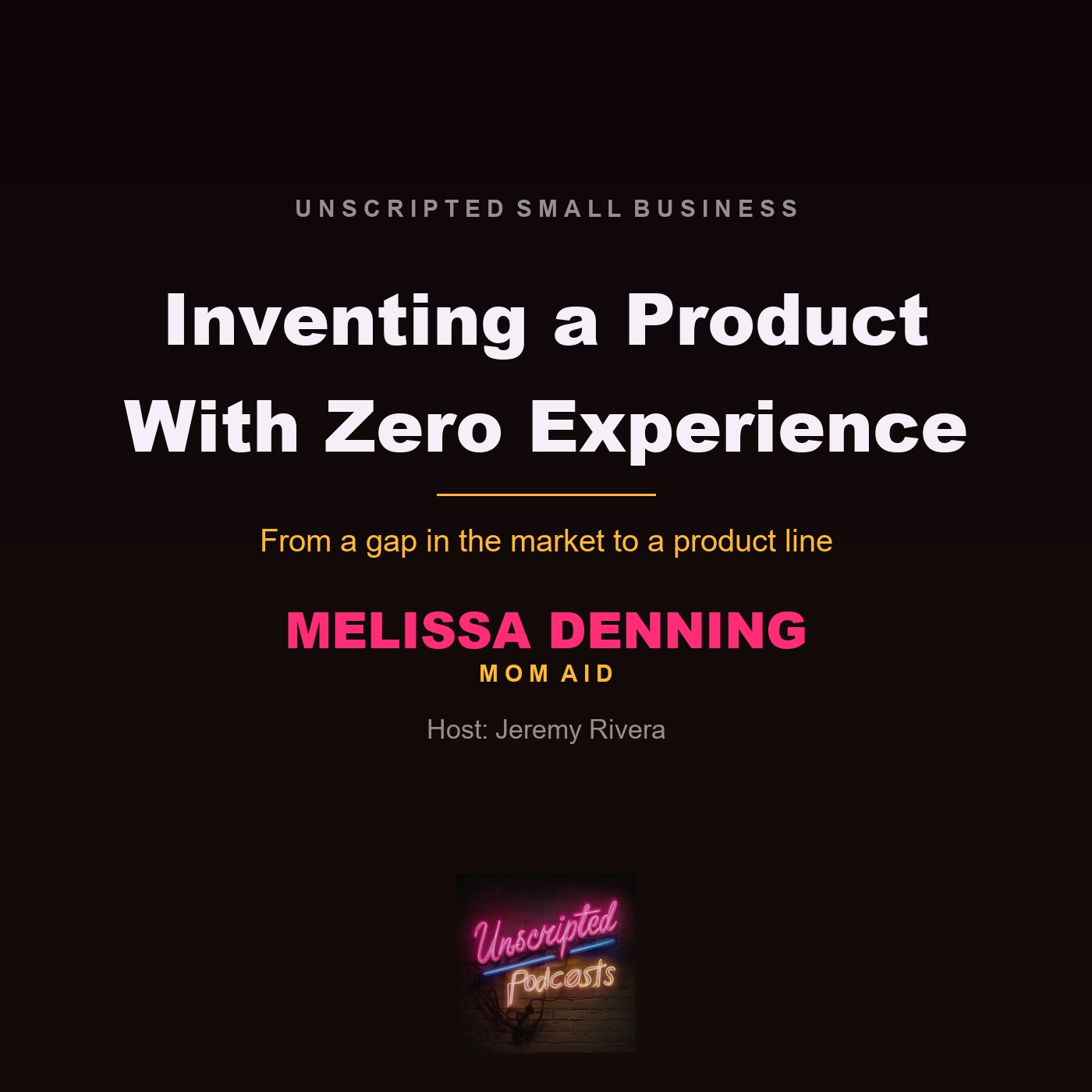
[00:00:01] Speaker A: Hello, I'm Jeremy Rivera, your unscripted small business podcast host. I'm here with Melissa Denning of Mom Aid, who's going to tell us why we should trust her as an expert in her field.
[00:00:18] Speaker B: Thanks for having me.
[00:00:21] Speaker A: Thanks for coming on. So what would you say you do here? Talk about your experience. Experience and what it is that you do with your business?
[00:00:32] Speaker B: So I have launched a luxury postpartum and baby care product line.
Our hero product is the boob aid nursing pads, and I invented those. And so I've kind of gone from knowing nothing about inventing a product to going through it and getting it patented. So I don't know that I'm an expert, but I do know a lot more than when I began.
[00:01:03] Speaker A: It's kind of the journey, and a lot of folk run into that with regulations. And I worked with Metaflex glove, and she had invented something that helps with carpal tunnel. It pulls your fingers back at night.
And, you know, she. She had talked several times to me about, like, the regulatory hoops, especially as getting qualified as, like, a medical device. And, you know, meeting this criteria for testing was some surprising additional breaks, aside from just like, okay, snip, snip, snip, and here's a glove, and it helps at night. You got to do a little bit more than that to get a product to market, right?
[00:01:45] Speaker B: Yes. So, luckily, I don't have to be FDA approved. I'm not technically regulated by them. I have voluntarily registered my nipple ointment and diaper cream through them and did all the documentation and everything. But to get FDA approved is like, I want to say, like, $11,000 just to apply and get it going, and then it's like a fee that you have to pay them every year per product.
And so luckily, I am not regulated by them, but I know it's a daunting task that people have to deal with.
[00:02:29] Speaker A: Was it from. Was the invention born out of necessity for yourself, or was it observing, you know, somebody else's product, pregnancy and their travails that inspired you to get into this particular niche?
[00:02:46] Speaker B: So it was from my own personal postpartum journey with breastfeeding, and I kind of found a gap in products.
Nothing that would protect.
I'm about to go tmi, probably on
[00:03:00] Speaker A: you, but I have two kids, and my. My wife went through hell and back, so you can't shock me. You can't surprise me. So, yeah, by all means.
[00:03:12] Speaker B: So there's nothing that will protect the nipple between feedings while also absorbing leaking milk. So for Anyone that doesn't know between pumping or nursing sessions, when you're breastfeeding, you have leaking milk. It's called your letdown.
And so like if you're in the grocery store and a baby cries, it's like your body thinks you need to leak milk.
And so there's. So moms wear these nursing pads that catch that leaky milk.
And there was nothing that would help protect the nipple that would also absorb leaking milk that was on the market. And so I kind of found a gap in it and searched the Internet for hours and hours and found nothing. So then I kind of, I had the idea, I kind of started the process. Then I waited like six months because life happens. And then I one day said, well, if I don't start now, I'm never going to start. So I just went ahead, got with a patent attorney, got with Oklahoma State University, has a inventors assistance program.
So I got with them, they accept like 75% of the people that apply is what they told me.
And so they kind of made a prototype for me, got me in touch with a patent attorney and kind of got the, helped me get the ball rolling.
So that's how I got started on it. Kind of taking the first step. But there was once I discovered this gap in the market and talking to other moms, I found that it was like a huge population of moms that suffer from pain. And if you are suffering from pain during breastfeeding and then say you get a wound on the nipple, well, the cotton nursing pad will stick to any healing wounds and skin. And when you go to pull it off, well, it pulls the skin off with it. And so it's just kind of like it never gets a chance to heal and it, you know, and kind of get a break from everything. And so the boob aid nursing pads give it that break. So.
But yeah, that's how I got started for my own personal experience was the
[00:05:41] Speaker A: once you realize, you know, hey, I'm making an invention, what were your thoughts about, you know, distribution, doing an E Commerce, building a brand, having, you know, selling it on a storefront, connecting with suppliers was is that anything that you had prior experience from? Like where was your prior experience or job? And you know, are you transitioning now from being part time elsewhere or have you been full time on this project for a while?
[00:06:16] Speaker B: So I had zero experience except for the being a mom part.
So I have three kids.
I used to be a stay at home mom and about 11 years ago I got my real estate license and so I'VE been a real estate agent agent full time here in Oklahoma since getting my license.
And then so I had my two kids. There was an age gap. I had my third. And that's where the she was the one that we'll say she gave me the idea because the problems that created the idea.
And so I kind of had to just start at square one. And it's figuring out a lot of things on your own. I one of the big blessings to me was getting a really good patent attorney that I could trust. But then also I kind of scoured the Internet for a long period of time looking for design and engineering firms that could help me make a legit prototype and kind of walk me through that.
And I came across one that was kind of a boutique. They're not tiny.
And they were out in California. I met with the owner of the company. I really liked him. He had past experience in doing like panty liners and things, and so he knew kind of the process. So we worked through a couple designs.
The initial design, I wanted it to have a concave center that already had the ointment in it and just had like a tab you pulled off. But it was going to have to touch too many human hands and it wouldn't be fiscally possible for us to do that. So then we change designs. Figured out a design where it's a silicone center and so it has like the cotton layer that they all have and then it's got that absorption layer and then a silicone layer. And then there's a hole cut out of those top two layers and it's kind of heat sealed to expose the silicone. So it's the silicone and it's BPA free, medical grade, breathable that sits against the skin.
And so it won't stick to the healing wounds and skin. It allows the ointment to absorb into the skin, not the pad. And then we added a tiny bit more. It's called, it's SAP, but it's the absorption layer. We added a tiny bit more so it could maybe make a mom through her whole workday. And then we made more adhesive on the back, a little stronger adhesive so that it'll kind of stay put better. Or if it needs to be exchanged from one bra to another, it can be and it'll still stick and be usable.
So that's kind of our differentiating factors.
[00:09:11] Speaker A: Kind of awesome to think that, you know, there's all of these resources, all of of these platforms and tools that, you know, for somebody who Just has an idea you can tap in. So tell me a little bit about how you've, you know, decided to build a brand, some of your marketing decisions, what have you been building to kind of support this invention and, you know, bring mom A to life on the market.
[00:09:45] Speaker B: So my design and engineering firm had connected me with a few different manufacturers over in China and that's where they were used to dealing with people. So that's just what he did.
So I interviewed them, talked through with them and found one that I really liked.
I started the whole process, thought we were going to launch that last summer. So summer 2025.
And then we kind of came up to a hurdle where the piece of equipment they have to purchase to make these is $120,000.
Initially it was going to be just a tooling that they added to their equipment they already had and it was going to be 50,000. And that was the easier pill for me to swallow and amount of money for me to justify spending.
But when they said 120,000, I was like, well, whoa, whoa, whoa, whoa.
So we went back to the drawing board on a more basic design that we could send out into the market to prove market validity.
Which is a thin silicone center. So it's basically a really strong sticker on one side and they will hand put them onto the nursing pads and then hand package them.
And so we're gonna do a Test run of 5000 once I get through funding for those, but with marketing and everything.
So I wanted to launch the nursing pads first, but with that hurdle, I already had the formulation for the appointment started. And so I was like, why don't we just go ahead and follow through with that fine tune that get it on the market so we can start building brand awareness.
Then when we come to market with the nursing pads, people will be familiar with our products. So that's where I decided to launch the nipple ointment and then do the tiny toe diaper cream a month later.
And marketing. I have a marketing firm that I've worked with.
I just recently hired them.
They've.
That's a, you know, sometimes you just gotta work through the pains and struggles of learning things. So they had really strong points, but they've also.
I was their first CPG company to work with and it was just, they didn't really understand. So I'm currently trying to figure out a marketing situation that I want to do.
I'm learning through this program how to run my own ads through meta and everything. And so I think I can handle that. But I know like, I've got great branding.
The people that did my branding were really good and my packaging and design and my website's great. My marketing team did website and so it's just kind of trying to figure out that growing brand awareness aspect and exactly how we want to do it. I just got on Impact, which is an affiliate marketing platform.
And so they've got tons of UGC people on there and a ton of creators that'll work with just doing affiliate marketing. And so I think that's kind of where a lot of our efforts should go from testing some things. And so I think growing brand awareness through user generated content is where we will excel. So I think it's a learning process. And because as a new brand, you do not have the funds to spend on huge marketing firms and things. And so it's kind of, kind of like trying to figure out how to be scrappy and make the most of your dollar.
[00:13:44] Speaker A: Yeah.
[00:13:45] Speaker B: And so that's kind of where I am right now because I'm still self funded.
I don't have any investors right now.
So
[00:13:54] Speaker A: that's, that's a blessing and a curse because I, I definitely, you know, coming from the SaaS side of things, I've seen and worked at several companies where you know, oh, hey, we want to grow, we'll get investors.
And that was the plan. And you get all the excitement, oh, we finally got an investor. And then the reality kind of hits like a year after of like, hey, these are their goals and you need to do these things to meet them. And even if it's not aligned with what your vision was for the company, the leadership was like, oh, well, I guess we have to do this now. And you have to do this even though we, it, it doesn't really vibe. So, you know, there's always that, that aspect of getting funding of, hey, you know, somebody else has a stake, that means somebody else has a say.
So being bootstrapped, you know, you got to pull yourself up by them, but they're still your bootstraps.
[00:14:50] Speaker B: Right? That's, I'm like, I understand that I probably most likely will not be able to hold on to 100% forever, but I sure am trying to for as long as possible. So I, I would love an investor that could also bring a lot of knowledge and maybe connections and things along with some money. But ideally in my mind, how I would prefer it would be to get enough to where we can bring the nursing pads to market, do the marketing that we need to for them, and then Start basically putting the money back in for new orders and stuff. And so hopefully, you know, we don't need millions and millions and millions, but hopefully we can kind of keep bootstrapping and self funding and things like that as long as possible.
[00:15:44] Speaker A: I'm curious, what's been your interaction with LLM based tools of any type? Have they played a functional role as far as research, discovery, implementation, been part of helping you execute on any of your marketing plan or have you issued any of those AI tools?
[00:16:10] Speaker B: So AI has been my friend.
I just. So I've saw some cute little obviously AI generated ad that was like a Pixar style animation ad for a couple different brands and it like pulled me in and I watched the whole like minute ad and so I was like, well these are intriguing.
So then I get on Claude, I'm like, claude, how do I make one of these? And I did a screenshot of the picture or whatever. So then Claude wrote me out.
You know, it was like the character sheets, what the song should say and all these things. And it said go to Chat GPT.
Because I have, I pay for the Claude and I pay for the Chat GPT ones. And so it was like go to Claude or go to Chat GPT.
It'll build you the still images, give it these prompts and then you need to go to. It gave me a couple options, but I chose Runway.
Runway.
You'll have to give it prompts, but it'll take those still images and make them into animation.
Then you put them all together in cap cut, overlay the music that you did in Sunno Sunno Suno Suno.
And here we have our little like 45 second AD. I haven't ran them as ads yet. I posted them on social media, but I want to run them as ads. One of the bunnies though has like two faces.
So it's like I have to remove that. But I AI helps me a lot in things like whether it's writing something for like a pitch competition, if I need something to sound really put together, like right, terms of this convertible note I'm offering or because sometimes they say in two words, tell us what your two sentences, tell us what you do, what your company does. And I'm like, I need a really good way to tell them what I do. And Claude and Chat have been with me since the beginning because they know the business and they know me well and so they can write something really good for me that sounds great and is really accurate. So I'm all about the AI. I, I do Know, I need to get in and do, you know, like prompts and you can make it do what, run programs and do all these additional things that I haven't done yet.
[00:18:35] Speaker A: But yeah, I, I had a good interview on the unscripted non profit podcast with Melissa and she's with leveling the fields and she's doing nonprofit. She's like, I use Claude every day. Naya was like, oh, you use Claude? And so I started talking about how I use Claude code and I've got MCPs that connect to this. And she's like, oh, I didn't. Like, you can pull your analytics information from your site and have Claude code process that for you and tell you, you know, how your marketing is doing against all these channels. I'm like, yeah, it's like I'm doing that by hand. Like I'm doing all of these things. So the, it's always like layers, you know, because I, I do a lot with Claude code to help me with the workload, for instance, this podcast. But you know, I also use it a lot in my SEO processes, search engine optimization, to gather data that's all dipped in different pools. Like, you can have Claude code dip into your browser and move around inside of Google Analytics and download spreadsheets. You can connect to your Google inbox, connect, connect to your Google Drive. I have my drive synchronized, so if it makes a folder and puts stuff into it, Google Drive synchronizes it and then I can share those links automatically.
So there's so much of my workflow and process that used to be used to take such a long time. I feel like I, like, I've got Steve Rogers super serum now when it comes to marketing is this. It's like super puny. I knew what I needed to do, I was committed to it, but I just didn't have the physical means to, to execute as much as I can. Now it's just a ground shift really when it comes to marketing and capability.
[00:20:38] Speaker B: I need to utilize it more for like the marketing aspect and pulling more information on like my buyer analytics and like, what are the keywords they're searching for. I mean, well, I know for the most part because I was the one searching for them at one point in time. So it helps that I know like kind of how my buyer's mind works, but it's constantly changing and like, what are their priorities when they're searching for these things. And it is a lot of legwork up front to do the cloud code. I know, but then it's like frees you up so much.
[00:21:12] Speaker A: Yeah, there's a kind of a mindset mentality about it too that I find particularly effective, which is when you gain efficiency through Claude, through chat, GPT reinvest a portion of that like 50% of that it back into the quality aspect. On another editing angle of it. The. Because if you just rely on immediately what it puts out the first time, you could get so much more by just adding, you know, take. You saved half an hour making it, well, take at least 15 minutes. Reviewing the quality, refining the prompt, putting in human layers, you know, checkpoints. Because just letting, you know, letting that AI stuff immediately go out. Then you have the, the AI slop problem of like, you know, you rushed too quickly to market. And I, I see a lot of bigger companies that have fallen into the trap of, oh, we're this much more efficient, so let's get rid of the people. And you're like, man, like, if you said, you know, in, in 2000, hey, I can make your people 25% more efficient, their response would be amazing. Let's grow by 25%. Not, let's cut percent 20, 25 of our workforce.
[00:22:36] Speaker B: Yeah, it's.
That part is scary. Like taking up, taking over and like jobs that are being taken by AI and stuff. I'm like, you better make yourself real valuable if you work for somebody because like in real estate, you can totally tell when realtors for like the property description have done it in AI and like not looked it over and made sure that it sounds like a real human wrote it. And it's like, oh my gosh, guys, like at least look like you put effort into it. Like, it's crazy.
I came up then you look like an idiot. Also, like,
[00:23:23] Speaker A: I came up in digital marketing by working with realtors at a website hosting company for real estate advanced access. If anybody. Ancient news by now, nobody knows what it is. But I, I mean there's. There is kind of a trope of like, you know, they couldn't even be bothered to like take a picture that isn't like from the doorway at the worst possible angle. And there's like two. There's like two pictures for the entire house.
Like one, there was, there was an entire website dedicated to, you know, these white plastic, those white plastic chairs that they have.
And so like real estate agents would not remove them. And they found all of these real estate listing photos with. They would just do like a daily drop of like the white plastic chair.
And it's just like a hallmark of like laziness of like not Thinking it through, you're like, come on, like you're trying to sell a hundred thousand, two hundred, three hundred, the largest purchase in anyone's life and you're not going to take the time to turn on the light before you take a picture. You're not even going to take the time to. Then like, yeah, sure, you save time by actually, you know, asking, having an AI program come up with a description of it, but it misread the room and said that there were three doors or that there was an extra kitchen. And come on, like, let's get the, the details right. If you're going save time, then save time and add quality with the time saved, right?
[00:25:00] Speaker B: Yeah, it's crazy. I'm like, some of these houses people list for $400,000 and they've taken the photos with their iPhones and like, I just want to send a letter to their seller that says find an agent that pays for professional photos.
I'm just like, it's people just always trying to cut corners and stuff and it does no one any good.
[00:25:28] Speaker A: What are you looking forward to in the future with Mom Aid? What's your two year plan? I know five years is a bit much. You probably have it written down, but let's. With the speed of change of everything happening, let's say even C6 months. What's 6 months look like for Mom Aid?
[00:25:48] Speaker B: I don't have it written down and I've done a lot of personality tests that say detail orientation is my weakness. And I've come to realize that it's not very accurate. Actually.
I'm kind of big picture.
I like the business development and growth side of things.
So six months from now, I would ideally have the nursing pads launching. My goal was to have them launching in Q1 of 2027.
It's getting kind of a tight squeeze depending on my funding situation to get them here by then. But that's still what I'm pushing for. So ideally having them on the market.
I do want to try to launch two new products per year, three on a really good year once we get going and kind of prove traction. But I have some really good products that I want to come out with that I've already started formulation and things on.
But ideally Mom Aid becomes a household name that, you know, we have all natural, really effective, high quality products that do what they're supposed to do. They don't just mask the problem and call it a day. So I keep saying, like Neosporin, I'm coming for you.
I want to create some really good products that they are higher in price, but I can justify it because the ingredients are way better and they're effective. So
[00:27:20] Speaker A: yeah, I mean you do, you do have like those fundamentals like cost, but also targeting, you know, the more luxury and a higher quality. It is something where, you know, as a, as a husband who had a wife who went through a lot in both her postpartum and you know, and the pregnancy phase was incredibly difficult and like, I think there is definitely a market and an appetite for not just bare bones support for it, but like good quality products because it's, you know, it's such a tough time and to feel like you have to go super generic. Like it's just, you know, the more generic the, the, the, the more poor the fit for the product. And it's definitely something where if you're experiencing, you know, physical challenges like that, like you're, while you're usually constrained by budget, you're, you're, you're often not reaching for the lowest part of the shelf, you're reaching higher up on the shelf because like, it's not just physical health, but it's also, you know, that self care. And I think there is a moment right now where self care for mothers is really important to, you know, the millennial generation and you know, the upcoming next generations as they, you know, become parents. Like the self sacrifice and martyrdom of the boomer generation is kind of on display. Like, this was terrible.
Why did nobody fix this? Like, let's get products that work, let's have health care that works. Let's have, you know, support for these challenging moments in our lives. Why, why would we ignore that opportunity to like, you know, deliver something as a business that actually really helps people?
[00:29:27] Speaker B: Yeah, I like to say we're intentionally designed so, you know, I always hated digging my finger into that ointment tub. Like it would get under your fingernail. You'd have to like dig it out and then like, how sanitary is that? And then you're going to put it on an open wound that then you're is going to be in your baby's mouth.
And I'm like, it's just not. The functionality of it is not great. So I spent a lot of time searching for an applicator for our nipple ointment that was big enough for the ointment to come out and not too angled, but angled the right amount that you could apply directly. Our products are in hydro, so they bacteria can't even grow in them.
And so our angled applicator, you can just apply it directly to any wound, and you don't have to dig your finger into a tub to get it out. So I'm trying to design things to fix all of these issues that we're, you know, moms and families as a whole are facing.
[00:30:36] Speaker A: What.
What prompted you to come on different podcasts? Was it the opportunity to. To talk about brands? Is it something that's, like, part of your bigger marketing strategy or just the opportunity to talk shop for a minute and kind of think it out? Or what's your. Is it. How does it fit into your bigger picture?
[00:30:59] Speaker B: I would say a couple different things. So marketing, you know, even if a show has 100 listeners, that's a hundred people that I can reach in one hour of my time to talk about and potentially help.
Also, I just, you know, I work at home by myself. I like to have some conversations with other business people. So it's great to get to talk shop with people.
And, you know, I listened to people's podcasts before I. I apply to go on to make sure it's like someone I would want to hold a conversation with.
And so that's. It's kind of a couple different things. You know, it's kind of building brand awareness, but then also just, I will talk about this product all day long. And so I'm like, anybody that's willing to listen to me and talk about just business in general, I jump at the opportunity.
[00:31:58] Speaker A: Well, as a. As a guest on other podcasts, is there a question that you hoped that your host would ask you and they haven't yet?
[00:32:12] Speaker B: No, not yet.
I mean, every. So I've been on before you, it's all women podcast, and it's like a lot of talk on the whole pregnancy side and postpartum side, and not as much on, like, the business side, which I like talking about the business side a lot because I went through inventing a product and getting it patented. So I feel like I have some knowledge that can benefit people on that side, too.
And so it's just two totally different aspects. I told my husband yesterday, I was like, I'm doing a podcast tomorrow. He's like, that's exciting. I was like, and it's with a man, so I can talk more about the business side versus, like, just the breastfeeding, the pain that goes with it. You know, that kind of side of it. So so far, nobody. I mean, everybody's asked good questions.
[00:33:08] Speaker A: What.
What do you think?
You think. What do you think that people who need your products should know about Mommade
[00:33:25] Speaker B: it is. I mean, it's all natural ingredients.
They're the best of the all natural ingredients. The reason we are priced more is because the really good ingredients I'm sourcing cost more. Like, lanolin is cheap. That's why you can buy it for $7 a tub.
Like, it's. But is it gonna actually help you? Probably not.
So there is a reason we're priced higher. It's not just because I'm trying to make beaucoups of money. Like, yes, the money part is great, but also, like, sometimes when I'm questioning what I'm doing or like, is this worth it? Or whatever, I can go look at like my Amazon reviews and see mom's that are like, I wish I had this with my first pregnancy, you know, or with the diaper cream moms have text me like, this is magic. It works within a couple of hours. Like helping babies not be in pain and helping moms not be in pain while they're trying to feed their babies.
It makes it all worth it. And so, yes, the money is great, but it's also really about, like, helping moms and babies and families through some of the hardest times. So I just love all my products and where I'm not gonna sell off someday to some big Johnson and Johnson or something.
[00:34:53] Speaker A: No more Burt's Bees. I want my. I want my actual Burt's Bees to be owned by, by a guy named Bert Clorox, you know, coming in and usurping these.
[00:35:05] Speaker B: Well, one reason, like venture capital.
Venture capital serves a great purpose with some, but like, their end game is for you to sell to someone really big in five to seven years and they make their money back. Well, that company that wants to buy me for a lot is not going to actually care about the consumer like I care about the consumer. So, you know, my end game is not to grow to sell. My end game is to grow to help people.
[00:35:37] Speaker A: As a kind of wrap up here, two final questions. One is I have all kinds of different SEOs, entrepreneurs, small business owners of all stripes and varieties. So if you've run into a friction patch, have a quick question that you're trying to solve yourself, go ahead and float it, Ask that question and I'll bring it up to the next guest who would be, I think, would be able to answer that question, and I'll ping you when they that episode comes out. So what friction business challenge aspect of being a small business owner that you're still in the rough on, that you want some advice and guidance on, on.
[00:36:20] Speaker B: Oh, gosh One big thing I struggle with is pricing strategy and says if you come across somebody that's got a really good method or knowledge about pricing strategy, I could find it useful.
[00:36:41] Speaker A: Excellent. Well, I do know I interviewed Patter Soulforce.
He's from the Netherlands I believe, and he had fantastic insights on pricing. So I'll make sure to include a link to that episode in the show notes.
But we'll absolutely keep in mind a fresh question for people on pricing strategies, particularly in the health and wellness and in the e commerce purchasable products side of things.
Thank you so much for coming on. Give a final shout out for your brand shout out your website. Are you active on any particular social media channels where if mothers who are nursing right now have questions about your products that they could have answered or if you're doing any other appearances elsewhere that you want to give a mention, this is your moment.
[00:37:37] Speaker B: So you can find all things Mom Aid on our website. It's momaid.com m o m a I d.com and then we are also on Amazon so you can find our nipple ointments and diaper creams on Amazon. We're also on Walmart.com and the website.
And then our Instagram, which is where I kind of tend to migrate to, is is my underscore mom aid and then everything there feeds into our Facebook which is my mommade.
[00:38:14] Speaker A: Fantastic.
[00:38:15] Speaker B: That's where you can find us. And if anyone has questions, I am the one that responds to everything. So feel free to DM me on Instagram or send an email through our website or anything like that and I'll get back to you.
[00:38:28] Speaker A: Incredible. Thank you so much for your time.
[00:38:31] Speaker B: Thank you.