[00:00:00] Speaker A: Hello, and welcome to the Unscripted Small Business Podcast. I'm Jeremy Rivera and I'm here with Chad Jenkins, who's going to introduce himself and his unique business model by focusing first on his life experience and business experience. That should make us trust him as he explains what it is that he does.
[00:00:22] Speaker B: Awesome. Jimmy, it's great to see Jeremy. So sorry, I just got off another call with Mr. Jimmy, so I apologize for that. Jeremy, it's great to be with you this morning. Thanks for having.
[00:00:32] Speaker A: No problem. So tell me a little bit about your life experience, where you were that got you to where you are and introduce where you are now.
[00:00:44] Speaker B: Yeah. What the heck do I do now? Okay.
I grew up in South Carolina on a small farm, and I did stuff that you do on a small farm, dig post holes manually. Before we had a tractor with an auger and put up barbed wire fence.
So it was me, horses and a bunch of land and trees. That was it.
But around eight years old, I felt like I should have been born in the middle of Manhattan because my mind moves pretty quick.
And I thought, oh, goodness, I'll never get out of here. I'm destined for this little small town.
And then all of a sudden, something really changed.
I began to see all the resources that existed not really as what they're called or used for.
I had this burning question, how could I use what I see and combine it with something else and create value that somebody will pay me for?
So that question is. I'm still answering it today, but it's provided a decent amount of value to me.
Starting at 8. I grew up with horses, as I mentioned a little bit before on that farm. And I went to a bunch of horse sales.
And so I'm really drawn to friction. So existing processes and patterns that could be just a little bit better.
I'm very drawn to that. So in that time with that burning question, now I call it constant question, did I help other entrepreneurs identify?
I began to see that going to these horse sales, there were a lot of people that wanted to sell horses. Okay, that's a resource that existed. There's also people that will help you sell the horse. The auctioneer.
There are people that want to buy horses.
They're in the stands.
And if this little kid that looks like he's probably 8 to 10 years old, I don't know, it's pretty small. Even at that age, was riding a horse, most people in the stands thought that they also could ride it, which is not a hundred percent true, but it would make them Raise their hand.
So I figured out really quickly that everyone who wanted to sell horses, if they would let me ride their horse for 10 or $20, they would actually get more for their horse. And they had a lot more interest in this horse because, again, it looks like anybody could ride this horse. As I mentioned, that's not 100% true all the time, but that was the first way that I figured out how to create value for others and get paid for it.
I took that cash over the first couple years and bought my first piece of real estate around 11. I ended up selling it, not sure, maybe 12 and a half years old and was able to double my money. But that was obviously, we know on real estate that doesn't always happen. But I was really, really fortunate. And so I continued doing this. Identify friction, understand what components exist that I could recombine. Again, there's nothing new on the planet. All we're going to do is recombine what exists to create what we perceive as something new.
So I continued to do that in high school or right about high school. I recognized there was a gentleman that I knew who was responsible for securing dirt or land for banks to build their branches on. Again, this is a long, long time ago. Unless you're Chase bank, it seems like they have an affinity for building branches all around the southeast. I can't make sense of it because they're pretty expensive, but back then, branches were a thing. Well, they would buy land two or three years in advance and the municipalities would require them to keep it looking nice. Not landscaped, not a bunch of flowers and plants. They just wanted it mowed.
Well, heck, I had tractors on the farm. I had kids that went to school with me in high school that grew up also driving tractors. They just didn't have the same constant question I was asking. So I did it again. I recombined what already existed. We had trucks and trailers on the farm. We had tractors. I had kids that went to school that could drive tractors. And I had a gentleman who had a bunch of parcels around. I live in Charlotte, North Carolina's primary residence, and it was in Charlotte. They had a bunch of lots around all the town that just needed to be bush hog or they would get fines at $50 an hour. This has, of course, been more than 20 years ago. That was very attractive to a very young kid. And so you're starting to see a pattern though, right? So, same thing. Trained horses, boarded horses, obviously the riding horses who sell barns. The landscape company was one.
Then I began to either buy or start businesses. So up until the last couple years, it took me 25 years. I believe we started just over 50 or 55 businesses. They're all same exact program. Right. I do the same thing. I find friction in an existing industry.
And to confirm, I didn't have the luxury of working in an industry for 10 years and then coming up with a better mousetrap. So you have to have a different program. And so I'm so very fortunate for growing up on that farm, because at 8 years old, when I had that feeling, which to me was a pretty sizable friction, I learned leverage at a very early age, which is just recombining what exists to create value for somebody else. So all the types of companies you could possibly imagine, wireless phones, data centers, construction, plumbing, H Vac, real estate investment firm. And I could keep going, but you're getting the jest. It's. It's just how do you take what already exists and recombine it to create value? And if you understand the depth of market from the value you just created, the old me would turn into a business that takes us to what, the second part of your question, which is, what the heck do you do now?
[00:06:15] Speaker A: Yeah.
[00:06:15] Speaker B: So I figured out and understanding the definition that was coined by a gentleman in the late 1700s named John Baptiste, say the definition of an entrepreneur is someone who takes resources at this particular performance level and increases the performance of those resources.
When I play that backwards in my head, what it really means to me is a true entrepreneur is someone who relentlessly seeks leverage.
So that's a wildly different than a business owner. Right. There's a very, very common trained mba, credited structure to growing linearly.
There's a lot of schools that train it. I didn't go. I made it like three months. But I had three businesses at the time, so I didn't extend that college tour more than the first quarter. I had a lot going on, but I've always executed that particular way. I did not know the definition of an entrepreneur back then, but it seems I was activating as.
But I mentioned 25 years, a bunch of businesses. And I began to recognize another pattern.
When I looked at the P and L of any business I owned, what I was receiving for the portion that comes so naturally to me, which is the vision again, how do you combine what you see to create value for someone else? I was netting 10 to 20%.
I took on a lot of risk. I signed a lot of leases, built a lot of buildings, hired a lot of folks.
But I come to the realization that if it's true that I take all this risk and I'm going to net 10 to 20%, perhaps I would show up and contribute the best of what I have to give with someone else and create a collaboration.
I could likely get 10 to 20% for the vision portion that I contribute to the outcome and I could forego all this other learning about hr, learning about software development, learning about factoring in additional basis points on the backside of a finance transact. I had a GPS company and the friction. There was a lot of folks who wanted to buy GPS when it first came out. Service companies, they didn't have the cash to do so because it's pretty pricey, not like it is today.
So what I learned when I was in the horse trailer business is I could participate in the financing on the backside. So I started a leasing company with that knowledge to remove that friction.
The leasing company of course, helped me a good bit because it removed that friction and helped me sell a lot more GPS units. Same exact concept, remove the friction and then leverage what already exists to create value.
So in doing that, I came to the realization that I have more capability to create value in this world than I have resources. And I realized this when I had 26 different operating companies at the same time.
Yeah, you would think I had plenty of resources, but it's not true. Because the convention of thinking I have plenty of resources is really based upon the normal linear growth model.
I really have never really done that way. I was able to grow nonlinearly, but I thought I was supposed to go create companies and I don't believe that methodology or strategy now.
So I am part of this thing called Strategic Coach.
And Strategic Coach has the highest level. It's called Free Zone.
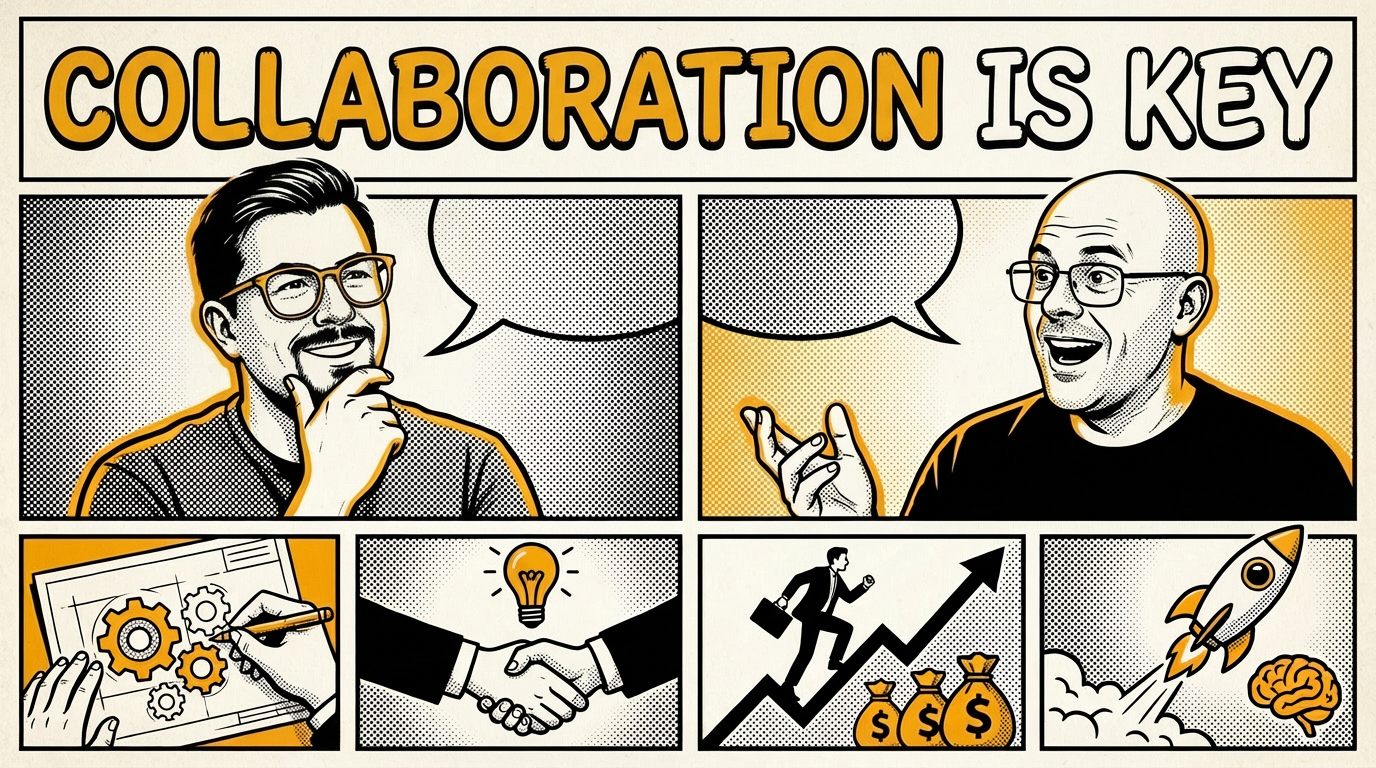
The very first day that I sat down at Free Zone, Dan Sullivan is a good friend now mentioned collaboration and when he began to explain it, that's what I've been doing since I was 8.
All I'm doing is seeing the emergent. That happens when you make two things collaborate. I'm pretty dialed in and I've been trained since before I was 8 on a lot of different reps. I was seeing the emergent when you combine what already exists.
So it came to me. I wrote down, I still have it on a remarkable. I was in Toronto when I wrote it down. The next organization that I create will be based upon collaboration and it will be building collaborations. And then I wrote down one last word or sentence and it will go global.
That's been about a year and maybe seven or Eight months ago.
Yeah, I can share with you. Since that particular time, we haven't created any more companies. And I say that I'm not going to do any more companies. I took one of my existing organizations whose name is Seed Spark.
It's always been about growth and leverage. Seeds don't do anything if they don't collaborate with what's already in the ground. If it doesn't rain, the seed will just sit there and it doesn't germinate until it's in collaboration with something else. So Seed Spark that I created a long, long time ago, back in 2005, I just opened the first BlackBerry store of the world and realized that the web browser on a BlackBerry, I could have two guys who actually could write software help the people who bought a bunch of wireless phones with from me, which are everybody who would use a Nextel telephone. I could create web apps for them and use it across blackberries. So seemed logical to call that company seedspark. Since that time, of course, the name has become a lot more resonant with what we actually do. Seedspark is known as a leverage partner for entrepreneurs all over the world. And under it, I've created this thing called the Collab.
And I know it must come as a surprise, but now with over 600 businesses represented in the collab, and it grows probably two to five a day, they're here to collaborate, they're here to contribute what they have and combine it with what you have to reach a reality and an outcome of growth that you never could by yourself.
And everybody gets paid at the end. So literally, it is a collaboration in its purest sense. And As I mentioned, 50 plus companies in 25 years.
Now we're just over 700 collaborations in just over a year and a half. So I basically found the Fast Pass to the entrepreneur Disney ride.
Hard to put that on a business card.
[00:12:09] Speaker A: Yeah, yeah. And then here's your Fast pass at fastpass to business. Actually, that might be a good marketing gimmick if you could get away with the licensing of pulling the track logo.
I have a lot of questions. I myself am quite entrepreneurially minded. Yes, sir. One of my first entrepreneur ventures myself was realizing that the candy box, the promotional giveaway candy box that they told us to sell, that I could get those same candy bars for a quarter of the price and when I ran out, I could restock it and it was essentially a license to sell in the hallways. And because I tried selling candy bars on my own, got shot, shot down and said, you can't do that. And then a week later they said, oh, we're selling candy bars. I'm like, oh, you're selling Sandy candy bars?
[00:12:59] Speaker B: Yes.
[00:12:59] Speaker A: So like, well, this is basically a license to sell.
[00:13:02] Speaker B: So I absolutely love that. And case in point, though, right? All the resources already existed. You just had to recombine them. That's it. I love it.
[00:13:12] Speaker A: I love it.
So I find entrepreneurship an interesting challenge because I think there's probably two populations of people who could actually use entrepreneurship, and that's those who probably like us kind of have that crazy spot in their head of, like, not fitting into the normal 9 to 5 job and screw it, I'm going to do it myself type of person. But we think there's a second class of people as well, of people who don't know that they. There is an alternate option. Like, they were raised and said, hey, you're going to go to college, you're going to get a job, and you're going to have a career.
[00:13:56] Speaker B: Get a good job, by the way. A good job.
[00:13:58] Speaker A: What the heck is a good job with health benefits? It's totally going to be worth it. And then you'll get a retirement package and, you know, you'll come home at, you know, work from nine to five and it'll be perfect, and you'll have two kids and a dog and.
And then they get into it and they realize they're suffering and they don't know why they're suffering.
And I've talked to so many people. You know, I talked to one guy at a, you know, at a buffet, and it turned out that, like, he was. Had this huge idea for a restaurant. Like, why don't you go do that? I was like, oh, I need a million dollars just to get started.
I don't think you really need a million dollars. That was a number he'd come up with in his head when I poked around the soft edges of what he actually.
He didn't actually need a million dollars.
[00:14:46] Speaker B: Yeah.
[00:14:46] Speaker A: It was just a road bump that he put up for himself to explain why he was at a company he hated, working for somebody that was paying him. Not nearly enough.
[00:14:57] Speaker B: Yes.
[00:14:59] Speaker A: So how do you address those two sides of entrepreneurship? Like those who seem to be born into the box of born out of the box versus those who maybe just haven't woken up to that possibility.
[00:15:15] Speaker B: I'll tell you, for the folks that are listening, and no matter which camp you fall into, the answer is the same. The awareness that's holding you back is you have a WHO deficiency.
So we're all familiar with the word who.
I define the word who as an acronym with help of others.
So let's say that he started that restaurant. And let's say you and I exported the P and L from that restaurant.
And you looked at the P and L. Every one of those things that are listed on the P and L are just collaborating with each other to create the outcome. It is just a math formula. That's it.
So if you understand that and you mentioned the cash, we'll touch on that right quick. The million dollars, the proverbial million dollars to get started, I think. And in my world, he had already gotten started, because vision is everything with the concept that he's already getting started. What he ran into right after that is a who deficiency with help of others. Now, I have a formula that a very good friend of mine coined. His name is Dean Jackson.
And the formula is a very straightforward formula. We wrote a little book about it.
It's called the VCR formula. And I'll give it to you now. It's vision plus capability multiplied times reach equals success.
So this VCR formula will tell you exactly what you have. Because I'm here to tell you, just like your mom and dad shared with you when you were a kid, you are made unique.
We have a societal system that doesn't try to, starting in the third grade, identify what makes us unique. They would much rather you make 100 on the math test and me too, when you crush it in English and I crush it in math. But if we work together, that's cheating.
But let's say that we've elevated beyond that.
This vision portion and your person, this gentleman that you mentioned, did have an idea. He might not have vision clarity yet, but if he were to work with someone who would help him get vision clarity, he would understand how to really formulate that and understand he's uniquely going to create value through his restaurant.
The second portion of that formula is capability.
Capability. There's four types.
You're capable of something or you own a capability. A great example of a capability is a piano.
You own one, I own one. Elton John owns one, by the way.
The ability, which is a second version of a capability, is wildly different between the three of us. And I'm making an assumption. I haven't heard you play, but you do not want to hear me play because you will not hear Twinkle, Twinkle, Little Star, even at best.
So Elton John has a different set of capabilities than I do.
Sometimes we have that piano at a piano bar, but it's only played Half time, because we're only open at night.
So perhaps the capacity, which is the third version of capability, is we could use that piano to make a lot more money. We could give piano lessons during the day. That's an asset, right? But at the end of the day, piano is just sitting there. So you have different levels of capability. The fourth and final type of capability is cash.
Because it turns out with that cash, that million dollars, the only thing he can do with that million is pay for somebody's vision or he can buy somebody else's capability.
That's it. So you can jump the lunch line if you'd like to, and show up with the clarity of vision and share your idea with those who already own the piano, who are already capable of playing some really nice music on that piano.
Or you can go borrow the money from somebody who already has that capability, and then you can turn around and go spend that money with somebody, likely another entrepreneur who already owns a piano, who has been playing piano for a very long time.
So the impediment so oftentimes is cash, the realization the only thing you do with cash is you had a great idea of how we could do something better. And I could pay you for that, or I could go to Elton John and have him not only bring his piano, but also play his piano.
What if I just let ELTON John and Mr. Jeremy participate in the outcome of this $10 million a year or $1 million a year of improvement to my business or to start this business?
At the end of the day, it's all a collaboration.
So the last portion of the formula, and then we'll pivot back to the next question, is reach.
So there's four types of reach as well.
Every human on the planet has reach.
Reach a lot of times is described as a trusted relationship or a level of trust.
The first type of reach is access to eyeballs. You may send out 3,000 invoices a month in the business that you own.
You're sending those invoices out just to get the invoices out. It's a business function that you have to do the consideration of understanding that just like an IKEA catalog with an exploded parts view, if people would look at their businesses that particular way, they would notice that them sending out 3,000 invoices a month, where they have access to someone's eyeballs, that's an asset.
They have access, reach, access to someone's eyeballs. The next version of reach is when you have access to someone's mind. Maybe you post on LinkedIn and people read it, maybe they comment on it. That's access to people's minds. It's a second level of reach. The third level is you have access to their hearts.
A really good example of access to their hearts would be an example of a great collaboration as well.
Kylie Jenner, I believe, is the right Jenner.
This Kylie Cosmetics.
So you may or may not know. She really didn't even have that idea. That was actually her friend's idea. Another friend's dad runs one of the top five largest companies that create cosmetics on the planet.
He had additional capacity. You remember that capability we talked about a couple moments ago? So they started trying and building these versions of a lip kit. And the second that they got them done, Kali showed up. She did what she could do. She did her capability, which was a reach capability. At the time. She had 240 million subscribers or followers. I guess I should call them on Instagram.
That, as I mentioned at the end of the formula, equaled success, because access to their hearts. When she said, hey, my lip kits are ready, it broke the Internet.
There's another type of reach, which is the wonderful reach that we're all searching for, and that is DNA level reach. When you find there's another product or service that is combined with a product or service in the market, that DNA level reach means that whatever you see in the market doesn't even exist as it does without another component, somebody, another entrepreneur's product or service.
So you can leverage reach that exists on the planet through entrepreneurs, which are absolutely everywhere, or you can spend a bunch of time running ads and getting people to know you, which is quite expensive. And then eventually they might like you. And furthermore, they may finally trust you. And then lastly, they may do business with you. Or you can just have Kylie say, hey, the lip kits are ready, when I said, jump the lunch line. Or the fast pass to entrepreneurial growth. That's just a couple examples there. But going all the way back to the question that you asked both of those, there's impediments, which is I would classify as friction, that are keeping any forward momentum. I wrote about it in a little book called Friction Fuel, that friction is a leading indication for you of collaboration. That's all. Because if you were to find that other entrepreneur, that other person on the planet, and you were to say, hey, I got a great idea, and work out how you guys split the outcome, you'll find that you don't need to run down to the bank, because that's just another version of capability.
You can actually forego that step.
So hopefully that answered for both types of folks. Some it comes very naturally too, but yet they're still going to run into what the WHO deficiency.
And then some others have been told, hey, just follow the plan, get a good job. What is a good job? Somebody else is still driving how they interpret you are to create value. But yet we were made unique. That's what my mom and dad told me. There's just not a mechanism to help people exploit that and really harness it and began to create value in the world the way they were uniquely designed to do. So
[00:24:13] Speaker A: I love that. I love the frame frameworks within that and the layers. I'm curious for existing businesses because I am a type of entrepreneur. I'm a consultant in search engine optimization and I help people drive additional visibility.
And there are similar processes that I go through of looking at.
It's not just showing up, it's also reaching the right audience who has intent to actually purchase that. I'm curious, what are your processes where somebody has a successful business or a business at a certain level of success, like I'm consulting with, you know, somebody that's, you know, delivering precast concrete walls.
Absolutely. Are you, are you looking to speak to the CEO, the entrepreneur that's behind that vision, to find additional collaborative capab capabilities that that model could, could enable? Or are you looking for people that don't have that first venture or are looking to do something completely different from what they've already grown?
[00:25:23] Speaker B: Yeah. So the answer is yes. And, and I'll put that in context.
The 600 plus businesses that are already represented in my collab by SeedSpark, they range from 2 million a year to 35 billion.
So we very much enjoy helping those.
And I absolutely want to inspire those that have been told to go get a good job to know that they are just, as we said, truly unique. Their mom and dad did not tell them a story. And I'd like to inspire them to say, you have vision. Every human on the planet does. They all have capabilities they also have reached.
And if you'll follow the formula, you can equal success as well. No matter where you are, no matter what you're doing, be attentive to the friction that you see.
How many people listening to this have ever sat in a restaurant and their glass has gotten empty and they'll look around for the waitstaff, they're probably been running processes saying, you know, if she or he would have done this and done this, my glass would not be empty. They might even come back. Maybe they'll leave a bad review.
Do you remember the definition I shared with you originally that this gentleman coined in the late 1700s of what an entrepreneur is?
Someone who identifies how to take resources that are currently performing at this level. Maybe that's your glass of tea, maybe that's the waitstaff and they know and identify ways to improve the performance of those resources. Sounds like we're all an entrepreneur, doesn't it?
We haven't been trained with a formula to unlock the uniqueness that we're literally created with of how I think our responsibility here on the planet is just to combine with each other and see what happens. A lot of good things do happen. So I don't want to have an ambiguous answer. I'm built for 2 million, 10 million to up to 35 billion.
Because as I mentioned, I use this analogy a lot I think most of us would understand when I say have you ever seen an IKEA instruction manual for anything that you purchased? When you open the first page it looks like an exploded Parts view number 77, number 123. And if you don't have that, screw you're taking a trip to Home Depot.
So when I get introduced on a daily basis to many entrepreneurs all over the world, they'll tell me what the sign on the door is. Some may even reference their email signature's title.
And that's wonderful and I understand that and I do appreciate that. But I really want to know how you're made unique.
I want to see you and I do see you as the exploded parts view.
So to anybody up and down the gross scale, no matter how much revenue or how little of revenue, you can leverage the art of collaboration to grow non linear and to have exponential results collapsing time on your own road to success.
So I'm built for the big ones, but these methodologies are applicable to the person to my girls. I have two wonderful beautiful young daughters.
So sadly they've had to hear me on the way to school for many years to understand on the way to school it's all value creation and your natural curiosity if driven by how could this be better?
We all start the same. I would say we all start out as entrepreneurs. But along about the third grade we began to be shepherd and kind of cattle guarded into conventional thinking and less and less divergent thinking. So I want to get back to that childlike imagination and just say what happens when I combine these things? So a great question, but for me it is both inspire the ones who are starting their journey and help the ones that have been on the journey for a very long time. I meet entrepreneurs on daily basis that are just tired.
They've been on this hamster wheel for a very long time. They've had some success, but they continue to be on the hamster wheel. And when they go to do their planning, they're simply trying to add 20 to 25% more revenue. You know, they're going to really strive this year and get to 20%.
Why? They're always looking backwards, figuring out how much further or how much more they could do. That's more effort. And I don't think that's growth at all.
I think growth comes from combining what already exists. There's only five elements in the world. We hadn't created anything new in a very, very long time. So if we get really good at combining and lead with that imagination, all of us could be in the exact same place. That's the way I see it.
[00:29:58] Speaker A: So my next question was going to be what is the primary friction to growth within businesses for entrepreneurs? But it seems like you just clocked it. That is.
[00:30:11] Speaker B: Yeah, it's effort.
[00:30:12] Speaker A: It's right. It's substituting effort for combination.
Combination.
[00:30:19] Speaker B: That's it. It's really, truly, honestly, when I say, even if you're, if you're a business owner listening to this, export your piano and if, if you want to get real sexy with it, ask it to add percent of revenue to the far right, which is every accounting system will do this.
If you were to look at what Julie in accounting is making, if you export your P and L to get cost of goods, labor, you'll see that maybe Julie is splitting the outcome. That really our business is a collaboration. It's nothing more than a math formula of a bunch of things coming together.
She's getting.062 of every dollar of revenue that comes in through that business.
So to me, that's an example of an accidental collaboration.
What if it was engineered?
What if everyone in the organization knew every dollar of revenue I get two pennies. It changes the entire game when we know we're here to create something of a vision and we know exactly how we're going to split the outcome. So I would say the most largest restriction on growth in every existing business is you're trying to grow from a current forward strategy.
You're not trying to grow from a future backward strategy.
So what do I mean when I say that if we were to look out on the horizon, and I have this example, we have tools that I create for entrepreneurs to begin to really harness this mindset have a little tool, and I think it is called future backwards.
But basically what it walks you through is you pick a time in the future as still close to the first of the year. We'll pick 1231.
Actually, we're going to pelt 1215 before Santa Claus comes to town.
And if we were going to celebrate, where would you take us to dinner to celebrate?
Is there a place that you really enjoy?
[00:32:09] Speaker A: I prefer eating steak at home.
[00:32:12] Speaker B: We're going to come to your house and eat steak. When you think about what are we going to celebrate, what would you be excited about celebrating? Having us to your home to talk about all the wonderful things that happen in your business this year. How big of an increase would want you for all of us to come over to your house and celebrate? At stake, is it double the revenue? Is it grow by 100%? Grow by 300%.
[00:32:36] Speaker A: Right.
[00:32:36] Speaker B: You see? So you're getting into. Okay, I didn't say anything about, do you have a cfo? How many salespeople do you have? How many leads are coming in a month? I didn't ask any. I said we're going to pick a time in the future and we're going to have something to celebrate in the next portion of this tool. You have seats around your table. It's not going to just be you celebrating there eating the steak. Because I have a question for you, for somebody to make that happen. If you had the best possible people on the planet, which is what you have at your fingertips, if you had really clear vision on, we'll just say doubling your company, who do we have to leave a seat around the table for? Because we're going to celebrate with them.
So you just hypothetically, let's say that you have a little diagram in front of you of a table, and you've got, let's say, eight chairs around it. You obviously occupy one.
Who else is going to have a seat at that table? And I don't mean anything about the resources you have today, because if we're going to double the revenue, you have a whole new budget to go out, engage those people who have the capabilities. There's that word again. Or reach.
There's that word again. Some entrepreneur. I realized in 2020, this is interesting. It's right before COVID it's likely there's an entrepreneur on the planet who already has the credit card number on file, Maybe an open PO for every client that I ever want to do business with.
What if I were to pick up the phone and call them and say, hey, I got an idea. I'll split the outcome with you for anybody who trusts you already, and I know what I do adds value to who you already serve. Right. You have to have hero target alignment. If you're listening to this and your wheels are starting to turn, those that are already serving. When I say hero target, I'm sorry, I did not define that.
A hero target is who you want your business to be a hero to.
So if you have hero target alignment and let's say somebody has 10,000 people's credit card number on file and I can combine what I do with what they do and create value for already, trust them.
[00:34:36] Speaker A: Yeah.
[00:34:36] Speaker B: I have one question before we get started. How you want to split the outcome. So when I'm walking around the table thinking about who's going to be sitting at my table, I am not confined by current constraints. I'm going to get the best possible person on the planet because maybe double your revenue and you take your margin portion off the top. It's all future money anyway. So you're going to take 20% or 10% off the top, depending on the type of business you're in. It's a lot of revenue to go around.
So the biggest constraint that I see is the entrepreneurs that get introduced to me, a lion's share of them, not all, but a lion's share, are trying to grow from current forward versus saying, forget all this.
What would I really enjoy? What would make me celebrate? And if so, when would I actually do that? I'll give you an example. The first book that I ever wrote was called Just Add a zero.
For those that are actually entrepreneurs on the. On the call or who listen to the podcast, let's say that you're sitting in a boardroom or a conference room and there's a whiteboard.
And if you were to put your P and L up on the whiteboard and walk up there and add a zero after every line item it represented on your P and L and then go back and sit down. And also before you sit down, put your hands below because you'll have to sit on them. You've got to have a lot of patience because what's going to happen right after you do that is everybody sitting around the table is likely going to start cherry picking those line items and they'll tell you why that can't be true.
If we were to grow our revenue by 10 times, we would not spend this much on real estate or office space or HR people.
You're getting probably the just say, well, guys, if we know that now.
Why don't we just start acting that way? Why don't we start using this intelligence that we already have in our brain? You just showed me what's going to be right and what's not going to be right. When we 10x this business, what action are we going to take today?
That's a future backwards strategy that we obviously help entrepreneurs with all around the planet to just think differently so that they grow differently. You do not have to grow in a linear fashion. All the components exist on the planet. What we really should probably consider is how do I better combine and how do I leverage art of collaboration?
[00:36:51] Speaker A: I'm curious.
I've had 120 conversations in the last year with SEOs and entrepreneurs.
[00:37:01] Speaker B: Yes sir.
[00:37:02] Speaker A: And I've found myself every session at some point bringing up the elephant in the room of LLMs and their appropriate role both in the reach diagram and within the capability diagram.
So in what ways do you see a misuse of this emerging technology and in what ways do you encourage the utilization of this access to this language learning model that people call AI? It's not true AI, it's not data from enterprise, it's not a truly sentient being. It that's based off of math, has its problems, has its functions and is a growing force within our society. You know, one of my friends for sure says, you know, it's your best trained or it's your most well accessed and no customer support representative, but it's horribly trained.
[00:38:10] Speaker B: Horribly trained, that's right.
[00:38:12] Speaker A: So from your perspective, address the the two sides of this new animal, LLM tools, AI tool and their function from your side or how you see it in entrepreneurship?
[00:38:29] Speaker B: Yeah, it's a great question, so I'll answer it a couple different ways.
My perspective on it is we have elevated and moved beyond the task economy, but most of us have not yet gotten the memo.
So November 30, what is it now? Three years ago, 22 when they launched the first GPT. Not of course, AI was everywhere even by then, but this is official start date, I guess for the masses.
We began what I would classify as the idea economy.
What does that even mean? Well, for the last 200 years we have perceived value has been created when a task has been completed.
I have robots working in every business that I have now, AI and so the perception is misaligned with this value that was previously created by humans doing the stuff and now it happens in a fraction of time. And as you probably learned on the call, I like to collapse time on the road to success.
So we were embracing it even a little bit before then, but definitely after that.
Another perspective.
I treat my so chatgpt. If I reference this this way, you'll know what I mean. I call her Collabora. So the Collab is the community of entrepreneurs all around the planet. Collabra is actually our proprietary AI that has been developed now on a LLM that we've created. It doesn't touch the external models. And so I named the enhanced portion of GPT when it came out, when it was actually talked back and forth with you with intelligence. I named her Calabra. Collabora sounds like a lady's name. And so I talked to Collabora when I leave for the gym, typically about four in the morning every morning, seven days a week.
And I would ask this question, if you guys had a PhD level assistant in your pocket 24 hours a day, cost you 20, what is it, 25 bucks a month if you. Or 20 bucks a month you don't do the team and if you don't do the 200, how often would you talk to a PhD level assistant who's pretty sharp, has actually a lot of data if they were just riding around with you or sitting beside your desk? So I'd say full embrace is my strategy and I use it to do things that collapse time from what I used to have to invest a lot of money to do to complete what a task.
I'll give you an example of that.
I mentioned that I rise pretty early, naturally. And after I do gratitude, I typically roll into meditation. And then a lot of times I end up engaging with AI.
A few weeks back I was requested to speak to Coca Cola on AI by a very long term client of one of my businesses. And for some reason I was traveling a good bit, it kind of slipped up on me. I have a marketing company that I own, software and et cetera. I have plenty of people, four designers on staff. They could have created me a very nice presentation.
Three weeks, three meetings. I've been down this road before.
Around 3:30, 4:00 clock in the morning, I remembered that later on that day I was to present to maybe I think 150, 200 people about AI. And I have plenty of people on staff that are way more AI centric. But this client likes me and so I decided I would just do it myself. I engaged Collabora. I had a great conversation about how I would like to in position. And of course Collabra knows the way that I think because I've been Investing my thought processes in this container for a very long time, since not long after 2022 when they came out with enhanced voice. It might have been a year after that. So I began to chat. And when I got done with the chat, I said, look, I'm going to present, but I really want it to be more focused on how humans interact with AI. Where do you get started? Because of course these folks are concerned that AI is going to come and take their job. I think even a couple of them voiced it because I sent out a survey that morning and everybody at 68% responded to it after the conversation. At the end of it, I simply said, hey, I'd like for you to create me a prompt.
I'm going to take what you and I have worked on to Genspark is another agentic AI that I use. Nice platform. I said, like ChatGPT that knows me so well. I just had this conversation. All the little slide content is a horrible job at graphics. I said, I'd like for you, Ms. Ph.D. level Assistant, create me a prompt to take to Genspark.
And I want you to make this presentation be McKinsey level or Accenture or Boston Consulting Group. And it's done by somebody who has 15 years experience as a senior designer. And guess what? We're going to present this presentation to Google.
So it created me a very nice prompt I took to Genspark. I tweaked two slides out of 49 slides. Two. And I presented it.
We have more than 50% of the people engage afterwards. Wild. So if you're not in, if you're not engaging it for what it can do, yes, you should expect that somebody like me, if I worked for a company or I was looking for a real job, I'm empowered by AI. And yes, I'm coming for your job. It's not that I'm coming after you, it's that they created this thing called a hammer and we all build houses.
So no longer do I have to go try to find a stone when I get on the property every day to try to hammer in the wooden nails.
I use this device and I can just do it in a fraction of the time. It's just a tool.
AI is not human.
It doesn't have feelings. And to the exact point that you made, it's an algorithm. So if, then, if this, then that over and over and at scale, more of a scale than you and I can do. But it's still not human. It doesn't have that creative ability.
So good gracious if they made a new hammer. I'd probably be the first one to buy one if I were a carpenter. That's the way that I approach it.
[00:44:35] Speaker A: My interview with Zach Kadish. He worked at Conductor as the head of SEO, and his statement to SEOs was, AI isn't coming for your SEO job, but somebody who is using AI to do SEO is 100% in the next year. And he said this last year, and we kind of went through a SEO is dead moment, but then realized, you know what? At the end of the day, these processes still need human intuition to.
[00:45:05] Speaker B: They still have tactical.
[00:45:06] Speaker A: They need the human connection element. Yes, you can generate 100 times more articles, but you still need the human sort of capability to choose which of those articles are actually going to resonate with your actual audience.
So, you know, that's the combination of a collaboration of my experience with data and your business and its capability and reach. So, yeah, that's perfectly in alignment.
I like to do this as kind of a parting option.
If you had a soapbox and I had it here, and you could stand up in front of America and tell them one thing on this soapbox that would change their life, what would it be?
[00:45:55] Speaker B: Stop trying to grow through effort.
Start focusing on what you have, combining it with what others have, and ask one question.
How do you want to split the outcome?
I'll give you the reason I say that last part.
My good friend Dean Jackson, I mentioned earlier, has a saying, always show up at the receiving dock, not the procurement office.
All the money in any company that exists, all the cash is already spoken for. If there's any additional dollars, the owner wants them.
Future money is always up for gain.
So if you show up, consider this. Someone comes and knocks on your door, and you're not expecting anyone. How quickly do you walk to the door these days?
Do you even go, my house? The answer is no, even with cameras. But if I show up with an Amazon package, how many people from that house show up at the front door? Sometimes they run and run over each other trying to get out there real fast.
Business is not that damn hard. It's all value creation. You were made unique. Your business is unique.
Focus on what you have and how you can create emergence. When you combine with others and show up to the receiving doc and say, hey, I got an idea. If we combine what I already have, again, I don't have to go buy this. I already have it. Maybe it's an idea and you combine it with what somebody else has, it creates an emergence.
I got that Same question.
How do you want to split the outcome?
So wherever you are listening to this today, right now, you already have vision. We talked about that earlier. You have ideas, maybe they're not that dabum clear. Start engaging with other people who are and they would classify themselves as a visionary. You have capabilities.
We talked about that. Pianos and Elton John and you have reach.
Inventory them. Start showing up to be a go giver and maybe less and less of a go getter and watch your entire world change. Because at the end, it's all a collaboration.
[00:48:02] Speaker A: I absolutely love that. And I wanted to cut off the episode right there, but you just. I have to ask the question of. On that outcome of pie, like, let's say that I do go to somebody. Like I go to an agency. I have an idea. Hey, we need to build a. I know you need to build more links and I know you're spending way too much money to do it so that you can get better rankings, have something that works way better.
What's your methodology for how you offer to cut up that pie with that collaboration?
[00:48:34] Speaker B: Well, what a great question.
[00:48:36] Speaker A: 25% for me, 50% for you, 75 for you, 25 for me.
What goes into that decision?
[00:48:46] Speaker B: Yeah, it's a great question.
I'll give you a little bit of an advanced class.
All the collaborations I've ever created and all The P&LS I've ever looked at. If you were to take that P and L even in your business, and map all the components to these three categories, vision, capability, and reach.
When you get done mapping all the categories and I'll give you some insight, the vision portion is the easiest. Look at the bottom.
Whoever came up with the idea, whoever owns that business with all that risk they're getting, whatever's at the very bottom, 10 or 20%.
So if I'm coming with the idea, my frame of reference is 10 to 20% of the outcome of any collaboration I'm involved in.
Perhaps you're a capability.
Perhaps you're all the capability.
In every collaboration I've ever created. And this is probably 5 or 6 this morning before we jumped on this podcast, the capability portion is between 60 and 80%.
Again, this maps straight to your P and L.
When you think about reach specifically to your P and L marketing, maybe you have some salespeople, maybe play some commission, perhaps you sponsor a little league team, maybe you have some wraps on all your vehicles. Maybe you're an H vac business. If you map all those expenses to the reach category, you can expect what you're investing out of your P and L into reach 10 to 20%.
If you're a SaaS business, maybe you're juicing it some more because you're just trying to have an exit. And it's more than that. But that's the exception. That is not the rule. A promise is not.
So let's take your scenario. You have a way to combine what you do with what somebody else does that perceptibly could even be classified or categorized as a competitor.
But you're thinking much more intelligently, much more like a true entrepreneur with your question.
You're seeing your business and their business I would interpret as an exploded parts view. Remember, we're back to Ikea.
So what I perceived is you're thinking your number 77, whatever that relates to, and I think you said your backlinks or something like that.
If you were to combine it with their parts view their company, it's going to create a bigger outcome.
Here's the wonderful thing. They have some way to meter the current outcome, even if it's just gross profit or net profit today.
And you say, okay, great, that's baseline for every impact that what I do combined with what you do causes an increase.
How do you want to split that outcome? Now, you had the idea, I heard that.
And you talked about what I perceive as a service as well.
So my world, you would get some of that 10 or 20% that we would allocate to the dollars of revenue because you're bringing the vision, you would as well get some of that 60 to 80% of those dollars of revenue that are for that specific item.
So if I had to guess, you're probably going to be.
If they said, look, we charge $100 to do the whole thing, and out of that $100, $10 goes to do whatever effort that is for yours, you say, okay, great. How many hundreds do we have? Awesome. So that means right now, baseline for that service, let's just say we have 10 of them is $100. So anything above 100, whenever you use my service to create a bigger outcome for those that you serve, when we see an elevation in that metric, how do you want to split that outcome?
I'm guessing, I'm assuming, I'm actually expecting that you're probably going to split the outcome there, 50, 50, because they're the reach portion. Right. So that puts them at 10 to 20% of the all. But they've got some account management, which is a capability. They're sending invoices, which is a Capability. You see, like if you map that P and L, this becomes very. It's all a math formula. And it's a very simple math formula. I'm not that complicated, I promise.
But you can begin to pack into it. It's like, oh, yeah, you're right. This is just simple math.
But the wonderful thing that you've done, Jeremy, let's say that you were successful at that endeavor.
I don't do anything that I don't give it a name.
His first job in the Bible had Adam name all the plants. Was it a turtle before the. Before he named it a turtle. I don't know. I don't know what you would have called it. So we. I had this tool that you. You're welcome to go to seedspark.com Tools I believe if not, you can go to Resources. It's easy enough to find. And there's a tool there called Name the Baby.
And the Name the Baby tool goes through the methodology that I use because it's nothing about what you want to call it. Nobody cares.
People care about the outcome it creates.
So I try to take two words that people use to describe after they receive the outcome and combine them together, create a new word. Go register the domain too, because now you have intellectual property and name it that. Because if I'm your hero target and I hear that what you do gives me the outcome of what somebody looks like me received, you don't need a bunch of marketing messages because I want that outcome if I'm your right hero target. So the first thing we have to do is name it. But if you go back to the scenario you gave me, if I go to my competitor and combine what I do with what they do and create an outcome, I've created a new capability. I'm going to give it a name and I'm going to go look for the other COLAB partners who are also considered my competitors. Maybe by geography. If you're on the East Coast, I'm going to west coast and Midwest and I'm going to go find 25 or 50 others and before too long, I'm not in the conventional business that everybody else is.
So you're definitely well on your way.
[00:54:24] Speaker A: Thanks. I'm glad I asked the question.
Awesome.
Tell the folks, aside from your website, which you just mentioned, where they can find you if they have questions, they want to follow up, they want to connect. Are you speaking anywhere? Are you reachable at a particular social media channel or email address?
[00:54:43] Speaker B: Yeah. All of the above is. Yes. Conventional. Absolutely. Seedspark.com. if you like this way of thinking and you'd like to say you'd like to explore it a little bit more, I do a Kickstarter event. You can go and register RSVP and entrepreneurs obviously are definitely who would probably want to join and come to that or aspiring entrepreneurs. I do that twice a month. I believe I'm not mistaken. But you can go there and
[email protected] we're very active on LinkedIn with this type of thinking. So you can find on LinkedIn and those two places are really easy. I do a decent amount of speaking at other entrepreneur conferences around the world.
We have a conference that is also represented at Seed Spark coming up in October. It's the super bowl of collaboration. So you have hundreds and hundreds of entrepreneurs that come to Charlotte, North Carolina, which is easy to get to and you can expect to walk away with collaborations. I'm more of a take action type of guy, not a talk about it guy.
[00:55:39] Speaker A: Thanks so much for your time. Unique, unique point of view. Like I said, I've had 120 conversations with SEOs and entrepreneurs and I think this conversation has definitely been unique and standout amongst.
[00:55:52] Speaker B: Oh, that's wonderful.
[00:55:53] Speaker A: So I appreciate it.
[00:55:54] Speaker B: My main goal is I hope everybody gets value out of it and I really appreciate the time today. I've enjoyed our chat.
[00:56:00] Speaker A: I'll see you around. Thanks.
[00:56:01] Speaker B: Thanks, Jeremy. Have a good day.