Episode Transcript
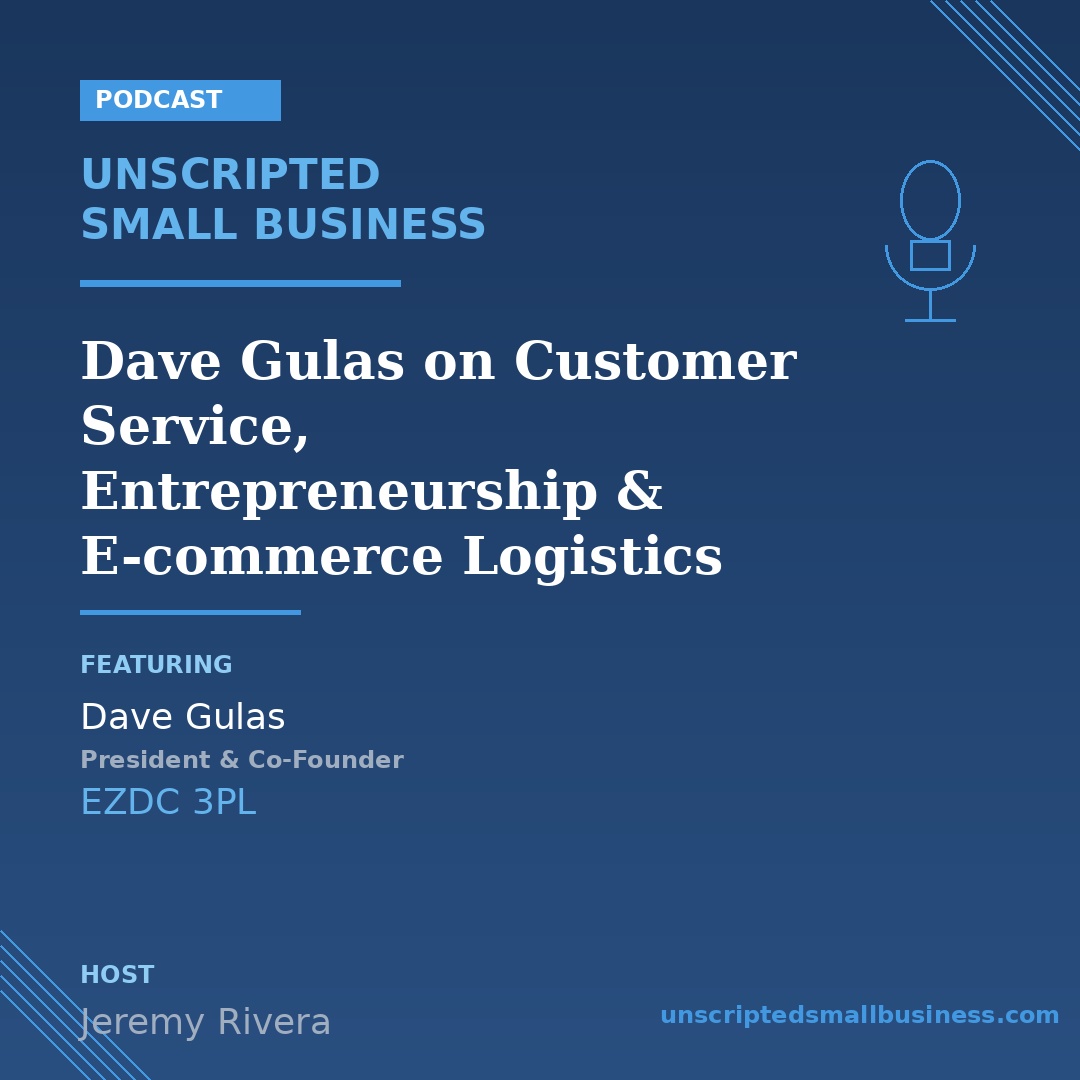
[00:00:01] Speaker A: Hello, I'm Jeremy Rivera, your unscripted podcast host. I'm here with Dave Goulis who's going to introduce himself. And as is customary with this podcast, I like to focus on what is your experience either professionally or personally. That's giving you the expertise that makes us actually want to listen and trust what you say.
[00:00:22] Speaker B: Okay. All right, thanks so much for the intro, Jeremy. Yes, my name is Dave Goulis and I am the president and co founder of Easy dcpl and we provide where housing, fulfillment and transportation services for manufacturers and e commerce brands. And in terms of what makes me an expert. So I've been in sales my entire adult life and that's 20 years in medical slash pharmaceuticals and then three years here over three years in logistics. And really that entire time I would say my expertise is in making customers happy.
So you know, particularly with the sales process, what I was involved in, it was a lot of continuous repeat business. And so often too the sales was on the was involved in making sure the orders got from A to B if there was anything going wrong, following up on issues dealing with that. And that's really where myself and my partner got the idea to start the logistics company. Because we saw a vast amount of complacency within the market to where legacy big box 3 pls were just not providing the proper service to e commerce brands. And we knew several of them that were complaining about this and so we saw a gap in the market and we thought our brand of customer service from the pharmaceutical world would be a great fit. So we jumped in and did it. And yeah, three plus years later we've got a stable full of happy customers and we're helping them continue to outsource. The headache for most people that is logistics, it's a headache for most people that are in that business. So we outsource that for them so they can continue to operate in their zone of genius and grow their business and we handle the logistics and making sure their, their operation and all their orders ship ship smoothly and on time.
[00:01:57] Speaker A: So what happens with the logistics industry? What is it that's challenging? Where's the friction point in that industry invited that deeper scrutiny? What, what usually ping and flies off into the corner that needs to be fixed.
[00:02:11] Speaker B: Well, so when you think about e commerce companies, which is really the specific niche that we serve every one of them, most of them start off self fulfilling, whether it's out of their home or a small office, a small warehouse or whatever and they, they sell their products online, they grow their business and they handle the ship, the fulfillment which is the shipping of those orders to the customers themselves. And usually at some point in their life cycle, every one of them reaches a graduation point where they, they reach, where they see that it's the logistics itself. If they've grown and scaled properly, they have way too many orders to ship and way too many other problems to deal with as the operation has grown to continue to handle it themselves. And it only makes sense to outsource that to a company that specializes in that. Whereas they can negotiate the carrier rate so they can maximize their, their scale of spending and they can have the right software options so the brand doesn't have to go and continue to operate or upgrade expensive software and they can rent the bas bigger building that the brand may need or have the space available and they can manage the staff and they can handle all the inbound and they can connect them with the right solution and they can have the right size packaging option for every different type of order that may need to go out and on and on. There's all sorts of different things that, that happen and problems that arise. And as you grow in scale, some people can self fulfill at a high level themselves. But for the vast majority of E commerce brands, it makes sense to outsource that to an expert.
[00:03:42] Speaker A: That makes sense. I' consulted with a number of different e commerce companies and it's interesting because as a business model it seems very dependent on, you know, inherently on technology. You know, like if you're a brick and mortar, obviously you get foot traffic. But if you're in E commerce, you're living and dying by the technology you're working with, whether that's, you know, the effectiveness of your SEO and marketing or whether it's the delivery systems on the back end.
What are some of the pitfalls, pitfalls that E commerce owners you've seen overcome? What are some of the best practices you've seen with your partners that you've been working with kind of overcome challenges and bring something new to the market?
[00:04:33] Speaker B: Well, I mean some are just basics, right? Like we, we have a, we have one of the top commercial wmss that we use which is a, for those that may not know, it's a warehouse management system. So it's just a software that basically allows us track every customer's invoice and then it connects to a variety of platforms such as Shopify, Amazon, Walmart.com and a host of others. So that's just for us, that's just automatic. And we, when we first got into this business and we were researching everything. We were told we couldn't even launch without a credible wms.
Not even feasible. But then as we get out there in the market we see that there's many 3 PLs that are currently operating without a WMS to where they track inventory on spreadsheets or they don't have automated shopping cart connections to where you know, if a brand is, is doing a good part of their business. On Shopify, you want all those orders to flow through directly to the warehouse where it's all automated and we get a whole list of orders and we can just pick, pack, ship efficiently and continue to move on. So I mean these are all just things that to a, to any credible 3 PL would seem automatic but for many people if, if you don't automate that in the very beginning, you're not going to be able to scale or as you do start to scale, you're going to have a lot of headaches and it's going to tough to get out of your own way.
[00:05:51] Speaker A: That makes sense. I'm curious what kind of impacts, you know obviously some of these things being automated are the outcome of, you know, software choices. Some are probably developer time to connect certain webhooks to other programs. Is there any growing or additional role or anti role for the development of AI and the use of it either within these platforms or as an augmenting tool or as a guiding system to help businesses tackle these challenges, these technical and developmental challenges to execute sufficiently on logistics?
[00:06:40] Speaker B: Yeah, I mean I think ultimately AI's got a lot of potential and it's only going to continue to get better.
I mean at this point right now, at least from what I see, and I'm not a software expert by any means. I mean I'm really the sales and marketing arm of our company and I have experts that handle logistics and we have software providers and then other people engage with that. But from what I see too, at least the problems and the challenges that we encounter, it definitely requires a human to come in and fix it. And like you mentioned web hooks, that's, that can be an issue with a variety of things and with logistics too. So many things can potentially go wrong when you have all different types of businesses and all different types of softwares and all different types of platforms all trying to connect and run efficiently and have it operate as a well oiled machine. I mean certainly you have to have a good team of qualified people with you and you have to. I mean our guiding principle too is we want to treat our customers as if it's our business in terms of we're going to operate with urgency and if they have a problem, we're on it right away. If we made a mistake, we own it. But really, especially if there's an issue with a webhook or store not operating properly or whatever kind of software problem, I mean, we're on that immediately to resolve it as quick as possible. And it may involve getting a third party or one of our partners or whoever. But I mean that's really the thing I think our customers appreciate about us most is just our sense of urgency in terms of making sure everything is running smoothly on their end and there are no issues. Oh boy. Well, so, I mean, probably one of the first things that comes to mind for me specifically, right. Is just in the very early days we were saying yes to too many of the wrong customers in terms of maybe trying to be everything to everybody and chase every type of deal and not really in a sense niching down hard enough soon enough and being open to way too many manual workarounds depending on what the situation called for. So you know, again, you're a new company, you're excited, you want the revenue, you want the volume, just bringing on too many of the wrong customers in terms of being a brand new company wanting to grow and scale quickly, you know, you want revenue. So we said yes, I said yes to many customers that in hindsight I really shouldn't have in terms of the wrong type of project, the wrong type of customer for us. Just really trying to be everything to everybody in a sense. And, and you know, hindsight 20 20, you certainly learned some valuable lessons from your biggest mistakes. So we certainly made many and we've, we've had to ask many customers to leave just as a result of realizing that wasn't the, the proper type of customer for us. You know, another one was saying saying yes to too big of a customer too soon, really, really where we just weren't equipped to, to really handle the type of volume. And, and they weren't really, you know, necessarily willing to, to operate in a way that was, you know, in terms of what we thought would be good being a good partners. Again, right. You see the revenue, you see the volume, you think you know what, we can make this work. And then in hindsight you realize that wasn't the right decision. So I mean we've had a lot of those moments and I mean three plus years in many of those mistakes have been created now too. It's more of, I certainly involve, I've got several logistical experts on our team. So it's particularly when a bigger deal comes up, I can have an initial conversation, I can bring all the details to them, and we could talk about the pros, the cons, what about this, what about that? And then really make a much more informed decision together about is this going to be the right fit for us and why or why not? So, I mean, we've certainly learned from many of those early mistakes and, you know, have used those experiences to just get better.
[00:10:20] Speaker A: I think that's an under. Under. There's an area of small business where there's that hunger. You know, you're, as a business owner, you really want, you know, that next lead, you want to make it work. But there is, there's being too accommodating and it's almost, you know, being choosy about who your clients are is as important as doing the marketing to get the clients in the first place. You know, not everybody that comes through the door is the ideal prospect. What are some of the other challenges that you've looked at or overcome when it comes to, you know, addressing the marketplace and reaching the people who need your services? What are some of the, the paths that you have successfully found or unsuccessfully found to, to try to put your message out there about your usp, about your unique selling proposition? What are some of the ways that have been effective in doing that?
[00:11:20] Speaker B: Yeah, that, that's another.
That's another. I guess overcome or whatnot is, you know, when we first started coming from where we come from in pharma, it's a much different type of selling environment to where it's traditional B2B.
It's a lot of phone sales and everyone knows who the customers are, and you can buy a list and understand and connect and whatnot to where within logistics, you never know where the, where the customers are going to come from. And people aren't moving warehouses every month either, so they really have to be able to find you when they're ready.
It's more, it's so much more about being visible and content marketing and putting out consistent posts on social media, guesting on podcasts like this.
You know, I have my own podcast as well, which I started a couple years ago, and I've. I've put a lot of time and effort into. So all those things combined with the LinkedIn posting and the appearing on podcasts and doing my own podcasts and as well as our, you know, our blogging and our other, you know, web, web advertising, all those things together have created a nice Flywheel of just inbound leads to where if people are searching, particularly within our niche, just you know, they, they can find us, you know, very, very easily in terms of if they're looking for one central location in the Midwest. So we're in Kentucky, which is an excellent location if you want to reach the vast majority of the country within two days ground. So we have that and we really focus on smaller items for direct to consumer e commerce brands. So things like beauty supplements, you know, those types of things. Books, home goods, you know, so just small, small parcel type shipments that would be sold direct to consumer via Shopify or, or Amazon or one of those types of channels. So those really are the, the types of products that are the, the customers we focus on.
[00:13:19] Speaker A: It's kind of fascinating to me to kind of look at what the marketplace is like for entrepreneurs and creators, investors and people who want to bring a new product to market.
Some of the best advice that you can give to somebody that's considering going into one of your niche areas, whether it's like you mentioned beauty or those types of products, what are some of the things that if somebody, they think they have something new, they've got a different approach to something or just are fascinated with the concept of starting their own business. What's some groundwork advice that you can give them to succeed in today's marketplace?
[00:14:02] Speaker B: All right, well, I mean this is going to sound kind of like a no brainer, but you'd be surprised. I mean just, just basic market research in terms of does the market want this product and are they willing to pay for it? I mean it sounds so simple. I mean that, that's the, the number one, I guess the number one threat I see to at least the companies we deal with is just a lack of sales. You know what I mean? So we, we've had startups go out of business or new companies, you know, look promising and business just because they don't sell enough product and we've had to liquidate inventory from people that, you know, couldn't move product and couldn't pay us. Right. So that type of thing happens out there. So if you are starting new company and you are to have an idea for a new product, I mean you certainly want to make sure you did the appropriate research. And is, are people willing to pay for it?
Is it competitively priced? Do you have the proper margins in place? Is your supply chain sufficient? What's the growth trajectory look like? You know, all those things and then again what's your acquisition cost gonna be? Because Sometimes too. Maybe people have a good product that people are willing to pay for, but it's an extremely competitive space and if they don't have enough ad revenue or the ability to organically market and create sales, again it's that they don't, they don't have, you know, the Runway to, to succeed and ultimately sustain themselves. So I mean it sounds basic but you'd be surprised how many people don't do that.
[00:15:30] Speaker A: Have you seen a difference in success rate of people who are attempting to bootstrap country companies from the beginning versus those who are taking their, their concept idea and taking it to investors who are then, you know, expecting X amount of return within a specific Runway of time?
From your perspective, have you seen what's the upside and downside of going the longer term bootstrap owner approach versus trying to get that funding to hypercharge more things that more faster, more better?
[00:16:07] Speaker B: Yeah, I mean we've certainly seen more success and again it might just be the companies we deal with. We've seen more success with the bootstrap companies. I mean with the funding obviously you have more resources and there's a, there's a much greater sense of urgency from the, those investors to really turn, turn a profit quickly. But then again it's a double edged sword to where if you don't, it can be a rat pretty quick. And we've actually, we've seen more success from the people that not only are bootstrapped but also have and it's, it may sound counterintuitive because again everyone wants to grow their business and everyone wants to scale, everyone wants to succeed but having the proper amount of patience to know that it's, it's a journey and it really is a marathon. And if people try to go too fast, too quick and maybe skip steps or they don't allow the ideas enough time to properly mature that, that can sometimes against you as well. To where the. Some of the best companies we see are the ones that maybe operate more conservatively with the proper amount of patience, but they consistently do the actions day in and day out that are going to incrementally grow their business to where maybe they don't go zero to a hundred overnight, but they have consistent growth and they can sustain themselves for the long term.
[00:17:22] Speaker A: Maybe my own internal philosophy, but maybe you have an opinion on it as well. I personally, you know, in my 18 years of digital marketing have seen more companies succeed where management has more of a, an ownership, has more of a perspective towards building a lifestyle type company where they're as equally concerned about the quality of life of their employees and how successfully they're operating their business versus a strict view on, you know, from C suite as far as profitability.
Would you say that's true or am I just an idealist?
[00:18:03] Speaker B: Well, yeah, I think, I think that's a certainly, I think it's true and I would say it's a sign of the times. Just in terms of what is the wor. You know, we're just brand new in 2026 as we record this. But what, what is the workplace? What is the work environment at large like today? I mean, people can work from anywhere in the world. Remote work is so prevalent and people, again, right, there's options out there, there's more money, there's more ways to make money than ever before.
It's a much more interconnected world. So, you know, again, employees have options, right? And there's other companies too that are willing to, you know, willing to pay more for top talent. So bottom line is you gotta take care of your people. And when taking care of them isn't just necessarily the high compensation or anything like that, but it's really understanding who they are, giving them the flexibility if they need it, depending on their situation and making sure that they're in a role that, that uses their skill set to the best of their capabilities where they can enjoy it and they can grow and flourish and that they're, they're, that they're, they're happy and just being, having the awareness to check in with them and if there is a problem, addressing it and if someone does need a break or whatever, letting them, you know, so, I mean we, we have, I mean it's easy for me to say because we have a smaller, tight knit team, but yeah, I would say in today's workforce it's, you certainly can't just operate that way and expect to have a team stay with you long term of competent, high quality people. At least that's my opinion. So, yeah, you absolutely have to take care of your people and know. And that involves a lot more than just salary.
[00:19:46] Speaker A: I'm curious, on those conversations you have on your own show, are there any trends or themes that have been recurring over the past six months that stand out? Some. Something interesting or surprising from those conversations you've been able to gleam?
[00:20:02] Speaker B: Yeah, I mean, I would just say so in general. So for those that don't know, and when we're talking about the podcast, it's the Beyond Fulfillment podcast, so that's available on YouTube and everywhere else. Podcasts are heard and basically what it is is it's stories of real entrepreneurs and it's the messy, like the real, real story of what it's like to be an entrepreneur, not the Instagram highlight reel. Right. So we get into, you know, all different types of businesses.
Some are nine figure exits, some are people that just started, you know, recently. Right. And everything in between. But I guess a recurring theme that I keep hearing, I think specifically one of them is just the importance of taking care of your mental health.
And you know, part of the genesis of the show was kind of exposing what it's really like because I feel like entrepreneurship has been glamorized so much in recent years. And look, there's clearly success stories and lifestyle and all that and that's all great. But let's be real about what it's really like to be an entrepreneur for most people too. Even when they reach that, those, those highlights, it's not without a lot of pain and suffering. And if you're not really built for that, and there's not a greater why than just money and lifestyle, it's really difficult to sustain yourself. And a big part of that is just the mental health and what it's really like dealing with all the challenges that come along with being an entrepreneur, particularly in today's world where it's a 24 7, always on interconnected world with options than ever before, more opportunities than ever before, but also more threats than ever before and just really navigating what it's like in this current day and age and, and really being able to, to stay sane while you're dealing with all this different type of things. So I, I mean, and at least the people I've interviewed have been very open and honest about their dark moments and challenges they've had and when things didn't work out and when it all fell apart and how they dealt with that and what the internal battle inside and how they got past that and how they overcame whatever obstacle it was. So I mean, I guess to answer your question, yeah, that's, that's a common themes for anyone out there. Preneurship is great, but let like the whole point of the show is to just tell the real stories because there's, you know, there's a lot to deal with.
[00:22:18] Speaker A: Yeah, there definitely are a lot of, you know, shiny hustle, hustle culture bros, you know, strutting their stuff on X and on Instagram and threads and LinkedIn, you know, making it all seem glamorous and glorious 24, 7. But you know, it's as with anything on these social media channels, you're getting, you know, a highly refined, you know, polished peek at these things that is, you know, I've done a number of different entrepreneurial things myself, interview, viewed dozens of different types of entrepreneurs, and yeah, I think the one consistent theme through all of them is they have all failed at some point, sometimes spectacularly, sometimes in a minor way that they were able to quickly recover from. But if you are, you know, sailing your. Your ship into the entrepreneurial waters now, just be prepared to figure out that what you thought you had figured out, no, you didn't have it figured out. You thought what it really represented was actually something quite different.
And it's probably that flexibility or that willingness to pick yourself back up, like Michael Caine in Batman Begins. Why do we fall down, Master Bruce? So we learn how to pick ourselves up.
And that's really the entrepreneur spirit that I've seen repeated over and over, is that willing to bash your head on the wall again after you did last time. And, and, you know, it's funny because there's that saying of, like, doing the same thing and expecting a different result.
I kind of feel like in some ways, entrepreneurship does kind of reward that of, you know, it is kind of the same thing to bash, to dive back in, but hopefully you do it a little bit different the second time. Right?
[00:24:08] Speaker B: Yeah. Yeah. And I'm so glad you brought that up, because failure.
I've never met an entrepreneur or talked to an entrepreneur that hasn't failed.
And like you said, sometimes spectacularly, but at least repeatedly. Right. There's. There's failure on top of failure on top of failure on top of failure.
But, you know, that reminds me of, you know, it's. It's a. I don't know if you've heard of the fable of the. The premature butterfly. Have you heard of that?
[00:24:38] Speaker A: No. Go ahead.
[00:24:40] Speaker B: So, you know, a butterfly comes out of a cocoon. It's, you know, caterpillar transforms in a cocoon to a butterfly. One day, a man saw a butterfly kind of in a coco, struggling to get out, but not all the way out. So he thought he was being nice and he helped him out. And basically the butterfly just stayed stagnant and never was able to fly and just basically died right there. And the whole point of that, too, is struggle creates strength. And particularly for the entrepreneur, in terms of the person you're meant to be and what you need to go through to evolve to who you need to be, be to reach those goals, aspirations, whatever you're meant to build oftentimes is going to involve failure and struggle and the ability to develop resilience and to keep getting back up after getting knocked down repeatedly. And so the whole point of that story too is the struggle, even though no one likes it at the time and it's very uncomfortable, it's really nature's way of making you stronger. And certainly entrepreneurs can relate to that with everything that they go through. And you know, like you mentioned in terms of the repeated failures and the, all the, all the times getting knocked down and, but it's, it's because you gotta keep picking yourself back up.
[00:25:48] Speaker A: That's definitely true. You know, my friend Michael McDougald at right thing Agency, I, I was, I helped consult on, you know, his door business where he was, you know, like partnered up with a guy that didn't understand things. And you know, I'd seen him, you know, fail at iterations for developing his own delivery software and intake and, and at times from the outside I was like, okay, I can help you do that so much faster. It's like, no, I really just have to figure this out. And it was better for him long term because he did manage to successfully exit that company, start his own separate thing. But depriving somebody else of the struggle.
It's weird because it's like there's an empathetic thing among humans of seeing people, you know, in distress and wanting to help. But you know, there are certain things where you have to struggle. Like I've, I started doing karate and like, you know, I had to struggle for those first couple of months with a complete lack of flexibility, you know, physical flexibility to get anywhere. But if I hadn't struggled for those first couple of months and gotten through it, then I wouldn't have graduated next to yellow belt and you know, like taking on those challenges, you know, and my daughter's doing the same thing. She's in karate class and I see her struggle and I have to pull back from that. Oh, I'm going to fix everything for you and be like, yeah, yeah, that was hard. That sucks. You should probably do that again. But you know, if, if she just gives up, then she just gives up. But there's something about that struggle that has its evolutionary power. Right?
[00:27:32] Speaker B: Right.
A hundred percent, 100%.
[00:27:35] Speaker A: So as kind of wrap up here, what are some low hanging fruit from your pool of experience either in the entrepreneurial space or specific to logistics. If you'd like to help other small businesses out, what are some perspectives like those easiest things to make sure you check off of your list to on that path to success.
[00:28:00] Speaker B: Okay. Yeah. So I'll give you one of each. So just from the entrepreneurial angle, so anyone, whether you're a new entrepreneur, a would be entrepreneur, upcoming entrepreneur, I would say particularly in 2026 and beyond, having a personal brand is more important than ever. You know, because people do business with people and faceless, nameless brands are really losing a lot of grams to companies that are founder led with a visible founder that'll get out there and speak and get to know people and let people get to know them.
It doesn't have to be anything glamorous or on a grand scale, but just getting out there on whatever platform you choose and getting your thoughts and your ideas out there and posting content is more important than ever before. And particularly with the rise of AI and so much fake stuff out there, people more and more are creating saving real human connection and wanting to talk to someone real. So I would say for entrepreneurship that that's more important than ever these days. And then specifically just well with logistics and E commerce we're seeing a shift too and I, I did a post about this a couple weeks ago that got a lot of, a lot of attraction just in terms of the complacency of these legacy big box type companies is more important than ever before. And even if a company's been around a lot of years and has a big name, if their people are complacency and they're kind of being killed by the bureaucra and they're not performing at a level like customers are quick to leave them for companies that operate with a real customer service approach and just people that care. So I mean that's one thing that we certainly try to do. Leading by example with a really hands on customer service approach and a fast response time and really making sure that particularly if you need fulfillment help that we, you know, we operate with a sense of urgency and we give you the first class treatment. So I would just say that that's one thing to keep an eye out as well is and I it's not just I'm just talking about our company. I see this everywhere within the software industry, certainly within logistics, within other service based industries is founder led up, up and coming companies that are really have a focus on treating their customers right and showing them that their people care are winning against these legacy giants. So that, that's my other take there.
[00:30:16] Speaker A: Absolutely love it. Thanks so much for your time, Dave.
[00:30:19] Speaker B: Hey, thank you Jeremy.