Episode Transcript
[00:00:00] Speaker A: Welcome to the Unscripted Small Business Podcast. I'm Daniel Hill and I'm here today with Brandon Leibowitz from SEO Optimizers. Brandon, welcome.
[00:00:08] Speaker B: Thank you for having me on today.
[00:00:10] Speaker A: Brandon, for people who might not be familiar with you, can you tell us who you are and what it is that you do?
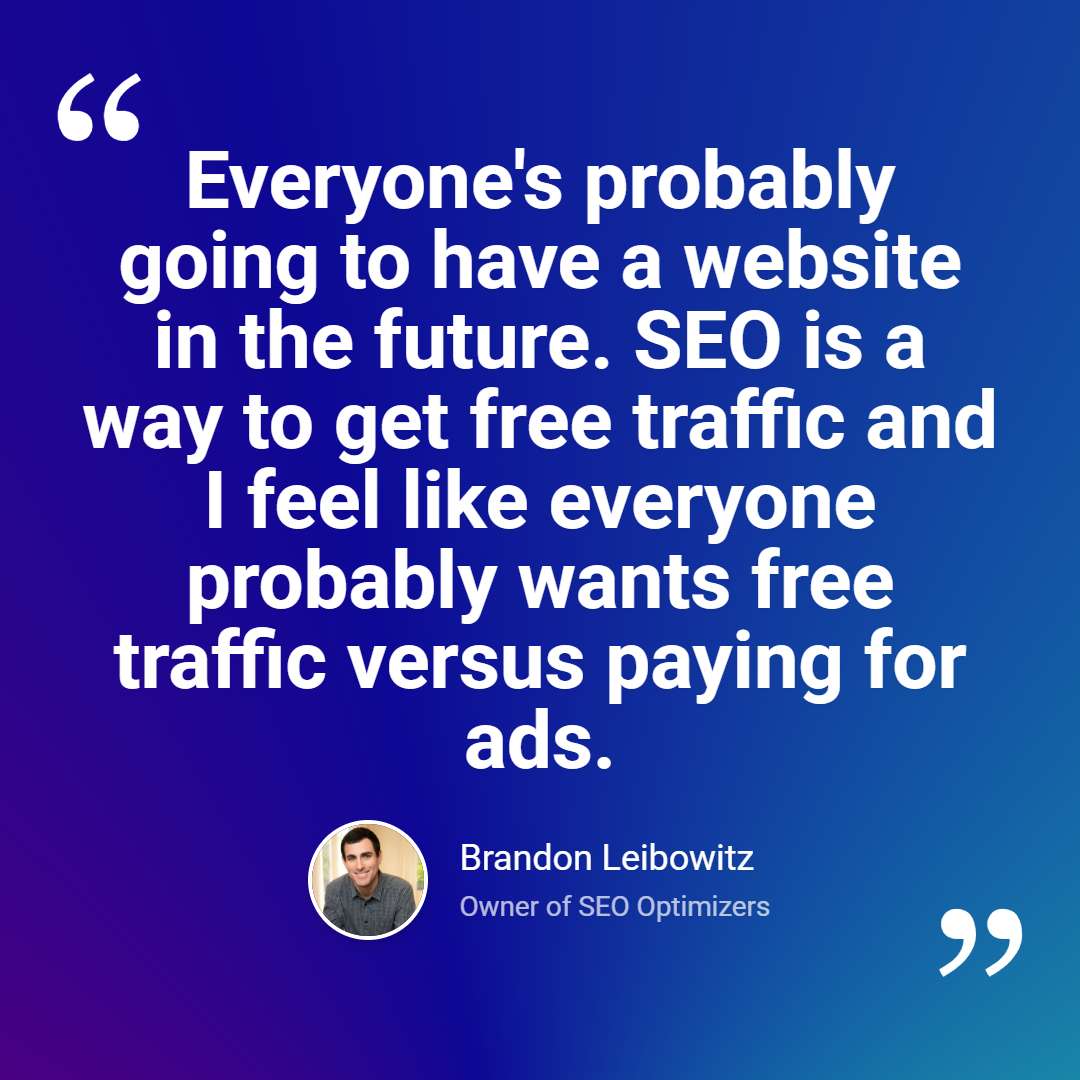
[00:00:16] Speaker B: My name is Brandon Leibowitz and I help people get more traffic to their website using search engine optimization and digital marketing strategies that get you that visibility. So when you're searching on Google, there's ads at the top, but right below the ads are the free listings. And I help websites get that free traffic from search engines. And just kind of fell into this after I graduated from college, got my degree in business marketing. And one of the first jobs I got out of school was helping a company out with their digital marketing, which I didn't really know much about it. They don't teach you that in school, at least not in 2007. They kind of briefly mentioned it, but not much. And I told the company that and they said, don't worry, we're new to this as well and we're going to learn with you. Taking you to classes and workshops and seminars. And after doing that for a few months, I realized everyone's probably going to have a website in the future.
SEO is a way to get free traffic and I feel like everyone's probably going to want free traffic versus paying for ads. And that got me to stick with this SEO. Working at different advertising agencies over the years as a director of SEO and before work, after work and on my lunch breaks, I'd work on my own company and eventually built that up to where I was able to quit my job and been doing this ever since.
[00:01:33] Speaker A: Well, that's really cool that you were able to quit your job and do your own thing. That's fantastic. What kind of clients have you worked with over the past few years?
[00:01:43] Speaker B: I have worked with a variety of industries. Not really any specific niche. I most businesses are local businesses or E commerce. But in terms of general niches, I've worked with kind of everything from people selling survival zombie apocalypse packs to people selling like exotic lease cars and everything in between people selling clothing and dentists and lawyers and doctors and have a bunch of different industries. And with SEO, the strategies are pretty much the same for depending on what type of industry you're in, then we're going to just change those keywords. If you're a doctor, we're going to focus on doctor related keywords. If you're selling cars, we're going to do research to figure out what keywords that have that buyer intent for people searching for cars and just keeping the strategies overall the same.
[00:02:39] Speaker A: Interesting. Aren't a lot of people doing similar strategies? How do you stand out when so many people may be doing something similar?
[00:02:46] Speaker B: Then you gotta go above and beyond what your competition is doing. So there's tools that let you look at any website's keywords. Well, you can just look at the code for that, but there's tools that will let you look at backlinks. And backlinks are one of the more important parts of SEO. Backlinks are clickable links from other websites that point to yours. And the more backlinks that you have from sites that are related to what you're doing and have authority, the more, the more popular Google thinks you are, the more trust Google's going to give to you and the more they're going to move you up those rankings. And we can look at your competitors and see where they're getting backlinks from and try to replicate those and then go and do a little bit more. So just trying to look at what the competition's doing in terms of content on their website keywords and just trying to do a little bit better of a job than they're doing because it's not really a one size fits all with SEO, we have to look at the competition to see what strategies are employing with their keywords and their backlinks and then we're going to incorporate those into the website.
[00:03:48] Speaker A: I love that strategy. Can you talk about who some of your favorite types of businesses to work with for digital marketing SEO have been and if you can share some success stories around those.
[00:04:00] Speaker B: I like working with most businesses but the more established, the faster and the more you're going to see that movement. If you just have a brand new website and you're a startup, to get Google to rank you does take time. It's not immediate. So having a more established older website makes it a lot better because you're going to see the results much quicker. One of my clients a actually the exotic car leasing company, they have a website that has been around for like 25 years. It's a really old website.
It was just built in a way that Google couldn't really read it and it was a really nice visual website. But Google just struggled and and we went in there, revamped it made it easy for Google to read all that code and understand what the keywords are. And within like two months they went from being on page 10 to shooting up to the first page of Google. And then we just did a little bit more and got them from page one to the top of page one. But they moved up very fast. Whereas with other businesses where one of my clients, they're doing AI consulting and it's a startup new industry, they don't really have much trust built with Google, it's a new website.
So we have to really push these backlinks and get Google to trust them. And that part just takes time. You can't just build a bunch of backlinks. You have to slowly trickle them in month over month to show Google that this website is relevant. And been doing that for a few months and been getting them to slowly creep up from page 10 to page 5. But it's not as fast as those older, more established domains move.
[00:05:37] Speaker A: How do you actually get Google to recognize backlinks and know that they exist? And how do you even create backlinks if you don't have any?
[00:05:45] Speaker B: Well, backlinks are other websites mentioning you. And you might have gotten written up on the latimes.com in there. It says SEO optimizers. And you click on it and it goes to my website. I'd be getting a backlink from the latimes.com and then you hope that Google, with their spiders, they go around crawling the Internet trying to find all the different pages on the online, and you hope they'll find that LA Times one. Usually the bigger websites, they'll find these backlinks faster versus getting on a smaller, very niche kind of blog that might not have as much traffic.
Google might not find that backlink for a couple days, a couple weeks, a couple months. They might never find that backlink. So you can actually build backlinks to your backlinks to help Google find them, or you could share them on social media. That usually helps get picked up a little bit quicker. There's also indexing tools that will help. You could submit a list of links and that helps Google find them and hopefully show them in the search results.
Doesn't always work. It used to work a lot better five years ago, but now it doesn't really work as well. The indexing, it's kind of just waiting and hoping Google finds it. And also you have to think how much content is out there. And Google has to go through all these pages and try to read through it all. And especially with AI now people are just pumping out hundreds or thousands of pages of content in a few seconds. And that's just more for Google. To try to decipher and try to figure out what this all is and what to rank, what not to rank.
[00:07:19] Speaker A: I'm glad you brought up the AI part, because I'd like to dive into that a little bit. So you described how when SEO is working well, you will appear at the top of the Google results. These days I noticed that first there's a Google AI answer ads, then the links. So is it more important to get ranked in that AI answer that Google's giving you? When the SEO links are farther down.
[00:07:47] Speaker B: The page, you want to try to capture as much free real estate as possible, but those AI don't really have. I mean, sometimes they'll have links, but most of it is just giving you the answer right there. So you don't need to go on a website and it deters people from going there, which Google's been doing that since, I think, like 2013. They had these, like, featured snippets that they would at the top, giving you.
[00:08:10] Speaker A: Google Ads or whatever. Sure.
[00:08:11] Speaker B: Now it's just a little bit different where it's AI and you respond back to it, and we'll have to see what happens.
Best practice, try to capture as much visibility in both places.
But the websites are going to be the best because that's where someone's going to click and go to your website versus AI.
It kind of cites you in there briefly and a little mention, but it's not as visible as those clickable links down the organic results.
[00:08:38] Speaker A: I know you've been doing so much in the SEO world for some time, and if somebody says, well, I think you're using a tool, I could probably figure this out myself. I'm sure there are other strategies that you help people implement so that they can rank higher. And there are things that they wouldn't know themselves. What is something that people often find out when they think, oh, I can do it them myself, I don't need someone. And then you, you take a look and see how things are actually not working. What. What do you usually find in that case?
[00:09:08] Speaker B: Primarily, it's the backlinks.
Either they're not building backlinks, or they've gone on a site like Fiverr and bought a package of a thousand backlinks for $5, and they got on all these spammy websites. And if you build the wrong type of backlinks, it actually does more harm than good. So you have to be careful with the backlinks where you want to focus on quality over quantity. And that's where a lot of people just don't know what to do with the backlinks and don't realize how much time it entails to get Google to trust you. Also, another big thing I see is just the website layout and structure is a lot of websites are just a couple pages where the, the more pages you have, the more keywords you could target. And I always tell people you gotta break out your website into as many different pages as possible. The more pages, the better.
My website has high 200 pages.
I do SEO, but I'm hitting different keywords like or different topics like I do keyword research. I have a page about that, I have a page about backlinks, I have a page about local SEO, I have a page about e commerce SEO. And the more pages you can put out there, the better.
One of my clients, they're a dentist and they had a page listing out all the dental services.
But it makes it more relevant if you have a page for each actual service. So they had a page listing all the services and then we made it so it's clickable that you could go to each service like teeth whitening or for braces, or for cavities or root canals. We made pages for each one of those because someone's searching for a root canal, they don't want to read a page about braces. So having that service page with everything was okay, but it didn't really solve that person's issue. And with Google, it's all about relevancy. The more related you are to that keyword that somebody's searching, the more likely Google's going to show you. And having a page just dedicated to that one specific keyword makes you really relevant to that. And that gets Google to then hopefully show you with the right backlinks and trust signals.
[00:11:15] Speaker A: That makes sense. I've seen a lot of websites, especially recently, where everything is all in one long page. And at the top they might have a navigation bar, you know, home and contact and whatever else, but it just takes you to parts of the page farther down. It doesn't actually load a new page. You're talking about having separate pages for everything, right? Not just one super long page with sections.
[00:11:38] Speaker B: Yeah, that's looks visually nice, but for SEO, it's actually one of the worst ways you could build a website because each page can only target a few keywords, like three to five words. After that kind of loses relevancy. And the more pages you have, the more keywords you're going to target. So one of my clients, they, I mean, I've actually Had lots of people with websites like that. And what we do is we. You could keep it like that where it's just a visually long one page, but then you have to make standalone pages in the back end. They could be hidden pages, they don't have to be clickable from the top navigation, but just making those standalone pages.
Also blogging is very important and if you just have one really long page on your website, it kind of holds you back because blogging became popular like 15 years ago. Because it's a way to add more content to your website. And the more content, the more pages you have, the better off you're going to be.
[00:12:33] Speaker A: Now, do your clients typically push back on, you know, having to write blog posts and doing other things like that and how do you help them?
[00:12:41] Speaker B: Nobody wants to write blog posts, so usually I'll take care of that. Some businesses want to write their own blogs, but most of them just don't have time. So if they write their own content, then I'll go in and tweak it and optimize it. Make sure everything reads properly with the technical header tags and alt tags and interlinking the pages together and adding schema and well, it's really technical stuff that they probably don't want to do, don't have time to do it. And then if they don't write the content, I'll take care of it for them and I'll share it with them beforehand. Which a lot of times they don't even read the content because they don't have time. They just say, hey, it sounds good, the title reads well, let's go with it.
So I'll take care of that and just make sure I have a staff of writers that specialize in different topics. So just kind of picking and choosing which topic or finding the right writer that's going to match that business. Because we have to put out quality content. Can't just put out content. You gotta make sure it's gonna be helpful, beneficial to the reader. Getting subject matter experts helps to make sure that's all in place.
[00:13:49] Speaker A: That's a really good strategy. I like that you mentioned before about the importance of backlinks from larger organizations. Like you mentioned the LA Times. If the LA Times or other very large news outlets don't know I exist, how do you try to get on their radar?
[00:14:04] Speaker B: For businesses, getting on those big sites is a little tricky. You gotta kind of stand out and do something that is newsworthy or something unique. But in general, if you're just trying to pitch yourself to Those websites, they get thousands of submissions probably every day and they just can't go through them.
So yeah, just get creative. Usually if you could find like a, if you could do some research on your industry and get some like statistics or data points that nobody's kind of released. So if I could go and pitch the LA Times and say, hey, I did all this research about AI and Google search and figuring out how many people click on the AI results versus the organic results and how is that impacting Google's market share from ad revenue and could submit that to them and then they'd be like, okay, this sounds a little bit more unique, something that nobody has done or not many people are doing and that's a great way. But even then getting your foot in the door, it's still tricky because you got to pitch them. And cold emailing those websites doesn't always result in the best or get them to respond back. But it's worth a shot. You never know until you try.
[00:15:13] Speaker A: Have you had success doing that?
[00:15:15] Speaker B: And there's Also websites like feature.com or haro help a reporter out, where reporters actually from these websites like LA Times or Huffington Post or New York Times are saying, hey, I'm looking for a subject matter expert that specializes in Italian food. And then if I have a client like that, I'd be like, hey, let's pitch you to see if we could get you in this article or this write up. So that helps a little bit more and it's a little bit easier. Still tough because there's a lot of competition, but at least now they're asking for subject matter expert. Whereas cold emailing the LA Times hasn't really worked too well for me. So. But it's still worth a shot. You never know because a lot of times these writers or these authors might be from an old article and we might find an old email address or an old contact submission form that if I could find a newer one, maybe they're not active on these platforms anymore, but they're really active on Instagram and I could send them a message there and hopefully get them to respond. So it's kind of like being a detective.
[00:16:18] Speaker A: I like that you mentioned Harrow help a reporter out. That's a good one. I've heard of it before. I personally have never seen a request for information that I could actually perfectly provide that no one else could. But I do think it is a great idea to watch that site for sure. If I can ask you, can you talk a little bit about how your SEO strategies vary for service businesses like a lawyer versus a production business, like.
[00:16:41] Speaker B: A print shop, they're both local businesses.
Then we got to focus on local and get them up on Google business profile, Google Maps, that's going to be a big part of it. And make sure they rank locally in their area for wherever they're trying to target. But in terms of keywords, that's where we're going to do keyword research and figure out what keywords are people are searching for. The print shop versus the other keywords or the other industry is going to be much different. So keyword research, find the right keywords and then the backlinks as well is getting you on sites that are related to what you're doing. So if you're a production print shop, we want to be on sites that are similar to you. We don't want to be on like a mechanic or an auto body shop or a medical website. Maybe you did the printing for that medical website. So it's okay if you got like one or a couple backlinks, but the majority of the backlinks need to come from sites that are related to what you're doing. And that's where the strategies kind of differ is. Got to find websites that are related to what you're doing and build those relationships. Cold emailing, pitching people and just seeing how we could spread the word and kind of doing digital PR for Google for these websites.
[00:17:49] Speaker A: I like that. Can you talk about how a mom and pop business could take market share from a larger, more corporate business in that same market? So like for instance, a small mom and pop car dealership competing against a corporate dealership with a lot more money behind it. How would you assist in that case?
[00:18:10] Speaker B: It gets a little tricky because those bigger websites are spending a lot of money on PR and getting backlinks and that digital publications and we could do the same.
It will be a little tricky because if you don't have a big budget to back it because a lot of these websites are going to ask for compensation and unfortunately there's not really any free backlinks. There are some, but most of them you have to either invest your time or pay to get in these websites and to compete with those bigger ones. It's tough because they're pushing big budgets and have probably a whole team of people doing their SEO. But you can always find low hanging fruit of keywords that they're not tapping into. Long tail keywords. Keywords that are two or more words or more city specific keywords. So if they're a national car dealership, and you're only in one city, you can make sure you have a really good presence in that city, maybe sponsor the little leagues and just have or offer discounts for colleges and universities in that city. So you have a really strong local presence and that could help offset it. And do an offline marketing too, because with SEO, you want to be everywhere, but those touch points help to build trust. And just being on Google is great, but getting some offline marketing that gets people to then search for you on Google, Google sees that people are searching for your brand name and that helps you start moving up those rankings as well.
[00:19:35] Speaker A: I like those ideas, especially the one you mentioned about sponsoring a little league team. Like, that's creative, not something that maybe someone who's so focused on the digital side of things would think of. But I do think that's a really good way and it gets you more ingrained in the community. Right. It's a chance to give back. And, you know, the parents of the kids who are washing the shirts all the time will think about your car dealership or whatever your business is. So I really like that suggestion.
[00:19:57] Speaker B: It's all about thinking outside the box and just trying to figure it out. Because then also that little league is going to post you on that web their website as a sponsor and you get an SEO backlink. So there's lots of benefits that maybe people don't realize besides just getting in front of parents, but you're going to get Google to rank you higher and get a lot more community exposure. Visibility.
[00:20:18] Speaker A: Yeah, absolutely. Brendan, this has been great talking with you. Do you mind telling us where we can find you online and what we can look forward to you creating in the near future?
[00:20:27] Speaker B: I actually create a special gift for everybody if they go to my website at SEO optimizers.com forward/gift. That's S E O O P T I M I z e r s.com forward/gift. And they can find that gift there along with my contact information and classes I've done over the years I put up for free so they could see step by step how to do a lot of stuff that we talked about. And also if you do have a website, I'm happy to check it out from an SEO point of view and you can book some time on my calendar for a free SEO strategy session.
And right now just working on finishing up a book and hopefully that should be done in the next few months about the benefits of guest podcasting and all the hidden SEO value of getting backlinks. And other things along with subject matter expertise and getting social media content. But you get some SEO value out of that. And hopefully that will be done in a couple months. And everyone can check that out too on my website. It'll be up there.
[00:21:34] Speaker A: Congratulations on the book. That sounds excellent. And we will link to all the things you mentioned in the show notes so that you can get there directly and get the free gift that Brandon mentioned. Brandon, this has been so great having you on and being able to chat with you. Thank you so much.
[00:21:48] Speaker B: Thank you for having me on.