Episode Transcript
[00:00:02] Speaker A: Hello, I'm Jeremy Rivera, your unscripted small business podcast host. I'm here with Joshua Altman, who's going to introduce himself, starting with why we should trust him as an expert in the marketing field.
[00:00:16] Speaker B: Thanks for having me. I'm Joshua Altman, Managing director of Beltway Media. We're fractional chief communications officers. My background, I started as a journalist, worked through that. I was a multimedia producer covering congress and politics.
I left that thinking I'd go back to a newsroom after being a freelance reporter and didn't go back to a newsroom. I stayed with doing these corporate business clients. I found this need that they had for video, for digital, for web, for content, all at an affordable price.
[00:00:55] Speaker A: Love it. Tell me about both the fractional concept and what you see as rolled up in that role of a cco.
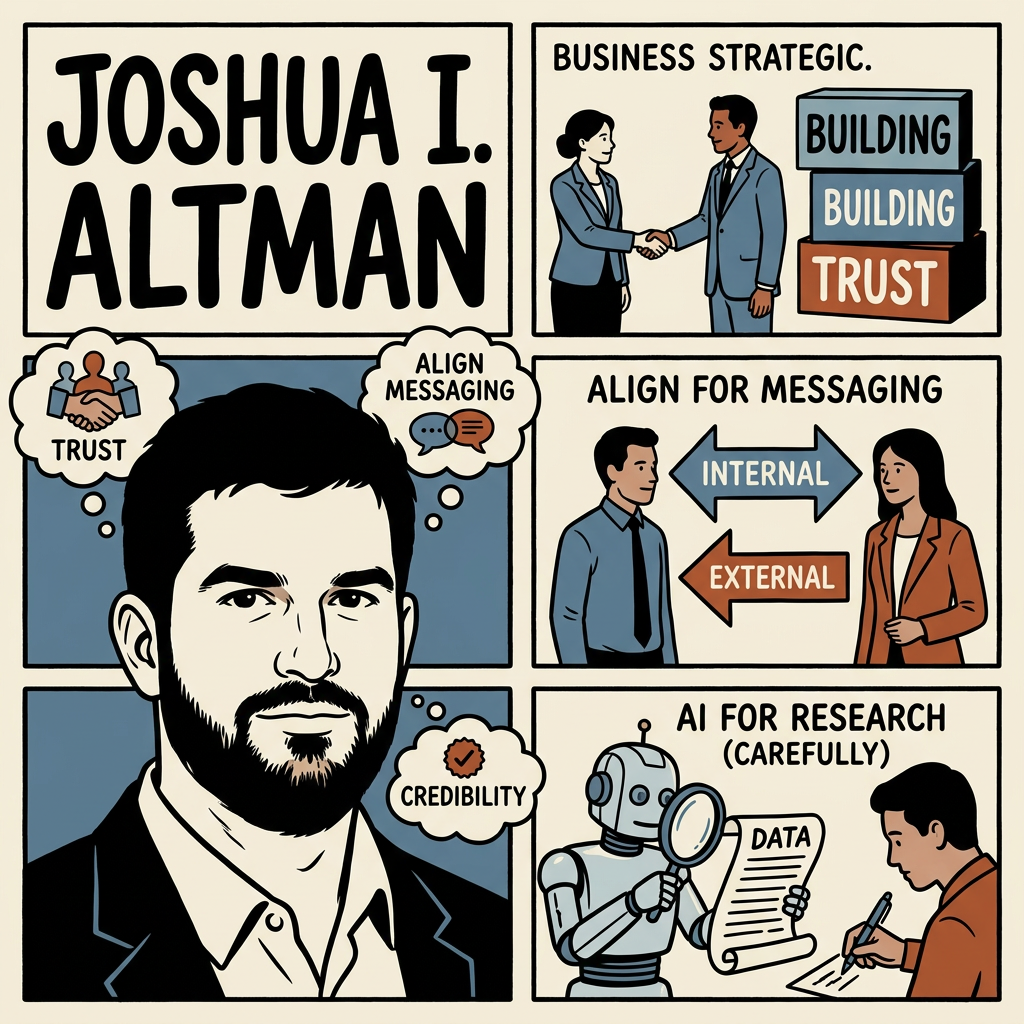
[00:01:05] Speaker B: So fractional means we're contractual, we're part time workers, we're fully integrated into the client's company and team. So instead of having a 40 hour a week Chief Communications Officer, you have someone 25% of that one quarter fractional. The role itself is one that's less well known. It's becoming much more common, Starting with Fortune 500s, top universities, major sports franchises, and the focus is on shaping perception and building and maintaining trust.
And we do that by taking an integrated big picture view of how messaging impacts reputation growth and stakeholder confidence.
So it's not project based, we're not launching a widget, it's not goal based, it's not email marketing. It's really bringing all the communications functions together under one senior leadership role and using that to shape perception and build and maintain trust.
[00:02:07] Speaker A: I would imagine that that involves a fair amount of interviews and meetings and conversations within the the team and within the company to really understand what that message needs to be based off of what the company's internal culture and policy currently is.
[00:02:28] Speaker B: Right, it does. So we're talking a lot with all the internal stakeholders. So we're not just owning external communications, it's internal communications as well. Because like you said, those are just as important because that's where the external messaging starts.
Your sales team and your marketing team have to be on the same page as your internal communications and product development teams. Because if not, buyers are going to be looking for something that might not be what the product is. They're not going to be communicating that message the right way. And it is, especially at the beginning, talking with the people who own this function now and also the people who are really doing it.
So it could be social Media managers, it could be internal communication specialists, it could be Google Ads team.
But we're going to start with figuring out what are all these different people, these different teams doing. And we take them through every project. Our same two frameworks from the beginning, you know, story, narrative, brand and our four languages model what people read, see, hear and experience. Experience to figure out are we on the same page and if we're not, how can we get everyone on the same page? And also what that page needs to be.
[00:03:51] Speaker A: Is this a position or skill that founders that are in the local services businesses on the higher end, let's say you're got a pretty big company and you're, you know, bringing, you know, concrete fences, building concrete fences in Florida or nationwide, or you have what size entity is comms, you know, worth something to consider as a whole position? Because obviously, you know, some if you're a solopreneur and you're just, you know, redesigning somebody's house and it's you, your comms are kind of you. So where is that sweet spot of scale or size of business where that CCO position starts to make sense?
[00:04:39] Speaker B: It starts to make sense really from that solopreneur, from that one person.
Because we're the expert at communicating your expertise. You're the expert in home remodeling?
We're the expert in communicating a home remodeling business.
You want to be doing home remodeling, you don't want to be doing email marketing campaigns, you don't want to be managing your social media feeds.
That's not your expertise, that's not your job. It becomes your job by default.
And we all know that, we've all been there, but you don't want it to be your job. One of the people we take over from the most are owners and founders or an early hire because they kind of just got stuck owning a function because they built the website. So now this is all on them.
You have a lot of CTOs who built the website whenever it was built and now suddenly they're in charge of all things digital and they don't want to. That's not their job. So we're taking over those functions for you. And the reason it starts to make sense financially at that early stage, there are really a couple main reasons. The first is it's fractional, so you're not getting more than you need. You're not hiring a 40 hour week per person.
You're hiring anywhere from five hours a month to 20 hours a week. So there's a Large range and with those small one person teams, those businesses, they really might only be five to ten hours a month.
But right now that five to ten hours a month he's not spending on home renovation, he's spending on managing email marketing, which isn't bringing in the top money that's going to get from home renovation all the way up to companies, anywhere from 100 to 250 people. And the reason for that range is you could be a startup and scale your engineering team to 100 plus people, scaled HR and finance and those support functions to support that engineering team, but never really thought about communications.
Or you could be a company making concrete fences in Florida and you really have thought about it and you need it now. But you're only a 50 person company because you need to communicate a lot of things to a lot of different stakeholders.
[00:07:02] Speaker A: That's fair enough. What are some of the questions that you're answering on those first weeks when you're in an engagement? You onboarded them, you started. What are the questions and conversations you're having?
[00:07:17] Speaker B: The first question is always, why aren't we seeing results yet?
And communications is a process, it's not the final product.
So it takes time to build that up. Especially if you're starting from zero or not having a lot.
You have to build up that content, you have to build up that audience.
Especially if you're looking to drive content from say search or AI search, it takes time to get in those results because it doesn't crawl instantly.
It can do it very quickly in some cases, but it's not right away. You need to build up that credibility over time.
So that takes time. One thing they're always wondering is, are we doing this right? Is this the right thing?
And if you've worked in communications, you have tried to do it yourself, there's no one right answer. There are different things we try. That's why we do things like AB testing.
Both could be good, both could get good outcomes. One might be better on a Tuesday than a Wednesday.
Some things you try around the holiday season aren't good in the summer. So. So right versus wrong isn't how we think about it. We look at effectiveness and we start putting things in. Is this effective in moving us towards the goal?
And are we working on building and maintaining trust, which is incredibly difficult to measure, especially to measure accurately.
And you only really know if you have it when something goes wrong, which we hope never does.
[00:08:59] Speaker A: I'm curious with, you know, AI coming up as a new channel, what's the matrix of Decisions that you go through for choosing what, what mediums, what channels, you know, social, email, like kind of list out what the different menu options of communications are and some of the thinking behind why you might choose that particular channel.
[00:09:29] Speaker B: We start with our four languages model to make these decisions. So what people read, see, hear and experience, what people read is kind of intuitive. People get that it's the stuff you read. It's most of what we consume when we're endlessly scrolling on our phones. While we're doing that, we also see a lot. We see videos, we see graphics, we see photos, what people hear, very common. That's anything from radio ads to podcasts to in store audio.
All are what we hear. And then experience has two components. People think of it as big experiential things pop up events, someone handing out flyers on the street. That's something people experience. But it's also how people experience what they read, see and hear.
And we look at this and how each of these languages amplifies each the others.
So when we're looking at channels, if you have a very visual product, if you are a home organizing business, you have great visuals, you have great before and afters, you have to show that in some way.
So there you have something very visual. You might want to be on a visual medium.
Also look at where your audience is. For some people, LinkedIn's great. For some people, Pinterest is the best thing you can do.
It's going to depend on that.
So oftentimes, if you're starting from total zero, it might be we're going to try everything.
We're going to try different types of posts, different content.
We're going to try these different channels and see where you get the best traction.
Sometimes it's TikTok, sometimes it's Instagram, and that could just be luck of the draw in some cases.
Sometimes it's really, you are having more people on Instagram, those are your people.
Sometimes it is your people are on LinkedIn. And while doing all this, we think about the channels and the content we create in a way that doesn't make us have to create too much new content. That's another big thing people worry about, is I'm going to run out. I was told I have to do three posts a day, I have to write five comments, I have to hit these guideposts. It's necessary. If not, there are no content police.
These aren't laws of nature. No one is going to come after you. Nothing's going to stop you from doing something like that if you do one a week, you do two a week.
And that makes sense in your cadence.
That makes sense in your cadence.
So you have to think about it that way.
And we repurpose a lot.
One post, one idea can become a post on every channel and then we can make more posts off of that initial concept. So there are ways to do that.
Don't overwhelm us, don't overwhelm the client.
[00:12:27] Speaker A: What's an unexpected medium that you've used for a client that had a really good success rate for them?
[00:12:38] Speaker B: We've had Reddit be very successful. That wasn't necessarily unexpected across the board for this particular project. We weren't really expecting that to be what took off.
And if you're familiar with Reddit, it can be very hit or miss.
It can backfire a lot if you try astroturfing it. If you get, you know, if the community see that you are inauthentic, you could have the exact opposite effect that you want.
And Reddit's really catching on to this, our newsletter today, actually, which won't be today, obviously, when this airs, but talked about how Redis very specifically is cracking down on this type of behavior.
Inauthentic AI generated fake content mills.
So you have to be very careful using it.
And I say that we use it for ourselves, we use it for clients, but very judiciously because we don't want to breach that trust.
[00:13:50] Speaker A: The narwhal definitely bacons at midnight. As somebody with a 18 year Reddit account, I have seen companies come out and crash and burn and I've seen strange, you know, like, somebody's like, oh, look at my picture. And then somebody's like, oh, this is their site. And it's like 500 million people like this, this picture of like a banana guy with some glasses. And it's like all over the Internet for no particular reason.
[00:14:18] Speaker B: And you never know what's gonna.
[00:14:20] Speaker A: Yeah. And then the next day somebody's like, look at my picture. Like, get out of here, shill.
You're just trying to get us to buy your banana man pictures. We already have a banana man. It's very chaotic.
Is there something about, you know, creating and trying to nurture like a branded, you know, sub ecosystem, like trying to own your own. Like, if you've got, I'll put it out there for myself. Should I try to be growing a subreddit that's specific to the project that I'm growing?
Or is it about finding where the community already exists and finding a way to participate Organically without triggering that shill. Ick.
Corpo speak
[00:15:07] Speaker B: generally find where they already are and engage organically, authentically and helpfully in those places.
Because if you're trying to start it from scratch now, you have to promote the community, which by definition you have to show it somewhere to get people to show up.
So that becomes a lot harder.
I won't say it's never been done because most things at some point have been. It's a lot easier to have success by going to where your audience is and being helpful, genuinely helpful, providing answers and don't show the end. If you visit this webpage and it's always your webpage to sell your product, that's going to backfire.
[00:16:02] Speaker A: Got it.
I have kind of a definitional question or challenge.
In what way do you see the fractional CCO role as different from a CMO role?
[00:16:20] Speaker B: So, marketing, the chief marketing officer that strategies to build awareness of the company's products and services is promoting the brand.
It's social media interactions, it's customer service, all of these are part of the brand.
The chief communications officer includes marketing, it includes branding, it includes advertising.
And our focus is, yes, build awareness of the company's products and services. But all around that idea of trust. Every purchase we make is a trust based purchase. Some are very high trust purchases, some are much lower trust purchases because, you know, you walk into a corner store, you buy a bottle of water, you know it's any corner store, they're there, it's a sealed bottle, you're pretty confident in what you're buying. As opposed to something like a home organizer where that's a very high trust purchase. This is someone coming into your home and touching all your stuff.
Very high trust purchase right there.
So we focus on that trust component as the primary driver.
[00:17:40] Speaker A: What's some of the biggest missteps that you're seeing in communications with companies that don't have somebody driving that role?
[00:17:53] Speaker B: They are frequently not giving enough time for things to work because like I said earlier, they're looking for these very quick results. They ask us, why isn't it working?
It takes time. If you're looking to get a viral moment in the first month or two of doing something, odds are against you.
If you give it time and you see this growth over time, you're going to have the results you want. Another is really looking for cause and effect.
I put, you know, I made these social media posts, we spent $1,000, we spent $10,000 on these, you know, promoting them.
And it drove these clicks to that sale that is measurable, it's trackable, it's easy to do.
Unfortunately, people are a lot more complicated than the thing that drove the click to make the purchase.
There's an old number out there. You know, it took seven to 14 touch points to make. You know, for a buyer to make a decision, that number is probably a lot higher now, close to 30 or more, just because we see so much more content. Think about everything you see when you scroll on your phone. That's one touch point. You see the same ad four times.
That's four. So you're now seeing a lot more those times that you saw something. Those times they interacted and saw a video thumbnail, they watched the first 30 seconds of a video but moved away. All of that primes a person to ultimately make that purchase decision.
And it's much harder to track, especially across devices.
Especially if you watch something on your spouse's phone that's you watching it, it primed you, but you watch it on a totally different device that will never be tracked to you.
That conversation you had with your spouse about it, that was an important part of that buyer journey.
But we can't measure that.
So if you're looking for that cause and effect, it's not there in as easy a way to measure as we'd like. And looking for it and making decisions based on that frequently leads to the opposite of the results people want because you're losing what builds up the buyer to make the decision.
[00:20:33] Speaker A: I definitely feel that, like, you know, I've struggled with, you know, Google Analytics packages.
You know, I've tried, you know, alternatives to Google Analytics.
I've been steeped in all of the metrics from all of these different platforms. You know, Microsoft Clarity is not bad in terms of ui, but you're right that there is inherently an attribution issue that we're never going to solve. And I feel a little bit duped by it, too, because there was a time, you know, in 20, between 2010 and 2015, where, you know, US SEOs in Arnish, we felt pretty good about the data that we had. And we're like, hey, we're getting.
There's links and people, traffic's coming in. And then they went to this page and then they converted.
[00:21:29] Speaker B: You could look across devices, you could see device id and you could see what happened with that device over time. You had that, and we still do.
It's less reliable than it is. You have a phone with browsers that you clear you're going across devices. It's not as easy to connect as it once was.
[00:21:55] Speaker A: Yeah. And there is also the, you know, the zero click world like you have the rise of TikTok, which it's very, very difficult to get anything that has anything approximating a link into their platform. And anything that's viral certainly has nothing like a link. So then that means that you have to rely on them catching some, you know, on, on a repost of your viral clip, finding the right keyword or phrase that's going to lead to a Google search that then led to you. So you can't even come close to attributing that they're buying, you know, your pink pants because they saw it on a TikTok video. There's, there's not even, not even a platform carrier. You know, you can't even say, oh, I've got this traffic from TikTok because there's no. They don't really know. You can't really. There aren't a lot of link, direct links anywhere in TikTok that lead you off of TikTok.
[00:22:54] Speaker B: Yeah. And if someone shares that TikTok video on Reddit.
[00:22:58] Speaker A: Yeah.
[00:22:59] Speaker B: And then it gets posted again. Yeah.
As you know, on another subreddit, it becomes much harder to attribute. So looking for that cause and effect as a one to one and then making your spending decisions on where you put your resources based on it, it's easy to do because you could feel confident doing it. It's very easy to feel confident doing it because look, there are numbers, but those numbers are not necessarily telling you the whole story or even the part of the story that you need.
[00:23:36] Speaker A: So what do we replace that with? Gut feeling, intuition or some other secondary system that, that you've developed or can suggest at? Like, how do you look at that holistically and not just say, trust us, don't look at the numbers, don't believe your lion eyes.
It's working.
[00:23:57] Speaker B: We're telling you if your clicks and you're buying and your inbound traffic and all those things are going up, if your subscribers are going up, if all these things are trending in the right direction, happening together. Yes, it's just correlation.
It's just two things that are happening simultaneously. And for all we know, if we stop doing everything else except say one Instagram video a week, it would stay the same or even improve.
That's an experiment. You could test.
[00:24:28] Speaker A: Okay.
[00:24:30] Speaker B: And you could see. Okay, well, is this working? Let's drop everything for a short period of time and focus on one specific channel.
Well, what happened to sales what happened to inbound leads? What happened to mentions? Because that's a way to measure. Are you part of people's conversation about your industry?
Not true for every business. People aren't necessarily having online conversations about, you know, concrete makers in Florida, but for some, that's very helpful.
And then add another one in. And you could do this very much over time.
But it is, of course, you're looking at correlation and using experience and the business itself and what they know about their customers and. And what the sales team is telling you to make informed conclusions. We didn't have all these metrics for most of modern history.
That's only relatively new that we even had these things to use.
And businesses grew, businesses made money. The system worked without knowing the exact device someone used and what they clicked and how and how deep they scrolled on a page.
We knew. We sent catalogs to people's homes and people made purchases.
Right.
That was Sears, basically, for the longest time. They sent catalogs to people's home and they made purchases.
[00:26:07] Speaker A: Yeah, yeah.
[00:26:08] Speaker B: And we could track, you know, you could track by zip code.
You could even track by what went, you know, we sent a catalog to this address. We sent five items to this address worth that number of dollars.
But while they spent this many minutes on that page and they scrolled this far down and highlighted that item, we never knew.
[00:26:29] Speaker A: Right, Right.
[00:26:30] Speaker B: So we had these things like experience and judgment and customer knowledge before, and that's going to become much more important now that these raw metrics can be so misleading. And having this chief communications officer, this, you know, in your business, fractionally, can help bring that experience to a business that otherwise wouldn't have someone or a team of people who can bring that knowledge in.
[00:27:06] Speaker A: My friend Matt Brooks of Seoteric says that ChatGPT and LLMs are the worst customer support representatives.
Yeah, but they are the ones that we have.
[00:27:20] Speaker B: You know, I think I would say both those are true because we've all been chatting with bots, and we've all been frustrated chatting with bots that keep us in endless loops that aren't answering the question, that won't let us talk to a person who could resolve it quickly, question very quickly.
And yet we still implement them because they're relatively easy and cheap.
[00:27:53] Speaker A: When it comes to not just like the chatbot interfaces that people put on their sites, but thinking about how we now have the potential of somebody asking Claude, hey, go find a.
A vendor who's going give me tickets for a ball game and go buy them for me.
GPT Other models are adding wallets. And so now we have robots running around with real human currency, but we also have robots running the task of finding out more about your niche, finding out more about service business. So from the comms perspective, what are you trying to do? What's your mentality about interacting with that bot? Like, what's your strategy on your site, off site, to try to influence
[00:28:58] Speaker B: how
[00:28:58] Speaker A: those replies come out when people put. Put those prompts in about your target clients?
[00:29:06] Speaker B: We use another bot.
The bots are best at talking to other bots. When you think about you have two audiences or two big groups of audiences. One is human, one is machine, and you have to be able to talk to both of them.
Humans are really good at talking with humans.
We've been doing it our whole lives, pretty much.
Bots are really good at talking to other bots.
So there are bots that optimize website and sales pages, front end and back end, all for those bots.
And we've developed some ourselves that we use for us and for clients.
We use AI. We don't hide that, we use AI. It's a great tool, but that's all it is. It's a tool.
It doesn't produce final content that we put out.
It doesn't produce things like blog posts or social media posts without any sort of human oversight.
That stuff all gets edited, or all it does is produce an outline in most cases, and the human is still writing.
But if you need to fill a new page with all the keywords and metadata and schema and all the backend stuff so it surfaces correctly for the bot, we have a bot that does it and does it relatively efficiently.
And then of course, we check it to make sure it didn't add in random stuff, because we all know it hallucinates.
It'll just make things up. So it does have very specific parameters to keep it from doing that.
It's as good as they can get.
[00:30:58] Speaker A: That's fair enough.
What's a surprising shortcut that you've been able to build into your workflow or process using some of those automated tools?
[00:31:12] Speaker B: A lot of research.
AI is great.
For the research that we need to do.
We had to research market conditions. It was like 20 or so cities, which is basically running a lot of Google searches.
Demographic data of Houston, income data for Houston, population data for Houston. Okay, next city demographics of Orlando. It gets very repetitive. So 20 cities could easily be hundreds of searches and scrolling the pages and finding exactly what you need.
We put the list into AI and it came back after we gave it very specific parameters of what it was allowed to use, it could only use official government sources.
So Census Bureau, Department of Public Health, all of those things.
It couldn't just use, you know, Josh's website of things to do in Orlando as the source.
[00:32:13] Speaker A: Right.
[00:32:14] Speaker B: And it had to provide all the sources to us and it did that within minutes.
Now we had to be very careful.
If you say give me the demographic information for Paris, it doesn't know if you want Paris, France or Paris, Texas
[00:32:31] Speaker A: or Paris, California or Paris Lake, California.
[00:32:34] Speaker B: Yeah, it'll just give you Paris. It might give you all the Paris locations. It might give you one randomly chosen. You have to be very specific. So tell it these are all US Cities.
Give it city and state.
Give it the information it needs so it doesn't start pulling Rome, Georgia and Rome, New York if all you said was there US Cities. But it did that very quickly output it in usable charts that we were able to use to make informed decisions and write a lot of content as people.
But it can do that research significantly faster than any human can. Especially now that the models have parallel processing capabilities.
[00:33:20] Speaker A: Yeah,
[00:33:23] Speaker B: that speeds it up dramatically.
Especially when you have complicated tasks that really would take single processing system longer and sometimes timeout on these systems. If you tell it can run parallel, you can accomplish a lot more then the people can focus on what people do. Well
[00:33:49] Speaker A: that I agree with that. I mean I even. I just used Claude code yesterday to go back through my older podcasts and sort and categorize out who talked about specific SEO tactics over time.
[00:34:05] Speaker B: Yeah.
[00:34:06] Speaker A: And then created a library which I just posted. It's the SEO tactics library on, on serk.com and boom. Like who, who mentioned that particular topic, who endorsed it, how to execute it? Like these very specific niche things. I'm like this would have been hours and hours and hours of work even two or three years ago. So it's definitely opening doors to a lot of data processing and giving brands an opportunity to surface more, more unique data points of what value they bring to the market, you know, interviews and conversations. I just spoke with Ben from, you know, open source SEO the platform and I can turn those notes into a resource document for myself or I can turn that into, you know, a blog post or, or ask it to turn it into a quote graphic that I can share on social. I've got an MCP to apply program that lets me cross post to social once I approve it. So like the, the, the friction kind of goes away, I think. Andrei Nikola, my other guest, he Said that AI is kind of the steroids that SEO and digital marketers really have needed. But we've kind of just relegated our past ourselves into past passed to you know, just kind of janitorial work of SEO and not freeing ourselves to, to think of the bigger picture. But it seems from your perspective of how you view your role in comms to be more, more of the omnidirectional, you know, value.
I certainly have changed my own opinion about the role of SEO and used to think of myself as much more of a, like a lone, lone gunman doing my own thing. But I need a bigger ecosystem. I need to play, play a role. If I'm being just the SEO and if I'm honest, you know, there needs to be that bigger view of that connection sauce of that connectability of organic goes cross channel.
[00:36:25] Speaker B: Yeah and there's so much that we can't control. We don't control the discoverability of our posts on Instagram or on Substack.
They show up because they are huge websites and we could put in the words to the post that we want whether or not it shows up as a top result, especially in AI search is relatively out of our control because we don't own the website, we can't really change the structure of it.
That's true, we can control our posts, we can control our page, but that's it.
And AI lets us work those very granular details with a machine that does it. Well, you and I, the people, people are doing the stuff that people do well and understanding the bigger ecosystem and yet even ask AI pull in the data from all these sources.
But is its analysis correct?
It makes a lot of wrong assumptions.
[00:37:36] Speaker A: Yeah, it definitely can as kind of wrap up up here. Give a final shout out again for your brand if you're working on anything special. If you're available for any particular projects, people want to get a hold of you. If you're doing trade shows or if you've got some material for people to go and check out, give us a few breadcrumbs to lead the path.
[00:38:05] Speaker B: Yeah, so you can find me on LinkedIn, you know, LinkedIn.com in Joshuai Altman. Email me. That's the best way to reach me. Jaltmaneltway media if you visit our website beltway media again no.com we have free resources for people to use that are designed, you could, they're, you know, HTML versions of them but if you download the PDFs they have a lot of white space space.
They are designed to be used to markup, write on them, use them. That's how we built them. They're not just a lot of white space for pretty design, although they are. It's there to give you space to work. We have some quizzes to see what your positioning is.
Do we have the right things in place. And we also have a lot of blog content on there on everything from what goes in our newsletters to our frameworks and how they work and how you can use them. And what is story in story, narrative brand. What differentiates that from the narrative component? That's all there on our website.
Check it out. We design this stuff to be helpful.
One big thing we tell everyone is everything you produce should be useful. An ad that's just a billboard doesn't help anyone, but things that provide value and help people will drive people to you.
And even if you are a home remodeler, you might be thinking, well, what can I do that's useful?
DIY tips, things that people can find you, give them a reason to discover you and learn about you.
Because that's a way in for a lot of people.
Most people are not going to see that and think, okay, well I am taking a sledgehammer and knocking out my kitchen and we are starting over from scratch.
They might be think, look at it for like, how can I replace cabinet
[00:40:09] Speaker A: pulls
[00:40:11] Speaker B: for something simple like that?
But it lets them know about you as a kitchen and home remodeler.
So everything should always be useful.
I love that.
[00:40:24] Speaker A: Thanks so much for your time and the conversation.
[00:40:27] Speaker B: Thank you for having me.