Episode Transcript
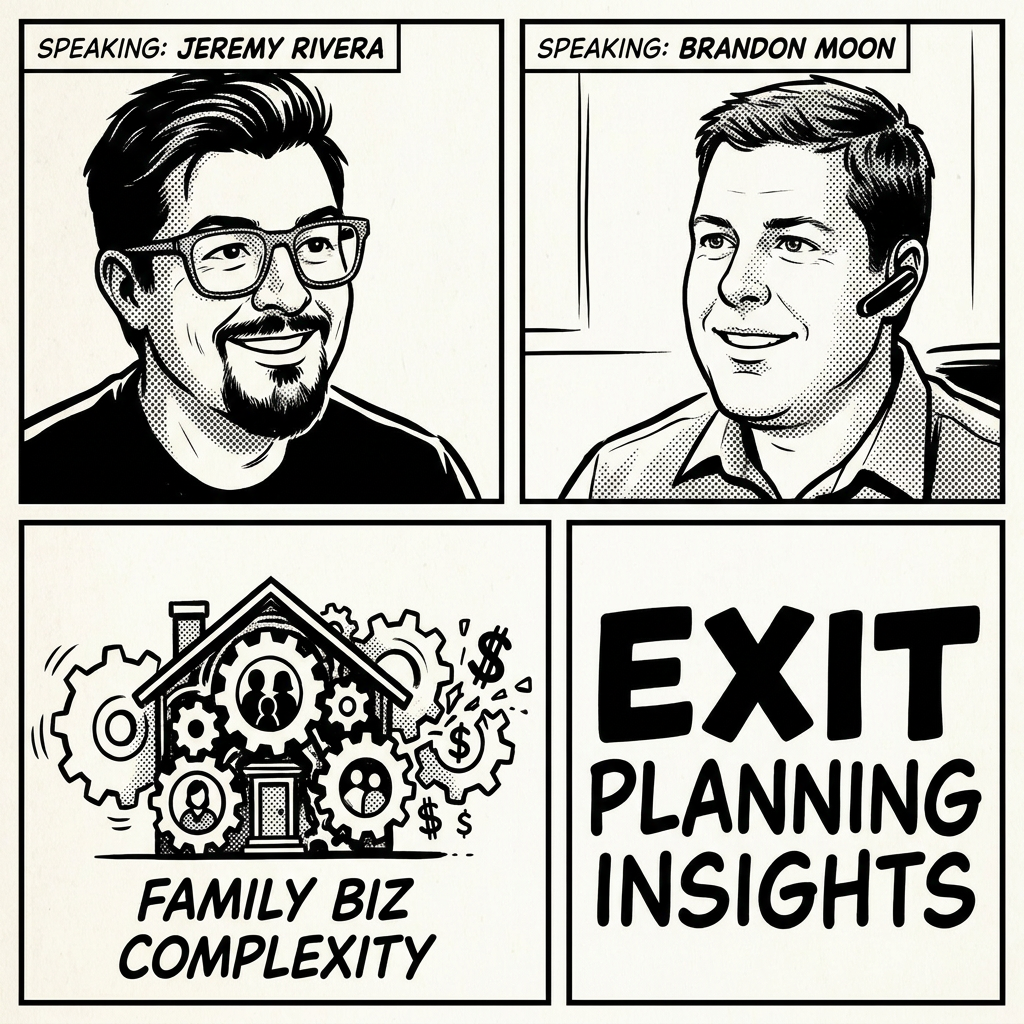
[00:00:01] Speaker A: Hello, I'm Jeremy Rivera, your unscripted podcast host. I'm here with Brandon Moon. He's going to introduce his advisors company and tell us what they do and what he did in life to earn the expertise that should make him trust us, trust him as an expert in that field.
[00:00:20] Speaker B: Thank you so much, Jeremy. Thanks for having me. So, TD Pine Advisors, we focus on increasing the value of businesses, helping business owners understand where they're trying to end their, you know, journey. You know, 100% of business owners are going to exit their business someday. And so that's a reality that we all kind of struggle with, on whether we should prepare for it, when should we start preparing for it? You know, what does that journey look like? There's so much value that can be created along the way as long as you know what that end looks like and what milestones need to be hit to get there.
So, you know, rewinding back to my journey in my professional career. Started in engineering, worked in the chemical plants, got to see operations really well, then went into oil and gas consulting. I got my MBA at night, but eventually got kind of burnt out in the corporate life and transitioned to my grandfather's family business. He started it in 1980.
I joined in 2014.
By 2018, he felt comfortable enough to retire, so he walked away, and I took full reins of growing the business.
Took it from a lifestyle business that had nice, stable revenue, but converted it to a growth organization where we acquired two businesses.
We were able to scale through not only the acquisition, but also organically by getting into other industrial or other verticals.
And then ultimately I resigned when I got a message from the attorney that said the authority that I had to do all of those things was null and void when my grandfather passed away. So I can give you all of the horror stories of family businesses, and I can give you, you know, all kinds of details about the growth journey. But ultimately it became really clear that, that there's so many business owners who are very reactive. The world happens to them, and if we grow the business very intentional, our options are so much more fulfilled.
[00:02:35] Speaker A: It's fascinating because I. I've had, you know, over a hundred conversations with different small business owners just over the past year, and I don't think any more than a handful of them have acknowledged that there is a. There's an end, you know, to. To this thing. You know, everybody's so focused on what can we do to grow, what do we do to streamline, what do we do to. To optimize? It's Kind of an interesting challenge to say, well, what's your end game on this? And I mean, I guess it's, it is quintessentially the, the human response to focus not on necessarily on, hey, I'm going to die one day.
But taking it to the business aspect is even more rarefied because, you know, like from the philosophical point of view, you could say all human activity is just ignoring the fact that we're going to die.
But it's kind of interesting to place it into the business context because I think.
How do you define the difference, that boundary line between, you know, solopreneurs, people that are freelancers and consultants versus, you know, hard to find, you know, S Corp, you know, ownership?
How does, what does that journey look like in this discussion? I'm curious.
[00:04:04] Speaker B: Yeah, and there's, there's a.
Both realities can be true, right? You can have a solopreneur type of lifestyle business and you can have a startup that is only in that phase of its journey. Right. Both can be very true. And if you look at them as a snapshot in time, they could look very similar.
But it's where the business owner wants to take the business.
If, you know, if you look at one lens and the in. The business owner wants to kind of stay in that space and be more of a lifestyle, give them the freedom to be able to, to, to, to have their life. And they really need to understand that if it's a lifestyle business and they don't want to create an asset, then, then the exit options are very, very limited.
Nobody's going to buy that job.
And because essentially that's what it is, is you, you own your job.
Um, so you get to define where you're gonna be, when you're gonna be there, and all of those good things.
But you don't have an asset. Now let's go back to the, to the startup. Right now you're. Yeah, maybe you're just a business of one right now because that's where you are in your phase of your business. But you're creating the systems, you're creating the processes you're focusing on. Okay, When I get to this free cash flow, then that's gonna allow me to invest in hiring somebody. Now I start building my team, and I'm gonna do that because in 10 years, I want somebody to buy this from, want to be able to transition it to my kids. Right? I mean, either can be a reality. Either can be a succession plan. A succession plan could be, I want to sit on the beach drinking my Ties. Right. I mean but, but for that to, to, for that reality to happen, the business has to have been built very intentionally and have systems and processes so that the business is making those decisions as opposed to an owner who is the bottleneck.
And so, you know, in any given snapshot in time, a, a, an organization could look the same, right? I have one, one person. I'm, I'm the person. But it's either I'm running a lifestyle business that I have no intentions to actually scaling this or that's just the season of, of where the business is. But I have very, I have very intentional directions towards building something that I can then sell.
[00:06:29] Speaker A: I'm curious because I've come across it in my career just a couple of times of you know, social alliance, B Corp versus S Corp conversations of, you know, and you, you hit on it on the lifestyle side because I worked for a SaaS that they were intentionally set up as a lifestyle business and there were three co founders.
I don't recommend having three co founders.
Based off of that and based off my later interview with John Henshaw of Raven Tools, he doesn't recommend it either.
2 seems to be a crowd.
But the lesson being that it was set up as a lifestyle company and then he sold and it became a cash cow for a company that didn't quite understand it and just maintained everything exactly the same but didn't grow. It just rode that wave of money for as long as it was going to stay.
So there is something there as far as long term vision because I know that that company, Raven Tools, once John sold it, that is certainly not what he had envisioned.
I know that he intended to keep it as a lifestyle, but three founders is too much and wasn't able to do what he wanted to. So.
But that kind of ties into the other half of the question of like does it have to become a soulless corporation or is there a mission statement? That system that you can build into what you hand over, that's going to survive the test of time or is everything going to eventually fall, fall prey to capitalistic predation, you know, because board members can be swapped out, can be hostile takeovers, et cetera are a thing. And I've been an employee at a company hostilely taken over and seen the jettisoning of talent and the extraction of value.
What's your perspective and take on establishing a company that's more than just a revenue extraction machine?
[00:08:45] Speaker B: Yeah, I think that's a great point and a great question because um, as a founder, as the, as the owner leader, you get to define what you want this to look like, at least while it's under your control. Right? Um, and it's by establishing that culture. Um, you mentioned mission statement, visions, values, all of which are so critical in creating what is going to exist when you do walk away.
Because if you can create a culture that is so entrenched that it doesn't require the owner to, you know, be vigilant on everything, right?
That you know, the, the owner can walk away and yet the core key members know exactly what the owner would have been thinking in various situations and they can execute on those situations knowing that it is what the owner would have wished or wanted. Now you start creating a culture that transcends you. Right? And look, there's, there's hundred year old companies out there that obviously cannot be dependent on a person because that's just not our life cycle. Right? Um, and so that becomes how, how much effort and focus that the owner has put into creating that culture. Creating the culture isn't just words. It's making sure that your hires are aligned with what your vision is of where the business is going. So your interview process is built around finding the right characteristics within individuals before bringing them onto the team. Once they're brought onto the team, you're training them the right way to know that. This is how I envision this business growing and succeeding in its future. And so this is the reason why we make the decisions that we make. And this is how we treat the customer, and this is how we treat our vendors, and this is how we treat, you know, our, our organization. And so all of these things are very, very intentional. This just, this doesn't just happen. Right? And that's the difference is there's so many business owners who are focused on, you know, am I going to be able to get this shipment out? Am I going to be able to deliver this service to the client? Am I going to be able to make payroll? Am I going to be able to do this right? These are very, very focused things that need to happen. I'm not saying they don't need to happen, but as you start to scale, being able to bring on people, that can allow you to focus on what, what environment am I trying to create. And having very intentional focus on creating that environment, not just the daily grind.
[00:11:30] Speaker A: Companies are more than human because they have little pieces of paper.
So in your experience, what are the most important pieces of paper and what are the words on those pieces of paper?
[00:11:49] Speaker B: That's a good question.
I would probably say let's go back to, you know, the founders and that time of realm. I think a piece of paper that often gets overlooked is operating agreements.
You talked about having three founders in a lifestyle business.
That's very difficult just from the sheer fact that as the three individuals mature and as they grow into, you know, their life, a lot of times their, their motivations change, right? And so as, as you know, they maybe whenever they form the business, they're all in line, everybody's happy with where we're going to be taking the business. And, and then you fast forward five years, they start to diverge, right? Just, it's just their lives are starting to change. Their, you know, maybe one of them has a divorce and you know, and now there's a, there's a, there's a family matter that is, that is impacting the business.
Maybe one out of the three wants their kids to join the business, but the other two doesn't want family to join. And Right, and so now you start to get this diversion of what's important to that individual. And so that's where operating comes in, operating agreements come in is you can clearly define as this company matures, this is the expectation.
And on top of that, we're going to review this on a set frequency because we know that our motivations at any given time in our life are going to be different.
And so that that piece of paper should adapt with the business as the founders and as the owners progress. And so that's something that my partner and I, whenever we were forming the business, essentially we had zero revenue, but we spent a day, if not more, developing a 50 page operating agreement that says, hey, these are the things that we want to see, these are the things that are important to us and we're aligned on where we're taking this business.
[00:13:55] Speaker A: Does that include things of like predetermining, hey, if this startup reaches X revenue, X income, we will consider selling it. Or if an offer comes in from the outside unexpected, it must meet X criteria for it to be evaluated.
And is this, are those are things that you recommend putting into the operating agreement or is there another different piece of paper that kind of records that conversation?
[00:14:32] Speaker B: An operating agreement is a great place for that. But at the very minimum, at least have the conversation, at least understand where the mindset is of what's important and what's not important.
For, for us, we didn't have a defined, a defined, you know, sell price or anything like that. So, so that wasn't a big portion of ours. But the things that were very important to us. Because I've seen what happens when these things aren't mitigated is conflict resolution.
What happens when two partners cannot agree to something?
How does that happen? Or how do you treat not only that individual decision that needs to be made, but even after you've gone through, you know, all of these gates and you still haven't come to a conclusion, how do you dissolve the business?
How do you amicably resolve the issue to part ways and go do your own thing? Because ultimately, you know that that's what's. I think the emotional disconnect from the business is. So many people will say, well, yeah, but why would you start something if you know that it. It. It's going to fail? That's not the intent. The intent is mitigate, mitigating as much risk as you possibly can. And so if the risk is that you know this, these two individuals are not going to be able to agree to something, then hypothetically, if you can't agree to something, how do you. How do you handle that situation?
Um, and, and so that's the, the part that we were talking about earlier about is a hundred percent of business owners are gonna exit their business someday. So why not understand what an exit looks like, even if it's during our lifetime, while we have complete control over what happens next?
[00:16:20] Speaker A: Preach.
[00:16:24] Speaker B: Sorry, I was on my soapbox a little bit.
[00:16:26] Speaker A: No, no, I have a soapbox for you. I want you to stand up on this year soapbox. I want you to stand on it and tell these small business owners what is your hottest take?
What do you think that they need to snap out of? What's the worst habit that causes the most problems for small business owners?
[00:16:50] Speaker B: That's a great question. And I can only think of one thing in my mind. It's pride.
Don't let pride create the glass ceiling that prevents you from getting to where you're trying to go.
And I've seen this happen so many times, and you have so many conversations with people saying, hey, this is what I want to do.
Great. Have you done it before? No, I haven't done it before. Okay, great. Have you circled yourself with the people who have done it before?
No, I'm just trying to figure it out.
That's the fastest way to make this the most expensive journey you've ever gone on.
I mean, if you have a vision of where you're trying to go, circle yourself with the people who have done it before and be vulnerable, be open to asking the questions.
There's not a single Question that is not worth asking.
And there's so many people out there that are willing to help you on your journey, that have done it before, but you have to reach out, you have to ask. And I think pride stops us from doing that so often because we feel like we have all the answers. Or let's say, and I've seen this happen a lot of times, somebody's in corporate America, they want to go start their own business, and they say, well, I can do this better than this company can, so I'm going to go do it. And they, they don't realize that why that company is efficient doing it is because they have departments that, that, that handle all of the things that need to be done. Now, as you go off on your own to go do it now, you have to do the bookkeeping, the marketing, the sales, the business development, the operations, and you have to wear all of those hats at the same time. Whereas, if you realize, okay, I'm really good at this, how do I support myself with all of the other people that can, can compliment my strengths and close the gaps in my weaknesses?
And so I think that for all of that, pride becomes the one thing that gets in our way.
[00:18:48] Speaker A: Question about co owners or co founders. Like, I work with HCH Construction, helping with their digital marketing.
They are a husband, wife, team.
So what's your advice for family members, spouses who are starting something together?
What's your advice for them?
[00:19:15] Speaker B: So I guess before I give the advice, I want to give a little disclaimer.
I have, I have learned a lot of my journey through the mistakes that I've made in the past.
And, you know, in the family business, there's a lot of things that I wish I could go back in and change.
I wish I could change how I treated the family. I wish I could change how growing the business wasn't just about the business and hitting milestones and all those things, because, I mean, we grew the revenue, we did everything from a performance in the business.
But the family relationship took a toll to allow for that to happen. And ultimately, that's why I had to walk away is because I was no longer a good leader for that organization.
And so, like I said, I want to be very clear that the advice that I give is hinged in the mistakes that I've made along my journey.
With that being said, it is possible to have a very successful business and a very successful relationship at the same time. But there are two dynamics that have to be managed in two very different ways.
Um, you know, for the for the business to be able to provide what the, the, the members need, it has to be profitable. It has to, it can't be scrapping to get sales. It can't be, it has to have, it has to be built in a way where it is an engine in and of itself that requires making certain decisions and sacrifices and things to make that happen. Right. And so from the relationship standpoint, everybody needs to be very, very clear about the do's and the don'ts to make that happen.
What are we willing to sacrifice? What are we not willing to sacrifice? What are we going to do as a team to make that reality exist along with the reality that we have a relationship that goes above and beyond business?
Having those conversations and those very intentional debates and I mean, sometimes it can get, you know, very heated just from emotion standpoint. You got family and you've got, you've got the business.
All of that needs to be managed in a way where it can be out in the open.
Being able to talk about it, being able to have this out as opposed to holding it and harboring it. And because all that does is it creates animosity, it creates, it creates tension that is going to eventually explode later on.
And so you have to have these, these common check ins and bring in a therapist, bring in somebody who knows how to handle these situations. Going back to everything that we talked about before is that, you know, you have to mitigate risk as a, as a husband and wife couple.
You're going to be dealing with very, very stressful situations within the business as well as in with your personal life.
So why not bring in experts that know how to deal with those situations before they even occur to help you guide through that, through that journey.
[00:22:50] Speaker A: I'm curious.
No, I've, I've consulted as a, an SEO for folks that are in franchise situations. You know, they got a pizza franchise or they got a roofing franchise. Does that change that dynamic? Because they're using, you know, they're technically an owner, but they're, they've got a bigger marketing stack on top of that and there's kind of an implied causation in that. How, how does it work or how do you advise thinking about, you know, if you are taking on a franchise or you're, you already jumped in.
[00:23:26] Speaker B: Right, right. I think it goes back to understanding what the benefits of the franchise provide versus what you still need to provide and where you're trying to go. Right.
Franchises are a great thing and the reason why is because they can provide a fast track to Creating the foundation for getting a business. Right. So, so yes, you can still have control in day to day, but maybe you're not having control over, you know, certain decisions because that's what the franchise defines. And there's various levels of franchises. Some franchise only provide the marketing, some franchises only provide operations. Some franchises say that you must be here at X amount of time and, and, and you must say these things and you must handle your business. This.
So there's some franchises that are very hands on and very strict and some franchises that are very relaxed and just kind of give you a playbook and say, hey, you go execute and you're going to pay us because I'm giving you the playbook. And so understanding why you're going into the franchise and what benefits you're going to get from the, from the franchise as well as the things that still need to be accounted for that are not provided by the franchise that you need to provide, you know, maybe that, you know, now, yeah, they're going to give you a nice marketing, but you have to go close, right? So now you have to do all the sales and you have to do all of the door knocking and the lead generation and all of that stuff. You know, the marketing is great, but it's not going to actually close deals. And so if you're not a good closer, maybe that's not the right franchise model. There's so many different franchise models out there that can plug the gaps that you have and be that fast track on where you're trying to go.
And so, you know, just like in any other business decision, there's pros and cons about, about any approach. You just have to really be clear about, okay, this is what that franchise is offering and this is what I need. Are those aligned? And if they're aligned, great.
If you're already stepped into the franchise, you know, and you're already working in it and you're, and you're having some struggles with, well step back and say, okay, what am I struggling with? Is it because the franchise's focus isn't where I am having my problems? If that's the case, then let's start thinking about, okay, who can I bring on to plug those gaps so that I can still have a successful business?
Because you know, a franchise isn't going to fix all the problems.
[00:26:09] Speaker A: So I'm curious, on the side of partnership, obviously there's the classic, you know, Bragdon and Bragdon or like, you know, the, the Atlanta Law Service has, you know, first two partners, then Three partners, then four partners, then five. You know, we already touched on. Maybe three is too much. But is that, is there a difference?
Is there general advice for, you know, choosing a partner versus going by yourself? So that's one. And then the second to that is, does that change by the industry? I mean, obviously the legal one is, seems prone to more partner partnerships because you can marry, you know, a injury attorney with, you know, this attorney, and it's really just that conglomeration to bring those different skill sets. But you got to call them part partners.
So let's start with A and then move to B.
[00:27:11] Speaker B: Yes.
Starting with, you know, when or why should, should I join a partnership? So just to be clear, you know, TD Pine Advisors is a partnership between myself and Rafael Pino.
He is spent time in investment banking, private equity, and then CFO of a very large family business. And so like, he understands finance at a very, very high level.
My background is more operations, business development. And so there's a, there is a clear benefit between marrying operations and finance.
And so often in business support you have one and not the other. And so there's so many clients that only get, you know, advice from one advisor from the finance side. But then, you know, when they go to try to implement operations is very difficult getting the team to buy in and all of those things. Right. And so that was why we chose to create TD Pine Advisors is because there's clear synergy between where his background is and where my background is.
And so that led to the partnership.
Just like what you were saying earlier is that partnerships are very, very common in very, very broad industries that to be very successful, you have to be very, you have to be very targeted. Right. So a, a trial attorney could partner up with a, you know, with a attorney that doesn't do any trial. And that way it, as things evolve and they need to be able to support the same clientele, you're able to do that in a protected way.
And so the thing though is, could I have created an advisory business by myself? Absolutely.
But my philosophy in business is that we can do far more with more people than we can with one person.
And ultimately where I wanted to take a business was well beyond what I personally could take just from my own experiences, my own, my own abilities. But then also there's a, there's a work life balance that I'm trying to also accomplish. And so as I'm growing the business, yeah, if you're in a partnership, you have more miles to feed, but you also have a much larger business that you can create.
And so there's a, there's a trade off. There is that, you know, on my own I can only take on five clients. If I bring on a partner, we might be able to handle 15 clients. Just because now I can spend less time on business development and less time on, on actually hunting for business and more time on operations and being able to help our clients through their, their satisfaction journey. And so there becomes a kind of a trade off that, you know, for, for me to get to where I want to go, I need to be with a group of people. And just inherently humans are built to operate in societies. We're built to be communal. We're built to be able to play off of each other's strengths. I think that's where partnerships really shine is when they complement people's strengths and they close the gap in weaknesses.
Where they start to break down is when there's not clear direction of how that partnership is going to operate, how that partnership is going to make the decisions, how that partnership is going to progress towards where they're going, what that North Star looks like of where we're trying to end up. That's where I think that you hear the horror stories of partnerships.
[00:31:16] Speaker A: I'm curious about starting locally, starting small and moving out of state and looking to national markets. Like I'm working with a precast concrete wall company and you know, they started in Florida, but now they're looking to start a location in Houston as a distribution hub. And really there's no reason they can't deliver even up to in Alaska because they can ship up there.
But what are the headaches or what are some of the legal challenges or thought process when you're looking for your company to then uplevel eventually to bigger and bigger service areas, national even?
[00:31:57] Speaker B: Well, I'm going to answer that from a, from a business development standpoint just because that's where I feel most comfortable. But you need to go where your clients are or where your customers are. And so understanding who you're trying to sell to and what their pain points are and how your services are going to plug that pain point is very important as you're thinking of expansion.
Because a pain point in Houston is very different than a pain point in Florida. And I'm not, I'm being, being very industry agnostic right now because you know, if we were just talking about concrete or if we're talking about building construction or whatever it is, there might be a supply chain issue in Florida versus in Houston. There might be a, there Might be a finding good workers difference between Houston and Florida. There's, there's always a pain point that is in the demographic that you're going to. And I say demographic because it might be regional, it might be a group of people, it might be, you know, it doesn't necessarily need to be a location, but, but location is a big part of it. And so you need to do a lot of research into.
Yeah, I would love to do, to go into Houston from Florida, but why? Is it because I've got family there and it'd be nice to have another place there, or is it because I see an opportunity? Well, what is that opportunity? Is it driven by demand or is it driven by supply?
Is it driven by operations? What is it driven by? And then as you start nailing down and drilling into what the driver for that expansion is, start to understand not only the pain points, because once you get past the pain points, you need to say, okay, now how do I message to that person, how do I message to that individual that has that pain point, that the clear solution to resolve that pain point is me and be thinking about it from that perspective.
It's great to understand where that growth, you know, geographically is going to be, but, but understand also where the driver is and how to attack that market from a, from a, a point of strength, not a point of weakness. Because you're going to end up investing a whole lot of time and energy into get into whatever that geographic expansion is, either through marketing or establishing a location or, or finding players that know that space really well. You're going to be doing all of this investment. You want to make sure that when you pull the trigger on that investment, you've already laid all of the groundwork and understand this is exactly how we're going to execute that expansion move.
For us, like, as we were growing the family business, one of the things that we got into was we expanded nationally, whereas we were very regionally focused.
But when we expanded nationally, we were laser focused on what we were expanding. We weren't expanding our entire business. We said that, Hey, 15% of our business is focused on this, and there's a real need for that throughout the rest of the country.
And so that's what we expanded was just that 15% of our current market, just that offering, and we expanded it nationally.
We were able to grow our entire business by about 40% just in that one expansion that we could, we could reduce our dependency on the local market of that product.
[00:35:50] Speaker A: I love that, that viewpoint. That's fantastic.
So I'M going to ask you to think about my next guest. Another small business owner is going to come onto the show and I want to kind of seed it forward and ask, to ask a question for them to answer. And when I have my next guest, I'll ping you back and share their answer to your question.
So talking to another SMB owner, what question do you think is most poignant to ask them from your perspective?
[00:36:24] Speaker B: I mean, obviously, you know, we haven't discussed who the who, who it is or what industry they're in or anything like that. And so how I would normally go into a conversation like that is, is what is your biggest pain point? Like what is your, what is your big, what do you feel is your biggest obstacle that's preventing you from getting to where you're trying to go?
When you start to, to shed light on that and you name it and say, okay, well my biggest problem right now is I can't hire.
Okay, well let's dive into that. Why can't we hire, you know, what have we tried before? What can we do differently? All those, you know, great things that, but the first question then becomes is, know what, what is that, that thing that's holding you back, that if you could fix this, the sky's the limit. It's, it's going, it's going to, to really catapult what you're trying to do.
[00:37:16] Speaker A: Fantastic. I'll make sure to report back and give you a clip of what their answer is. In the meantime, give us again your company name. If you hang out on a particular social media channel, you have any in person appearances, conferences, books, widgets, you're selling erasers, whatever, you let us know where you're at and how people can connect with you.
[00:37:37] Speaker B: Thank you. TD Pine Advisors is our name of the company. Tdpineadvisors.com you can find assessments which are very helpful.
There's an exit readiness assessment that like we were talking about earlier, nobody really wants to talk about exiting their business.
But as an owner, you should always be thinking about it. You should always be thinking about what does that look like? What does that end look like? And so that assessment provides some really good questions that should be in the back of your mind as you're growing.
And so we're also on LinkedIn. We spend a lot of time on LinkedIn.
That's our social media of choice for sure.
Brandon Moon is how to reach Me on there. And we are writing a book.
We do expect it to come out sometimes in Q3 is what we're shooting for.
It'll be from job to asset, an understanding of how to change the mindset of an owner from having a job to creating the asset that they're looking to have to support whatever their future goals are. So, yeah, those are the things that we're working on.
[00:38:54] Speaker A: Fantastic. I'll make sure those get linked in the show notes for anybody that wants to connect. Thanks so much for stopping by.
[00:39:01] Speaker B: Thanks.