Episode Transcript
[00:00:01] Speaker A: Hello and welcome to another episode of Unscripted. I'm Zanetta Chinikin Power and today I am met with Andrew Lampa.
What's going on, Andrew? How you feeling today?
[00:00:13] Speaker B: Hey, Zadena. I'm doing fantastic. How are you?
[00:00:16] Speaker A: I'm great. Thank you so much for joining me on this Tuesday, this heat wave Tuesday we are having here in Atlanta, Georgia.
So it's wonderful to have you on our show today.
[00:00:29] Speaker B: Thank you. I'm thrilled to be on. And even though I'm up in Michigan, it's still pretty darn hot up here as well.
[00:00:36] Speaker A: Listen, I have friends back home in Michigan still probably could assume that by my shirt and they all have boats and so they don't seem to mind that they are on St. Clair shores right now.
[00:00:48] Speaker B: I was in the water two days ago on Lake Michigan. So yeah, it's a good time to be in the water for sure.
[00:00:55] Speaker A: Absolutely. So speaking of in the water, tell me a little bit more about the waters you navigate professionally with the work that you, the work that you're doing right now.
[00:01:06] Speaker B: Yeah, thank you. So a lot of the work that I do focuses around how to build up high performing teams, especially for small business owners. Yes, there are big corporations where you have multiple levels of management and you have HR teams that can really help, help with that. But for the people I work with, the people that have two, three, four, five, maybe a dozen employees, they're not only just managing them, they're also doing a lot of the work. And many business owners I work with, they are experts at what they do. They have advanced degrees, they are, like I said, experts at doing the thing. The challenge they face is when they have to hire people to do the thing that they're then going to put their name on. And it creates a lot of, a lot of stress, a lot of micromanaging, a lot of other, that's a lot of other challenges because they want, oftentimes they just want to hire the person just then magically do the thing as good as they do. And that's not the case. So there's a lot of missed expectations, a lot of confusion, a lot of fogginess around what exactly our role is or what, what does good quality look like because maybe for an employee, the last place they worked at it was B level was acceptable and now they're working where A level is. The, is the expectation. And so really bringing a clarity to what people do, why they do it, how they get it done is a lot of the work that I do.
[00:02:37] Speaker A: So most Business owners. And I'm an entrepreneur myself and we wear many hats.
And oftentimes the team building or the leadership aspect is something that is inadvertently overlooked. It's not intentional, it's just I'm wearing so many hats. And so what is the, what are the largest pain points that you solve and how do you work with your clients to get to the other side of this particular issue that may be happening in their small business?
[00:03:02] Speaker B: Yeah, one of the primary things, one of the first things I do is I create employee success agreements. And this is sort of a job description on steroids.
And I look at, I look at employees situ being employees as a two way street.
The employer wants a really successful employee to function, function highly in their business and do a really good job. And the employee wants to enjoy the work they do. And so we create these ESAs, Employee Success Agreements that really lines up or delineates out exactly what the expectations are.
And that right there can solve a ton of problems. Because I talked to a lot of business owners and they say I don't even know what my employees are doing all day long or they're continually being asked questions. I had one past client that he said, I want to put a sign on my door that says, if you knock on this door one more time, I will hurt you. Because he was so tired of them continually asking questions. When he felt like you have the answers, just do it. But a lot of times there's clarity or missed expectations.
And so the, the owner wearing these many hats is still the central cog in all the other aspects of the business.
[00:04:20] Speaker A: And that can play out in a few different ways. And sometimes again, you, as in the business owner, can easily become the bottleneck for success. And knowing what your expectations are as an employee is very important. So you mentioned R&Rs, what I call R&Rs, but roles and responsibilities.
And that really sets the tone. So from an employee engagement standpoint, what would you say are the biggest factors to keep your employees not only just tapped in, but also collaborative in this environment, especially as change may be happening at the leadership level?
[00:04:58] Speaker B: Yeah, I really look at an acronym called care.
I like, I want my employees to care about the business. A lot of business owners, I asked this question to a group of business owners once. I said, do you think it's possible for your employees to care about the business as if it was their own? And most of them said no. A few of them even said it would be impossible because it's my business. There's no way they should care about the business like theirs. And I get that that's a common sentiment, but I don't agree with it because we care about things that we value.
And if the employment opportunity, if the job is unique and valuable enough where they can't just quit and go get another job somewhere else at a competitor, they're going to care about it more if they know that they love the culture, which for me, culture is just how we do things here.
But if they love the culture, if they love their manager or their boss, they'll love their co workers. They like the work they do, that's they're going to care about it. It's rare to find something of value and things that are rare, we end up caring about.
And I've deleted it down to four different steps to sort of frame how to create an environment where people do that. The first is the C, and that's clarifying expectations and identity.
If we don't have clear expectations, then we don't really know what's expected of us. We grew up, I had a lot of employees back when I owned my restaurant. And we had a different growing up. We had a different educational level, different experiences. So they're coming in with one set of expectations and perspectives that aren't bad, they're just different. I have a different set. They may take actions that they think are the best for the business.
And from my perspective, it could be, why are they doing that? It's like they don't even care. So if we clarify both their expectations and their identity with core values, that sort of sets the baseline.
Next is the A, and that's acknowledging individuals.
When we acknowledge people for who they're capable of being, we enroll them in becoming a better version of themselves. Acknowledging isn't just thanking them. It's actually speaking possibility into their life by evidence that we see. If we see some doing something that historically they couldn't do. My daughter, she's scared of dogs right now.
She just told me the other day. She said, hey, Dad, I went to a friend's house and I didn't scream when I saw the dog. I just let it walk by. And I said, you know, to my daughter, I want to acknowledge you for taking that bold action that shows to me that your fear is getting weaker. And if you keep taking action like that, your fear will continue to get weak enough where you won't even notice a dog and eventually start petting dogs and maybe we'll get a dog.
But acknowledging the behaviors that we want to see of our employees helps Them feel heard, help them feel seen, and they're going to want to engage a lot more. Next is the R, which is we reward the results.
A lot of business owners, they, they think if we, if we pay them more, they will get more engaged. And it works for a little bit, but, but oftentimes like any dopamine hit, there's a, there's a big rush and then it sort of tapers off. So you get a, you get a raise and that feels great. Two months in, it's back to the same old thing. So I look at a purposeful incentive plan that really keeps the team engaged. And we look at employee performance, quarterly goals and company performance. And when we reward the results on a regular basis, not once a year at a, at a holiday bonus, but on a more regular basis, it's, it can be way more engaging. And now when people show up differently, there's that they get a, they get a piece of, piece of the pie. They're not just working for the man and not getting any reward. They know if we do X, if we rise above where the baseline is, we will get some sort of benefit that's, that'll get people engaged. And lastly is empowering them. The E.
This is where we help them see, sort of give them a behind the scenes view of the business. A lot of times businesses really want to keep all the information to themselves, but when we do that, we're not empowering them to make decisions on their own.
I'm not saying you open up your books and share every line item of profit and expense and revenue, but you start to give them some information to where they can make decisions without having to knock on your door and say, hey boss, you know this is happening to this. What should I do? They know, they know a baseline of information. There's a, there's a statistic out there that says most businesses, most small businesses profit around 8 to 10%, yet most employees think they're the owner, profits around 35%.
So business owners think, I don't want to tell them, I don't want them to know how much money I'm making.
Oftentimes they think you're already making four times what you actually made. It would probably help you. You may actually get a little empathy from them. If you said, guys, I only do this, and that's before taxes and all these other things that they have to pay for, they may actually be like, well, actually I have a story.
One of my clients, he made promises all the time that if we hit this revenue goal I'll pay a bonus. Well, for five years straight, they grew and hit this revenue goal, but every year their profit actually went down. Not their margin, the actual amount of profit. And he never had any money out of profits to pay, so he promised bonuses that never got paid out.
Well, once they had a team meeting, once we put this plan in place, the employees realized what was going on and the sort of had a behind the scenes look at the numbers and they're like, wow, it's. One of the quotes was from the employee, it's really going to take all of this to make all of us to make this business work. And that was a huge light bulb moment because before they thought, this business is doing seven figures, it's rolling in money. I mean, look at how much money this company brings in. But it's not what you bring in, it's what you can keep. And once they realized that, they really felt like, okay, we can do this. We can rise together as a team and make this business work. Because not only was the owners, you know, neck on the line, it was the employees as well. And it really was a shift for them. And it's, it's been turning out really good since then.
[00:11:20] Speaker A: That's amazing. I think something that underscores each of those tenets that you just described is also transparency and a little bit of vulnerability too. And so as I think about the industry, just the working industry as a whole and shifts to AI and things that are less human, you still have human capital that is required to have a level of nurturing, dare I say a caring word when we're talking about people. But people want to literally feel as if they are connected to something and knowing the true health of the business. Not just having a town hall, but entrusting others with information that, as you mentioned, can empower them to make business decisions. Definitely insulates them into a committed, a commitment to being a part of that organization. So that's really important, especially when we're thinking about the cost to bring in new employees. Retaining them is going to be our best option.
Wonderful. So before we got started, we had a little chat and you and I talked about an offering that you have available to business owners who may have.
[00:12:30] Speaker C: Just some questions or want to get.
[00:12:31] Speaker A: Started until learning more about your work. So tell me about this clarity call that you have.
[00:12:37] Speaker B: Yeah, so it's called the Team Clarity snapshot and you can go to teamclaritysnapshot.com to get started.
And what this is, is it really sets the foundation for all the other work that I do with small businesses, like I said before, clarity is critical.
And this deliverable, it really, it's going to look at every one of your team members and it looks at what they do, why they do it and how well they should do it. And it's, it's a done for you product that takes, takes a few days for me to produce after the, you know, form is filled out. But it really sets this, this overview, the snapshot of your entire team and says, okay, here's, here's where we're at. Here's the baseline of all the other things we want to do. It makes performance conversations a lot easier.
A lot of times, small business owners, they avoid performance conversations because it's uncomfortable. They don't want to rock the boat. And this actually brings in a third party into the conversation. So instead of you talking to them from a manager to employee type of relationship, it turns into more of a coaching conversation where you two can be curious about this, what I call an employee success agreement, and say, let's look at this, see where you're living up, where you're not, where we've made agreements to and where we maybe need to. And it also answers the question of what are people doing all day? I talk to business owners and they're frustrated because they're like, I have employees, they're getting some work done, but I'm really not sure really what they're doing all day. And this can bring a ton of clarity around what everyone's doing.
[00:14:17] Speaker C: I think that's such a valuable resource because it gives, I like data, informed decisions. And so a snapshot like this takes away any subjectivity from how you may feel about individual employee and just whatever feelings that you might have. And it gives you an objective vantage point to decide how to best manage your team. Something you also referenced around performance reviews.
I really wish that the performance review process in all organizations will evolve to where it's actually helpful because it's only a little helpful. But having.
And it goes back to what you mentioned earlier about roles and responsibilities. Understanding where your role fits into the organization and how it furthers business outcomes is really important. And that's a good check in for the employee and for the employer to understand if the relationship is viable.
[00:15:16] Speaker B: You know, I think there's a misunderstanding, especially I don't know when it started, but this idea of measuring employee performance and how it's getting a little bit of a.
It's not having its shiny moment right now. And that's so interesting because for high performers, they want to know how they're doing. There's no, we talked about, you know, spartan football and basketball and different things and no athlete wants to get on the field and not have a scoreboard that they can look at.
No fans, very few fans want to go to a game and not know the score. I go to some, you know, my kids lacrosse games and sometimes the scoreboard, the little paper one falls over or they don't have one and so the reps keeping track of the score and you know, we don't, we don't know the time and we don't know the score.
It's just not as engaging of a athletic competition to watch. So same thing works in business.
Yes. Can it be overdone? Can we micromanage the heck out of metric? Yes, we can. But employees, high performing employees, the ones you want in your business, they want to know how they're doing, they want to know how the company's doing. They want to know all that information because they want to get better. And the people that don't want to have that information, well most likely you don't want them working for you anyways. And if they, if you do keep them around, the high performing employees will see the people that don't care and they will start to care less or they will leave for another organization. And so now keeping employees that really don't care is, it may feel safe, but it's actually detrimental to the health and growth of the business.
[00:16:57] Speaker C: It is really a morale loser to be a high performing organization where slack is acceptable. So I'm really glad that you mentioned that because changes the meter from, you know, more, let's say the, the left is more performance leaning. When there's others who are dragging that ratio down, the average just continues to decrease. And so at what point point should a business owner have a conversation to say, okay, I think I need to turn around like what are the red flags that a business owner should look out for that incites the need for the work that you offer?
[00:17:38] Speaker B: I think a very easy red flag is when they hire their first employee.
I had an engineering client that he didn't have any employees and we put a lot of structure in place.
And when he went out to the marketplace, look for an employee to do actual engineering work. So he was looking for someone to not, not an admin or a support staff, but an actual engineer.
The individual he hired was so impressed by the amount of structure and systems in place, he was not expecting any of that from a very small company. And he was excited to be part of, to move from a 500 engineering company to a very small company.
But really that sets the precedent. If you're thinking about hiring employees or you have a couple employees, that's, that's when you want to get started. Red flags after employees is really, if you get this gut feeling that you're doing a lot of things that you hired people to do, whether it's double checking work, whether it's doing things that you hired them to do that clearly you've tried to communicate but you don't trust. So double checking their work because you don't trust them.
That's probably the really biggest one is if you feel like, I don't know, oh, this is a really important client, I better take this one on because I don't trust this employee to do it. That's really the pinnacle point, the red flag where we need to have a conversation because paying you, we're exchanging my money for your effort, labor, thought process, whatever. And if I can't get a return on that, I can't continue to pay you much longer because the ROI is not there.
So we want to be really clear on what's expected and make sure when we hire employees that they are able to, you know, perform at a level that, that makes sense for the owner because if not, then the owner is going to get frustrated, the employees may feel disfranchised, and it just continues to erode away the relationship and it's just going to crumble. So getting really.
If you're hiring people and they're not doing what you expected them to do, or you're having to double check a lot, or you don't trust them, those are great times to start engaging with myself and say what needs to, what do we need to fix so that I'm not so frustrated when I'm hiring these amazing people to do work.
[00:20:07] Speaker C: Something that came to mind in that vantage point of the question that I just asked is around micromanaging. Because I think the first step, even though these red flags usually exist, some leaders lean into micromanaging instead of having a clarity space snapshot, for example, because if you feel as if now I'm distracted from my individual objectives and just for clarity, I've spent time at Edelman as the vice president of digital strategy. So again, leading a team, you're able to observe where there may be some opportunities to again, redefine how everyone is supposed to work here and to make a sports reference. I used to play basketball.
We both can't Be in the paint. Okay. If we're both in the paint, we only have a couple minutes to get in and get out. And if so, double work is, is happening or somehow the play is not being ran. And so I think it's very important. Oh, someone's knocking at the door. And I'm not sure why. Transparency, Transparency conversations. Getting clarity and really understanding those RRs is key to keeping employees engaged. And so they say that people don't leave.
What is it? They don't leave bad managers, they leave bad companies. It's a quote that I've heard about leadership and all. So one of the things that I want to ask you is that our listeners, who may be other small business business owners, what's the best way to reach you and get into contact with you and take advantage of the expertise that you have?
[00:21:48] Speaker B: Yeah. So two ways.
A, if they want to do the team clarity snapshot, they can go to teamclaritysnapshot.com and fill out the form. Or my website Built to benefit. That's built to benefit. Built to benefit.com and you can connect with me there or find me on LinkedIn. Andrew Lampa.
[00:22:05] Speaker C: Awesome. So as we pivot back into our conversation, you mentioned before your expertise as a restaurant owner. So before you started this work, how did your expertise in the restaurant business bring you into this service offering?
[00:22:23] Speaker B: Yeah, so the restaurant space is a very interesting space. It's a challenging space. It's gotten, you know, really during COVID was a very difficult time for this industry.
So I owned my restaurant for 14 years. And during that time, I, I bought it. I, I drove it into the ground. I had no clue what I was doing, if I'm be completely honest. And then I. What.
[00:22:45] Speaker C: What kind of food did you have?
[00:22:46] Speaker B: It was a. It was a brunch restaurant, breakfast and lunch.
[00:22:48] Speaker C: Okay.
[00:22:49] Speaker B: And we started as a greasy spoon, very generic diner type place. And we ended very intentional. Ingredients very vegan friendly, celiac friendly, no artificial colors and flavors. Like, really intentional establishment. We grew it to seven figures. We had 25 employees. I had amazing employee retention rate. But there was a process, there was a middle decade there that things were challenging. My wife owned it with me for about five of those years.
And I think a couple things I really took away from it was caring. Really starts with the owner caring about his employees.
It's really hard.
Even with systems and processes in place, if you don't actually care about them, it's gonna be really hard to receive that. So starting there, second of all, getting really Clear on your identity, especially around core values. Core values, I think, is the best tool to transplant the way you think transplant your brain into someone else's head because they don't have the same experiences, they don't have the same common sense which doesn't exist. They don't have the same education or anything else like that. So if you can. And we don't want a bunch of minions that think exactly the way you do, but you do want some alignment of values in people that you're going to employ, especially for a small business. So core values made a huge impact. Maybe one of the most impactful things I did was implementing core values that I felt were valuable to me and implementing them across the company because now they can make decisions in my absence, knowing that one of our core values was generosity. If we're generous, we're going to do things differently if there's a mistake with a menu item or anything else compared to someone that maybe isn't generous.
So that was another one. And then lastly was incentivizing them, looking at metrics and incentivizing them. We started with little scratch sheets of paper that we'd write menu items on, and we ended with a digital point of sale system. And once we had the point of sale system, then we had data. And I could look at table turns, I could look at ticket times, all these data points. And I would have regular meetings with my staff weekly, sometimes, and really talking about where you're at, where we want to go, giving them a payout if we hit our critical results on a weekly basis. And that really drove the performance of the team to where we could get more guests through the door more quickly. We had less errors, we threw away less food, all these different things because we were measuring, we were incentivizing. They knew how to think about things and make decisions when I wasn't there. And that was really the foundation to now taking, you know, that and putting out into other businesses that I work with.
[00:25:29] Speaker C: Nice.
So how important is the onboarding process when you mention the core values and instilling those core values into your team? The first thing that came to mind is onboarding coming into an organization. Sometimes it's a really junky process where everybody's just happy to be here, you're happy to have a job, and they're happy to have you do that job.
[00:25:56] Speaker A: And.
[00:25:56] Speaker C: And there's no real, for lack of a better word, indoctrination or matriculation into the organization as a culture. So can you share with me your perspectives on onboarding and its influence into this process.
[00:26:13] Speaker B: Yeah, I think it starts with knowing that core values aren't just something you do at a workshop once a year and then they go away. They need to be fully integrated in the company. And I think core values play a role even the step before onboarding during the hiring process, when we're vetting employees, figuring out where, where do they align, are they able to align more to our, to our core values then once they're hired through the onboarding, getting really clear what that looks like, what core values will lead to core behaviors. So that's another thing we can do is we take these core values, generosity, honesty, whatever they are, and we say here for your position, here's what those core values would look like lived out in day to day.
When, when this happens, our core value is this. We're going to, we're going to do that.
So I think getting, bringing Claire direct during the onboarding stage of not just the values, but the practical implicit implement implications of those values on behaviors and keeping those values and looking at. You can use those. Yes. Both for hiring and onboarding, but also for retaining, promoting.
Every change of employment could be funneled through the. The core values lens.
[00:27:34] Speaker C: Absolutely.
So this is my. This might be a personal question, Andrew. What are your core values?
[00:27:42] Speaker B: Generosity is, is definitely one.
Humility is a massive one. One that I probably wear too often. I had my coach once tell me, sometimes you got to take off the humility cape and, you know, share a little bit more of what's on your mind. Don't just be so humble.
Service, which is related and competitiveness. I'm pretty competitive.
My best friend and I, we, we've probably competed thousands of times over the last 25 years. And honestly, he's beaten me 97% of the time. He's a drummer. He can do all the little ping pong, foosball, video games. But I love to compete. I love the challenge of, of the game. So even though most time I lose against him, I beat others on occasion. I still, I still show it. My wife's like, how do you do that? If you know you're gonna lose, how do you compete? I was like, I just have a competitive nature.
[00:28:36] Speaker C: Well, that's good. That's the, that's the spirit that entrepreneurs have to have.
[00:28:41] Speaker B: Absolutely.
[00:28:42] Speaker C: Keep turning the corner on their next big win. So I love that you personally embody core values and you emanate that through your business. So that's really awesome, Andrew.
[00:28:53] Speaker B: Thank you.
[00:28:54] Speaker C: All right, so this has been a Wonderful conversation. And I myself feel more empowered to be a better leader.
I usually create the space of. Of a mentor as. As a senior leader. Most junior colleagues do not have someone that they can come to. And, you know, I will block out 15 minutes. If work is completely unbearable and you need to cry, I will sit on Zoom and I will listen to you cry, and then I'll say, all right, well, here's my mentoring advice now. It's, let me put my leader hat on. Put. Put your hat back on. Let's forge a way forward.
And it really makes your team feel safe.
[00:29:35] Speaker A: Right.
[00:29:36] Speaker C: There's so much going on in the world, outside the world, on my phone, even when I'm at work. And so creating an environment where people feel like they are cared for encourages more productivity and participation.
[00:29:49] Speaker B: From my experience, Absolutely.
[00:29:53] Speaker C: Well, Andrew, awesome. Well, if there's anything that you want to leave our listeners with, here's. Here's your space. You have the mic.
[00:30:02] Speaker B: I appreciate Zanetta.
I think if people could, especially business owners.
Business ownership is challenging. Managing employees, growing them, empowering them, doing all the things, all the hats that we need to wear.
It is not for the faint of heart, but oftentimes I see business owners that there's help available, and they choose not to use it. Whether it's free help, paid help, mentoring, coaching, anything.
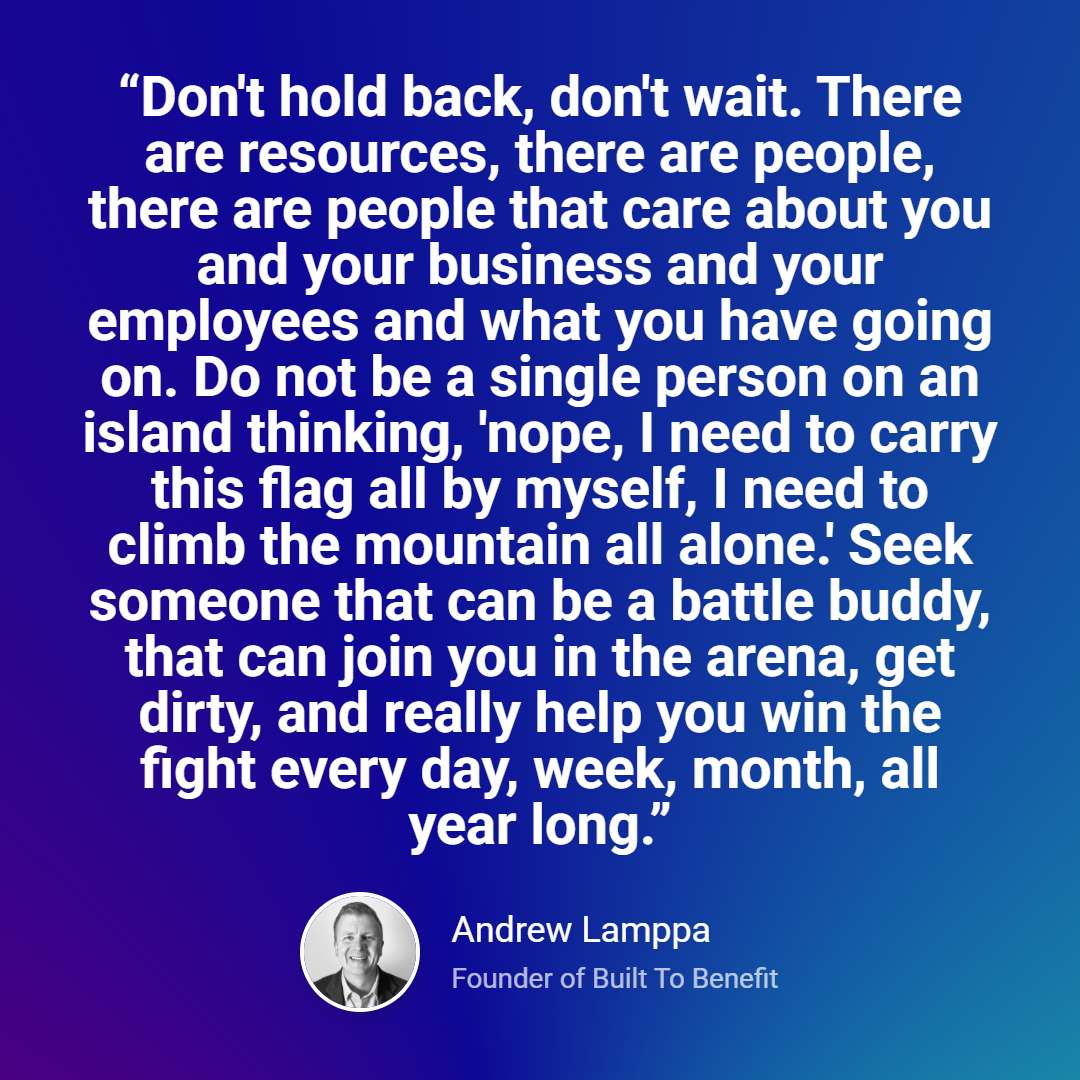
My suggestion to all your listeners would be, don't hold back, don't wait.
There are resources, There are people. There are people that care about you and your business and your employees and what you have going on. Do not be a single person on an island thinking, nope, I need to carry this flag all by myself. I need to climb the mound all alone. Seek someone that can be a battle buddy, that can join you in the arena and get dirty and really help you win the fight every day, week, month, all year long. That would be my advice. I think so many of us think there's this Americanism of we need to just do it on our own. And, yes, there is. I get that. And yes, many people have. But there's a lot of. Lot of people out there that are rooting for you, want you to succeed.
If you stay silent and quiet and don't reach out, they can't support you in ways that they want to. So that'd be my suggestion is whether it's me or someone else, find someone that can support you, help you grow, put down your pride, if that's what's getting in the way, or anything, any other block that's preventing you, and reach out for help. Because the world needs more of what you're doing.
[00:31:56] Speaker C: I love that. And for one good and final time, share how the listeners can reach you.
[00:32:03] Speaker B: Yeah. So they can either go to teamclaritysnapshot.com and fill out the form and get started with that, or they can go to builttobenefit.com and engage with them.
My name is Andrew Lampa and you can find me on LinkedIn as well.
[00:32:16] Speaker C: All right, well, thank you, Andrew. I hope you have a wonderful afternoon.
[00:32:21] Speaker A: This.
[00:32:21] Speaker C: This conversation was amazing. And may our organizations take advantage of your team Clarity snapshot. And we'll continue to grow and support each other on this journey.
[00:32:33] Speaker B: Zanetta, thank you so much.
I feel uplifted and blessed to have been welcomed as a guest on your show.
[00:32:39] Speaker C: Oh, thank you.
Thank you so much, Andrew. This has been wonderful and I'll connect with you on LinkedIn and we shall continue on this journey together. So thank you so much. This has been another episode of Unscripted. I'm Zanetta Tunique and Power. Have an awesome day.