[00:00:00] Speaker A: Hello, I'm Jeremy Rivera, your unscripted podcast host. I'm here with Bruce Ashford, who's going to introduce his agency. He's going to introduce himself and tell us why we should trust him.
[00:00:14] Speaker B: Jeremy, it's great to be on the podcast.
Thank you for having me on. So I'm the founder and CEO of a small consulting firm called the Ashford Agency.
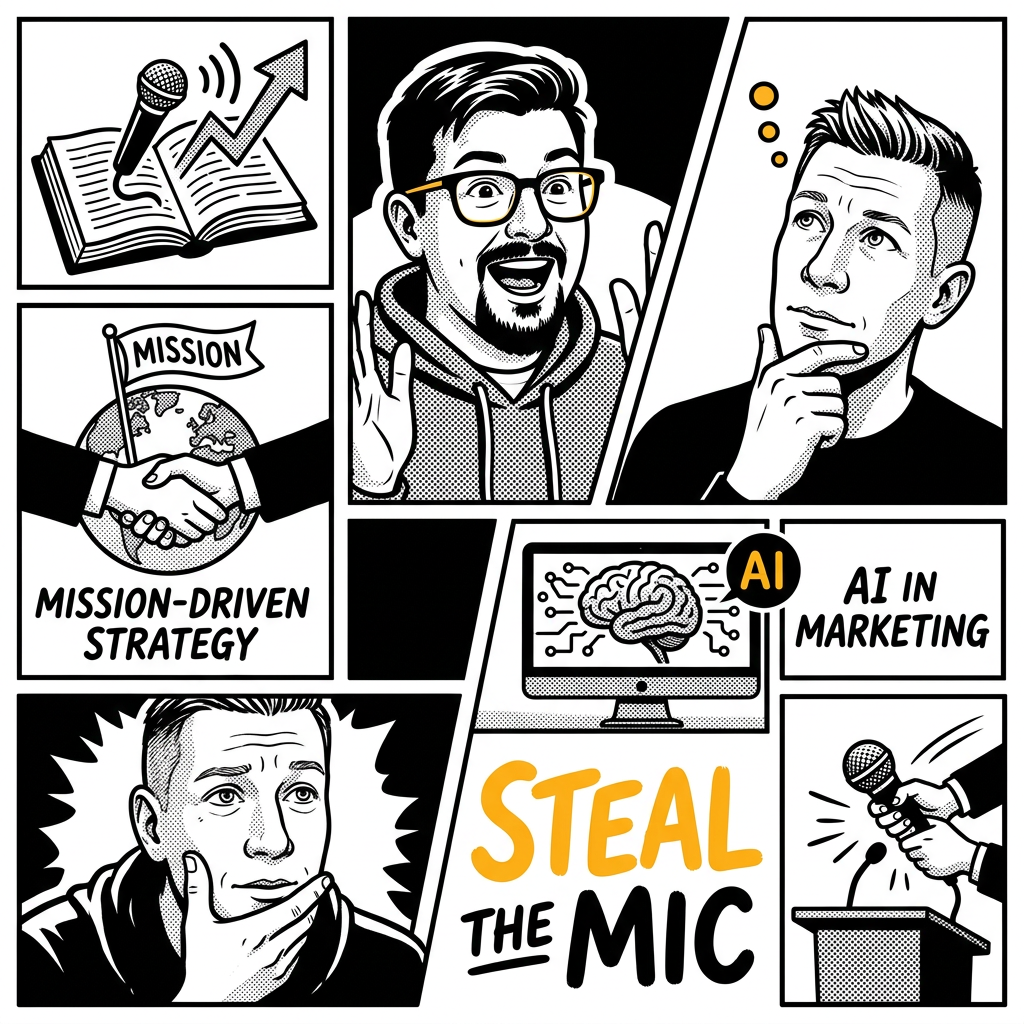
You know how the people out there who are telling bad stories in the world tend to hog the mic and get all the attention? Well, I help the good guys steal the mic, move to center stage, tell a better story and get the attention. So I help CEOs of nonprofits and small businesses who have a high value mission, but they're either unable to grow or unable to grow at the speed at which they want to grow.
And so they come to me if they've got a problem with message clarity or structural clarity or both.
So message clarity being their marketing message is really not landing. It's not compelling.
And then structural clarity is just trying to wrap their head around the moving parts of a business, how to integrate them, get them to fit together where all the, all the cylinders are firing together at the same time.
[00:01:20] Speaker A: I love this.
I love these conversations because I think there's such a.
There's a misconception that nonprofit means no money and that if you, that you have to become, you know, this martyr and put up your hands and nail yourself to the cross in order to work at a nonprofit or to make a difference in the world. And I think that there's room for businesses that want to do social good.
Andy Choi, who is part of Do Good, he had a really good interview with me where we talked about, hey, you know, if you are a small business, like, you can partner with nonprofits and you can make that part of your bigger business plan and business strategy. But is that something that you've run into with your consulting of nonprofits of like, they just expect to never be paid for anything they do and are just kind of expecting to be a martyr in order to get anything done.
[00:02:28] Speaker B: You're talking about the nonprofit itself.
Yeah, I mean, you know, nonprofit, nonprofit leaders. The thing is, most of them, in my experience, get into nonprofit work because they're passionate about a mission and they usually don't have business experience. Sometimes they do.
Often they don't.
Often they have strong leadership skills but have no idea how to wrap their head around moving an organization forward.
And, you know, I divide nonprofits into six components, similar to a business. The categories are a little different, but they're they're parallel, you know, businesses.
Leadership, marketing, sales, product optimization, management, productivity, cash flow. With a nonprofit, it's a little different.
It's leadership and governance because a nonprofit's got a board over him. Marketing.
Instead of sales, it's engagement. They basically have to sell to two audiences. They have to sell to donors.
This is kind of back at what you're talking about. Always have their hands out begging.
[00:03:37] Speaker A: Yeah.
[00:03:37] Speaker B: And then they also kind of have to sell to their program participants, the people they serve. I mean, it's weird to talk about it as selling, but.
And then instead of product optimization, they're trying to optimize their programs and their impact kind of, you know, and, and then management and productivity is, is about the same. And, but then instead of cash flow, to get to your point, we talk about financial health. Because the point of a nonprofit is not to, you know, make money for shareholders.
[00:04:11] Speaker A: Right, right.
[00:04:12] Speaker B: You know, there's no initial public offering with the nonprofit.
But, but, you know, they've got to, they've got to bring dollars in from donors and nonprofits. A lot of people don't know there that there are some nonprofits that can and do make money with the services they offer. Right, right. They offer a, a spirituality app, you know, that you subscribe to for 3.99amonth and then have to learn how to nonprofit does how to make their, their organization financially healthy. Often they're not. They don't have the background or training to know how to do so.
[00:04:47] Speaker A: It sounds like financial planning for, for somebody who's running a nonprofit is probably a key skill to develop, but sounds like the people that get into it, it's not on the front of their brain. Is that accurate?
[00:05:02] Speaker B: No, no, it's not on the front of their brain. And usually, you know, numerous of these components are usually not on the front of their brain. Usually on the front of their brain is programs and impact.
That's the first thing they get into it for the programs and the impact.
Yeah. Then when they get into the thick of leading, the next thing that suddenly goes into their brain is marketing. Oh, no. I need a magic trick with my marketing to help my programs go forward and get my donors drawn in.
But the magic trick doesn't necessarily usually work. And then you have to go a little deeper and realize, wait a minute. At the leadership level, I've got to set my critical objectives correctly and then take those critical objectives and connect those to how we market, how we fundraise, how we do our services.
And then if I do that all of a sudden I'm going to have the cash flow that I'm looking for, to use a business term. The donors are going to see the value in this thing and they're going to give.
And so then you have what's called a virtuous cycle instead of a vicious cycle, kind of a cycle upward instead of a cycle downward.
[00:06:14] Speaker A: I'm curious, what's the straddling point and borderline of a small business owner who wants to do social good versus, you know, choosing it to be a nonprofit? Let's say that they deliver a good or service that, that does a social good.
When should they consider, hey, you know what, this might be better as a nonprofit. And hey, I could get grants to do this thing. Like it came up personally for me because there's a local board game lounge and you know, the opportunity came up to buy it. And the first thing I thought was, oh, hey, if I, you know, opened this for a community center in the early part of the day for, you know, homeschoolers and put in some SEO training programs and then had a play, you know, board game sessions at night, I could totally leverage 501C3 and get some advertising dollars from Google once that's verified and maybe get a grant locally.
But you know, is there a lot of opportunity that people are leaving on the side because they, they have a very strong distinction between what they're doing as a business and what they might think of as a nonprofit?
[00:07:41] Speaker B: Yeah, you know, I don't have experience helping somebody transition from a being, say what we could call a mission minded business to being a nonprofit. But you raise a really interesting question.
And the biggest, you know, if you move from the business model to the nonprofit model, of course on the financial end of things, the biggest difference is that your, your nonprofits being carried forth on the back of donors who buy into the vision. But I'd say the biggest line in the sand between the two is government regulation. The minute you move into nonprofit work, there is a whole praetorian guard of government regulations that you've got to learn to follow.
And you know, and so it is a, it's a big move. But I think the most interesting thing out of what you just said, you know, that I would focus on for a moment, is that I like to help you notice in the, at the, at the beginning of this interview I said, you know, how there are people out there telling bad stories in the world. They tend to hog the mic. Yeah, well, I help the people who are out there telling good stories in the world, steal the mic, move to center stage and tell a better story.
And I think the important thing out of what you just said there is that you don't have, you don't have to be a nonprofit to do good in the world.
[00:09:04] Speaker A: Right?
[00:09:05] Speaker B: And you know, and, and that there are a number of mission driven businesses. I just use the word mission as that they know that they have a good or a value to offer in the social realm, that their business moves society in a healthier direction. And that is a very legitimate and a very valid way of doing some of the types of things that a nonprofit does. And for a business that wants to do that, you know, one of the ways, one of the ways to declare that is on how you write your mission statement. And I would advise a mission driven business for their mission statement to sound somewhat similar to a nonprofit's. So if you look at a difference in a vision statement and a mission statement, I think this should be helpful. I think for anyone out there running a business or a nonprofit.
Vision statements and mission statements that I see are usually really bad. D minus. They're a tangled spaghetti of ethereal and lofty ideas or technical jargon or they're just bad.
A vision statement is a statement of the mountain that your small business or nonprofit intends to scale. This is what it looks like at the peak if we win.
This is what it looks like. That's a vision statement. The mission statement is, and here's the path we're going to take to reach the peak of that mountain. And the mission statement, you know, a mission minded business and a nonprofit.
I encourage them to have a mission that includes what they're going to do, when they're going to do it by, and why they're going to do it. And that's the justice component. And we do this because every person deserves clean drinking water or sort of a justice statement of some sort. And you build that into your marketing collateral up front, your website, your business cards, your signature line, a very well stated, compelling mission statement. And then you make sure that the rest of the business or the nonprofit actually does what the mission statement says it's gonna do. It's a pretty powerful combination. It's something donors will give to if you're a nonprofit. And it's something that customers will buy for, you know, if you're a business.
[00:11:21] Speaker A: That dovetails nicely. Cause I have a question from a previous guest and I'll ask you at some point too to give me a question to ask to the next guest from Thiessen and Associates. They wanted to know what your suggestion is for businesses to add to their business current business plan.
And that sounds like it dovetails nicely with your, you know, have a vision and business and a mission statement.
But you know, thinking on the financial planning side, like having a business plan for yourself.
And this came from another guest too because he was talking about what does the end of your business look like. When you start a business you should think about the end of it. And I think that that longer term view plays nicely into also considering the social impact that you want to have long term. Because there's a lot of corporations out there that have now existed over a hundred years and gosh, wouldn't have been better if the founder at the start of that had said, hey, this corporation isn't just going to make profit, but it's also going to make sure that we have clean drinking water or put some sort of social benefit because you know, 100 years ago they didn't think about, you know, they just created business and it kept going. But what's your thoughts on the fundamentals that SMBs owners should be thinking about adding to their business plan is the question.
[00:12:54] Speaker B: Yeah, well, you know, I'm a paragraph guy in a bullet point world. You know, I'm a really wordy guy and you've asked me to list one thing and only one thing and I'm gonna, I'm gon to, I'm going to list two things, if that's okay, that every business owner should add. So I'll just start with the one that you foregrounded to have a clear and compelling vision statement and mission statement that gets after what you were just talking about. Vision statements and mission statements. And here's the trick, should be no more than 25 to 30 words.
They should not include technical jargon.
It should not be an opportunity for everyone in the C suite to get their favorite phrase or concept thrown in. They should be clear and compelling and they should let the customer or the donor or the program participant know exactly where you're headed, that's the end goal and exactly how you're going to get there. So that's one thing. And well, you know, vision statements and mission statements. When I mention this, business owners eyes glaze over it. Meaningless drivel, you know, just superficial meaningless drivel. Who cares?
That's because most vision statements and mission statements are awful and they can't be leveraged for marketing because nobody remembers them, not even the CEO, not even the board that voted them into existence. They're no good and so write a really good one, Repeat it in every single all staff meeting, put it on all your marketing collateral, and it becomes a powerful piece of marketing collateral.
The second thing, and a really important one here, is to Whether you're a business or a nonprofit, the marketing story that you tell, the marketing message that you have should be one in which the customer is the hero. Far too many businesses in the marketing message, if you read it carefully, the business or the product is the hero.
With the nonprofit, the nonprofit itself is the hero. But if you want an effective marketing message, you need to write one in which the customer is the hero. I'll focus on business for just a moment.
[00:14:47] Speaker A: Yeah.
[00:14:47] Speaker B: And this comes from. This is the storybrand pattern of marketing. Storybrand is the marketing firm that's made this well known, but it draws upon a messaging pattern that's 2,000 years old, minimum 2,000 years old.
Every great Hollywood movie, every great piece of literature we've ever read, the plots are all the same. I hate to ruin it, but it goes like this.
A hero, just meaning a main character, wants something really badly. And at the beginning of the movie or the story, they want something. The guy wants to win the girl or the warrior wants to win the war, they want something. If they don't want something, you don't have a story.
All right.
But very quickly, the hero faces a problem of some sort that's too big for him. He can't figure out how to solve it on his own. And this is what complicates the story and gives it suspense. The guy can't figure out to win the hand of the girl because she's married to a billionaire who looks like George Clooney and lives on a yacht or whatever. There's some sort of problem that he can't fix. And then very soon after that, in the story, the hero meets a guide.
The guide only appears very briefly.
The guide has empathy and credibility.
The guide empathizes with the hero's problem. Says, look, I know how you feel. I've been there. I've solved this problem, and I can help you.
Gives the hero a simple plan. If you do this, 1, 2, 3, you're going to have a fighting chance or you're going to win.
Calls the hero to action and gives him courage, and then tells them, if you do this, you'll avoid such and such bad consequences and you'll get such and such good consequences. It's the storyline of every movie that's ever sold tickets. There's a few indie movies that don't Follow the storyline. They also don't sell tickets.
And when it comes to a marketing message, it's very similar that a company's marketing message needs to. The main character of their homepage of their website needs to not be the business, it needs to be the customer. And what the customer wants.
Now the customer wants this. And they wouldn't have come to your website unless they're having a problem getting what they wanted or figuring out who's going to help them with what they want. And so you foreground what it feels like for them to have that problem, that they're not sure what to do or which product to buy. You foreground that the guide in the story is your business. You're the guide. You appear briefly, you're in the story, but you're not the hero of it.
And you show empathy and credibility. You empathize with the problem, how difficult it is to find a product that meets their need or whatever.
You show that you have credibility, you can solve their problem. That's where testimonials come in, stats.
You give them a simple plan. It's very easy to buy from us. Here's how it goes. You call them to action. And then an important part of the marketing message, the last two components of the story is to mention in natural human language, if they don't solve their problem by buying the product that you're offering, here are the negatives.
And if they do, here are the positives. And so that's a complete marketing message. It's very simple. It might seem just obvious. You might be like, thank you, Bruce, you know, Captain Obvious for telling us these things. But it's amazing.
I mean, the businesses that come to me often have two or three of the seven components in their marketing message. And here's why.
Most marketing firms in the past 20 years have gravitated. Marketing has expanded into numerous areas of expertise.
And marketing firms are focusing on social media channels. Very good to do that. Website building, user experience, graphic design, all of these different subspecialties within marketing.
But the core expertise within marketing is the one that's gone by the wayside and that's the actual message.
Why is that important?
First impressions are visual commitments to buy are message based.
So marketing firms are usually using boilerplate techniques or boilerplate AI language that is C or C plus level at best.
And the most important thing for a business or nonprofit to do is to put together a highly effective message.
The words that we use to talk about ourselves are the differentiating factor between whether a person buys or doesn't buy whether they donate or don't donate.
So I told you that I'm a paragraph guy in a bullet point world and I just proved it.
[00:19:32] Speaker A: So no, I like that.
[00:19:33] Speaker B: That's what I would add.
[00:19:35] Speaker A: I.
How do you apply that to.
It's easy to sell sexy stuff. What if it's really boring? It's like battery, energy, storage, storage system, walls. Like you're super niche. Like, how do you still tell a story when you got something boring like walls?
[00:19:57] Speaker B: Well, you know, when you get into it though, for a person who really needs the given thing, it's actually not boring to them because. So when a. When a customer faces, they face that problem on three levels. There's an external problem. I need a battery. Used a battery. I need a battery for my car.
Okay? That's the external problem. It's pretty boring, right? I need a battery for my car. Can I get some guy named Biff to come over and like put a battery in my car?
But there's an internal problem there too. And that is, how does it make them feel when they have that problem? That's where it gets a little more interesting. And it might be this.
I'm tired of replacing the battery in my car every year and a half.
Can I not get a battery that will last for three or four years?
You know, and this makes me frustrating. It's irritating for me. I work two jobs, I've got three kids, I'm a single parent, you know, whatever it is, I'm tired of having to deal with this. So in your marketing language, you actually foreground the internal problem for them. You name in natural human language how they feel because they've got crap batteries, you know, that they keep having to replace, you know, whatever the problem is. And then underneath you've got the external problem, the internal problem. Then underneath that, you have what I would call a justice problem, even with something like a battery. And that is that when a customer gets frustrated, it feels like an injustice.
And so in your marketing language, maybe you say something like, every car owner deserves a battery that will last longer than a year and a half.
And you state that.
So all of a sudden a pretty boring problem becomes pretty interesting to the person who has the problem, right?
And that's what we try, you know, that's what we're trying to do. And this is where marketing isn't spin.
If we followed this messaging pattern. Marketing is not manipulation. It's not spin, it's not selling. It's just putting into natural human language the actual experience that the customer is having and showing that we can solve the problem for them.
Does that make sense?
[00:22:00] Speaker A: It absolutely does. And I bet this is an easy question.
Where are businesses, both in nonprofit and profit, misusing the new technology that's coming into their hands with LLM based tools? You know, my friend Matt Brooks of Seoteric says, you know, ChatGPT has become your least trained customer support representative.
Uh, what are you seeing are the misuses of and of the potential of that tool?
[00:22:37] Speaker B: Okay, so I'll miss, I'll list two.
The first is in the, in the first misuse is how we use or rely upon AI to create our written content.
So written content could be an article or a website message, but written content is also the script for a video or what goes out on social media.
And we're all trying to figure out how to do this. But basically large language models have developed at a rapid pace over the last three years, but the place where they have not developed very well is their ability to write.
And ChatGPT, Claude is better than ChatGPT and Grok, in my opinion, better than Perplexity. It's the best writer of all. But none of them are really all that great.
And so let's talk about that for a moment. If your business, this has been producing say C minus, D level, F level marketing script, then if you go into ChatGPT, it can bring you up to about a C level. Because what the large language models can do is they can produce grammatically correct sentences organized around an outline. Very good at doing that, but not very good at doing anything much more than that.
So if you're already at a, say a C level and you want to upgrade to a B or AN A, the AIs are not going to be able to help you do it. Even if you're using them really skillfully and prompting them, well, you can still, you know, and I've been a writer for 25 years. I've authored nine books, I've ghostwritten 15. I cut my teeth doing that back in the day. So I'm a pretty good writer.
And even if I'm working really hard with AI to get it to write really top shelf stuff, it just can't do it. What it can do is help me in the drafting and editing stage. But you're going to have to have a skilled human eye. AI script is, it's, I guess, soulless.
You know, you people just, they can tell when something's written about a machine.
And now that everybody is doing their writing with machines, it just it just all blurs together.
And so we want to do is we want to make sure that in our use of AI we're going to have to use AI to write because we've got to produce so much stuff that the human element has to be very, very involved at every stage.
If you want the text that you put out to feel alive and if you want it to actually cause people to buy.
The second thing that I would warn about is that the thing that's off the radar for most businesses and nonprofits, I hardly ever encounter a businessman or a nonprofit for whom this is even on the radar at all.
And that is we just talked about how to use AI to produce stuff for your organization. Now I want to talk about using the AI to recommend your organization. In other words, how can a business or a nonprofit make itself visible to ChatGPT, Grok, Claude and Perplexity.
So that when they go into Google and search or when they go straight into an AI and ask a question, that the AI trusts your business enough that they make your business part of their answer, or that they provide or that they link to your business. And that's what we call Artificial Engine Optimization.
Aeo. It's a piggybacks on SEO. And there are three categories for how to do that. I'm going to try to do this in a way that's not boring for your people, but there are three categories of things that you're going to want to do to your website.
If you want me to help you consult with you on it or help you do some of the implementation of it, you can reach out to me@theashford agency.com One is technical that you're going to have to get somebody who understands the back end of a website to make sure that the back end of your website is making your web pages readable by machines. You want these machines to be able to read your website as easily as possible because the machines are looking to conserve calories.
What website is going to give me what I want to know as quickly as possible? Right, Right.
So that's the technical. That's the most kind of boring or abstract.
The second thing is that you're going to have to the content that you produce on your website and through your social media needs to be good enough and substantive enough and written in natural human language well enough that the AI trusts you as an authority.
That's a pretty big category. We don't have time to talk about it a lot, but I'll give one tip to the business people who are out there. One of the quickest ways to do that is to place an faq, a collapsible, expandable FAQ on your homepage or any other significant web pages that you have, where you ask the kind of question that most customers are going to ask you or should be asking you. You ask the question in natural human language, close to the way they would ask it, and then you answer it in natural human language the way that they would want it to be answered.
Machines love that, the AI's love that kind of thing. And if it's been coded correctly, they'll pick up on it and they'll use your FAQ as part of their answer.
When somebody goes into the AI and asks them a question, the third category.
So you've got to make your stuff machine readable. Then you have to show the AI that you're, that you have to do things that make the AI itself view you as trustworthy.
The third category is you have to show the AI that other human beings trust you. And this involves you having Google reviews and LinkedIn reviews that prove to the AI that there are people out there that trust you and hopefully that those reviews mention your business by name in the review and maybe even the product that they purchased.
So this is a new area, you know, that's, that is only, we're only beginning to see the importance of it. It's going to come much, much more important over the next year that you make your stuff accessible to the AI. So you're trying to win over now the humans to trust you, and you're also now trying to win over the machines to trust you. If it weren't complex enough already, now the task is even more complex.
[00:29:07] Speaker A: You know, it's funny because, like talking to another guest of mine, Alejandro Mayor Hans, you know, he's a link builder. And part of what I've done in SEO for many years is link building. And honestly, the getting mentioned and citation part is way easier for us because we've had our minds. And okay, I need to convince somebody not just to mention my business name in this context, but, but also to give me a link from their site, which editorially is a, is an even higher bar. So in some ways, for older SEOs like me, I've been doing SEO for 20 years, it's almost easier for me to grapple with that question of like, hey, what are some creative ways that we can get your name out? There is is a genuinely easier conversation than, hey, I know Google rankings are important to you, and part of that is Google Understanding the authority of your business. And you need backlinks. And you know, backlinks are those blue clickable links and only those are actually valuable. And we need them to be the specific reference point of, you know, topicality. And it connects from a relevantly topic, topically relevant page to yours is a lot more of a mouthful than hey, we need to do more to get your business visible online. Like that. I could say that in one sentence. So I'm from that aspect. I'm way happier, you know, oh, hey, your brand's Newton Crouch.
Let's get you out in the community. Let's sponsor a trash cleanup in the community. And you know, say that you're behind it and you can send a couple employees down, they'll clean up the community, make sure that that's visible online. You know what you do. One of my theories of effective marketing is to make sure that what you're doing in the real world gets penciled in on, in on the Internet. Like if you do a charity drive, if you're showing up every Saturday with your trailer and displaying movies for free at the park, that's amazing because you've got that logo at the top for your roofing company or your construction company, well done.
But if you're not going to the post board of the Facebook group and saying, hey, free movies at the park, you know, or putting in on the event sites and, or putting information or talking to a newspaper person about what you're doing or you know, getting on the church message board and saying, hey, I'm going have my trailer out for the church crew to watch. Watch the Passion of the Christ. You know, if you're not sketching in those details of your business that's in the real world, onto the digital side, then you're missing out.
[00:32:02] Speaker B: Yeah, I mean, it's a good point. And it's not manipulation to do that. You're not virtue signaling. What you're doing is you're trying to let people see who you really are at heart.
And so this is what we're doing. We want you to know that this is who we are.
And now we've got to do that for the AIs too.
No pressure, no pressure.
[00:32:28] Speaker A: Let's just add more onto it. It's not difficult enough for a small business owner.
I'm curious about your hot take on this.
I've helped a couple of small businesses launch recently.
One was a home contractor. They just had a Facebook page. But signing up for Google, my business, getting them into directories, literally the second I Entered them into a directory, the spam phone calls started, the cold email started. The second I made an email box on their site, they started a Facebook page, they got DMs, we added a LinkedIn page, they got spam DMs.
How, how do you advise for SMB owners to find a source of truth or find marketing advice that's credible or trustworthy when everything's going off the rails, trying to get them to give them their money?
[00:33:26] Speaker B: Man, being a CEO of a small business, it is a brutally difficult thing because you are wearing so many hats at once. If you're the CEO of a very small business, you're not only the chief executive officer, you're the chief sales officer, the chief marketing officer. All of this.
And like you say in the marketing realm, I mean, it's overwhelming.
I mean one, one thing I would say to small business owners, I don't know if this is exactly what you're looking for but you know, marketing is made up of so many different disciplines and specialt you're going to need to have somebody in house doing some marketing, but you're also going to need to have some people that you outsource to who are trustworthy. I think it's helpful for those people to be local, but they don't have to be. They could be digitally. You could, you know, things can be done digitally and so you're going to have to outsource and get an expert like you, like you were just talking about who knows SEO. You know, you're going to have to lean on experts to help you.
I don't think I'm giving a great answer here, but it's just marking your business is a tough thing. It's messy.
I try to find the right people to help me. I mean I own a small business and I've chosen to go a non employee model. Right now I don't have employees and so I have trusted vendors who I work with.
And don't be afraid to fire a vendor and hire a different one and find the people you can trust and help get them to help you solve the problems one at a time. And then I have to promote my own business here. And if what you really need is clarity, message clarity, a message that will land, reach out to me and we'll have a
[email protected] or if it's structural clarity, trying to come clear on how to put all the moving parts together.
That's what I'm really good at. You don't want to hire me for SEO.
You don't want to hire me to do graphic design.
You know, there's so many things I cannot do, but those are two things that I can do and do very well.
[00:35:28] Speaker A: So last question is, what is your question? I have SEOs, I have small business owners that I'm coming on and interviewing.
What are you curious about that's outside of your expertise? Or is something you're curious about somebody else's perspective? I'll ask it to the next guest and ping you when they answer your question.
[00:35:53] Speaker B: When I tell you, you really throw some fastballs. Jeremy. You know, I've never been asked this question on a podcast before.
Well, I mean, honestly, the area where I'm the weakest is cash flow for a small business, for my own small business. So a question I would ask is I've been exposed to one cash flow system, which is profit first, and I've kind of wrapped my head around that. My question would be what is an alternative book or two, an alternative system or two that I can encounter while I'm trying to figure out cash flow for my own small business? That's my question.
[00:36:30] Speaker A: Fantastic. I'll ping you once somebody else answers that question.
Really appreciate your insights. I'll make sure that your links to your agency and your social media profile. I think you said you hang out mostly on LinkedIn.
I'll make sure that gets linked in the show notes and thanks for coming on board.
[00:36:49] Speaker B: Thanks a lot, Jeremy. Have a good one.