Episode Transcript
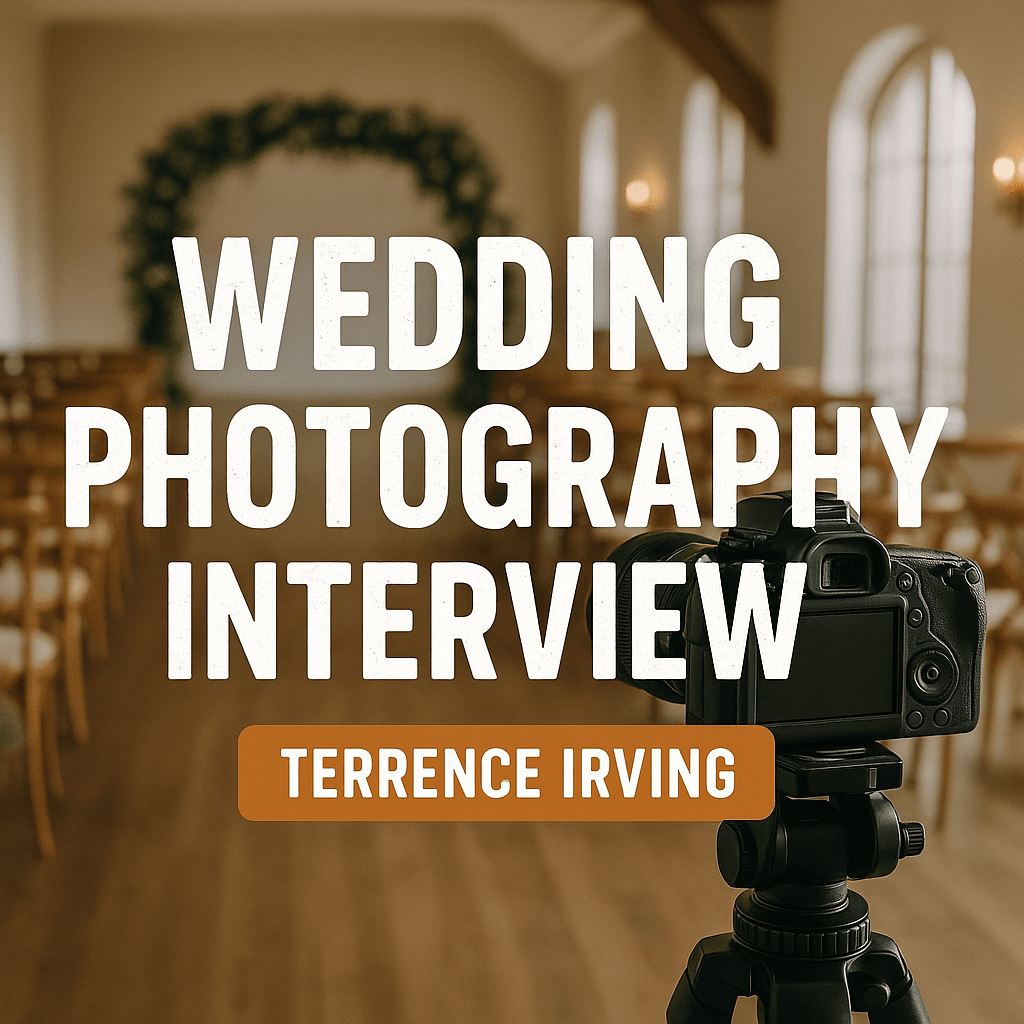
[00:00:01] Speaker A: Hello, I'm Jeremy Rivera, your unscripted podcast host. I'm here with Terrence Irving. Why don't you give yourself a quick introduction what your business is and where you got interested in it initially.
[00:00:13] Speaker B: Sounds good.
First of all, I want to thank you, Jeremy, for the opportunity to speak about my business and talk with you.
So my name is Terence Irving. I am a wedding photographer. The name of my business is Terence Irving Photography. I'm based up in New England, southeastern Connecticut, along the shoreline, a little town called Ledyard. And basically, I got my interest in wedding photography shortly before COVID So actually, I started my business in 2017 that was just landscape pictures that I would sell on Etsy and stuff. And then inevitably somebody said, can you take pictures of my toddler? That turned into a snowball effect of their friend was getting married. So they. They said, can you do our engagement session? I said, sure. And then that same couple asked me to photograph their wedding. And I remember being terrified. And then I remember doing it and having so much fun with all of the unpredictability, all of the changes, all the stress. And I said, I think I want to keep doing this.
So I had been into photography as a hobby since I was like 8, 9 years old. I had one of those dads who went to all the family functions with a camcorder or a film camera. So. So, you know, my sort of hobby or passion for photography goes back to when I was little. And then as far as the business goes, I'm coming up on, you know, eight or nine years here that I've been running my company.
[00:01:32] Speaker A: Fantastic. Do you run with a crew at these wedding events? Is it something you're. You. You're shooting solo and, like, what scale or size of these wedding events are you managing to hit right now?
[00:01:46] Speaker B: Great question. So my business is just me. I'm a single member llc, but when I go to weddings, I bring at least one person with me. I'm a very technical photographer. I'm also an engineer. So when it comes to digital photography and gear and stuff like that, it's just my personality, I guess, that I love to have equipment. So I'm never going to be without an extra camera. I'm never going to be without extra lights. So I bring somebody with me to help keep track of all that stuff.
Even the weddings that I photograph myself, I have an assistant with me.
Sometimes my couples opt to book a second photographer through me as well. So I offer three standard packages, and two of them come with a second photographer. So I usually either have one or two people with me.
I photograph everything from elopements all the way up to 300 people.
300 guests list weddings in huge banquet halls. The biggest wedding I've ever done was about that size. 300 people that was in Providence, Rhode Island.
And the smallest wedding I've ever done was an elopement. Two people plus me and the justice of the peace. So pretty wide range there. Most of my weddings are in Connecticut. I do a lot in Rhode island as well. And then elsewhere in the Northeast, like New York, Massachusetts, New Hampshire. But I will go anywhere. It's just, you know, most of the. The client base that I. That I pick up is right here in New England or the Northeast.
[00:03:13] Speaker A: Talking to other small business owners or potential small business owners. It's very different from the pace of going and putting in, you know, 40 hours a week at a specific location. There are a lot of variabilities based off of your industry and niche. What are some of the challenges you've had to overcome? Were you at a 9 to 5 before you transition to this? And is there something interesting in the lifestyle, in the process of taking on being a small business owner that's taught you something or was a particular challenge?
[00:03:51] Speaker B: That's a great question. So I'm actually in, I think, the rare bucket, which is I have both. I have two careers. One is my small business as a wedding photographer, and the other one is working a corporate job as an engineer. So the challenge for me is more so about balancing the two and then also, you know, being. Being a family person. So I'm married and also a father. Yeah, the. The challenges of balancing the two. The differences between the two are pretty obvious. Right? It's like being your own boss, being the one responsible for success, failure, and everything in between. That's one set of challenges. It's also one set of blessings in a way, because I don't know about a lot of other people.
Actually, I do. So a lot of my friends who run their own photography businesses, they love that aspect of, you know, everything is on me. And all of the successes are on me. And the failures, there's something to learn from. So I, I kind of share that sentiment with a lot of the friends that I have that are in the same business.
And then there's the, there's the nine to five side, the corporate side, which is it. It has its benefits. It definitely has its benefits. You know, the stability is nice as far as, like health insurance and things like that, because that's a real issue. When all of Your income comes from the business that you. You run and operate on your own.
So that's how I've chosen to sort of balance those two things. And really, I'd say the hardest part is you use the phrase side hustle. For me, it's not really a side hustle if I'm not at my nine to five, if I'm not actively with my family, for better or for worse, I'm doing a lot with my own business. And, you know, only 10% of it is actually taking pictures. The rest of it is editing those pictures. I do a little bit of video. I do a lot of work on my website. I do a lot of work with basically fielding the inquiries as they come in and having meetings with the booked couples. There's a lot, there's a lot that goes into it. As far as wedding photography goes or being a wedding vendor, my opinion is you're not doing it right if the only times you talk to your couples or your clients are when they book and when the event happens.
If I'm paying thousands of dollars, I'd really love to hear from you. I'd really love to have touch points in between. So I know that, that, you know, I'm not just a number or a statistic for you.
That's the way I feel about it, and that's the way I treat the clients that I work with.
[00:06:14] Speaker A: Love that. And since you brought it up, I'd love to hear what you're working on when it comes to that marketing side of your business. I personally am a search engine optimization guy. I do a lot of interviews with different folks about it. So I'm curious to hear from the owner side of things, what it is that you're trying to do with your website, how you might have been able to leverage it successfully, and how that might be changing. You know, when you know Matt Brooks of seoteric, I work with him, he said, you know, Chat GPT is one of the. Your least trained customer support representatives. And another guest is saying, you know, hey, ChatGPT isn't your friend. They're working on behalf of somebody else and checking out your stuff.
So there's this extra layer of, you know, you got search engines, you've got these new LLM tools. How's that working in your mind? How are you approaching that marketing question for your niche?
[00:07:14] Speaker B: Great question. So when I started out back in 2000, when I transitioned from. From the artistic side to the. To the wedding and event side.
[00:07:24] Speaker B: Facebook ads and Instagram ads were basically like King and Queen of wedding vendors, particularly wedding creatives, the photographers and the videographers. There were courses, there were experts out there, like, you know, pay me 600 and I'll teach you how to make the best Facebook ads you've ever seen. They never worked for me. I'm just gonna be honest. Paid advertising on social media never really worked well for me. I just wasn't good at it, I guess. I dabbled in Google Ads for about 10 minutes. I actually booked exactly one wedding from a goog ad years ago. But for me, other than word of mouth, other than other vendors working with me and then putting my name out there, SEO has. Has been it for me. So I've put a lot of work into my website. That is my main focus when it comes to marketing. And basically the way I do it is there are two elements, I'd say. One is being able to write down and articulate who I am as a wedding vendor, as a wedding photographer, and making that specific and explaining my niche and my expertise. So that's one aspect of it. And the other aspect is having worked at so many different wedding venues, having done so many engagement sessions, sprinkling out into the world little blog posts or images with alt tags in them that basically say, here's what I can do for you at this place you might be interested in. And of course, the goal there is somebody who is searching for, let's say, the society room of Hartford in Hartford, Connecticut. Hopefully, what they find is that result number six on a Google search is my. My blog post about the venue. They click on that, They're. They're reading it, they're getting information, but hopefully they're also grasping the fact that we're looking at these beautiful pictures here, and, and we like the voice that's coming across in this post. And you know what? We're gonna. We're gonna check in with this guy. We're gonna check in and see what this guy is all about. And maybe in addition to getting our information from him about our venue, we can actually get a photographer out of him. So those are my two approaches. It's like the brand voice part and then the.
How do I put out breadcrumbs that may attract potential clients?
[00:09:30] Speaker A: I love that analogy of breadcrumbs. And funny thing is, I can. I can give you secondhand validation of your strategy, because I just. I happened to interview an SEO who's over in Germany, and he's taking photo wedding photos of Konigsberg, and he said that his biggest organic success for him was. Was he would take extra time at the wedding, shoot to shoot the venue and then create a extensive blog post and then do it a YouTube video, turn that into YouTube shorts and then TikToks and creating a funnel of extra visibility across these additional platforms to try to capture the interest.
Because there's that geographic angle, you know, like my friend Michael McDougald of Right Thing CEO, like he says you have to find what's true about an area or a region and then multiply that through your marketing. Like if you want to be genuine, you know, there are service area companies, you know, there's companies that say they do business in your area but you know, if they're in California, they call it the Interstate 40. And you're like, you're not from California, it's the 40 or hell, you know.
[00:10:45] Speaker A: The 91 freeway or the Gateway to hell. Either way, you know, like there's colloquialism, there's way that ways that people talk. But then you know, there's the on the ground effort of like if you're at a wedding venue already, you can generate extra marketing material yourself and multiply it by the reach of that venue because if you share that video with them, you've accessed their marketing budget. They're going to share your video with your watermark. They're going share that picture that has your watermark in the corner. And when somebody asks, oh hey, that incredible photo you have on, on your homepage, who took that photo? Well, that's you. Or so I think. So many digital marketers sometimes forget the potential of real world connection.
So what has been your experience with co marketing or cross marketing or or interacting with other entities or companies or peers or competitors in a surprising way that's had a good outcome for you?
[00:11:46] Speaker B: Great question. So I want to say that in Connecticut, in Rhode island, it's a really nice community of wedding photographers and videographers and you know, you get to meet a lot of cool people and work with them and stuff like that. But what, what specific to your question? What's really nice is when we're booked we tend to refer each other, which I think is a really cool thing because it's like this, my friend Steve Walter always uses this phrase, community over competition. So it's like, okay, I'm not available on your wedding date. I'm not just going to say thank you, goodbye. I'm going to say, hey, I've got three friends, check in with them, they might be available. I trust them, I know them. Their work might be similar to mine or not. But I know that I feel comfortable sending you because I'm not available to those friends so that you can work with them. So there's that sort of like grass grassroots. I'm not open for the jump shot. I'll pass the ball to you. There's that.
As far as the venues go, some of the venues are pretty tough.
Some venues are pretty tough out there. What I mean by that is basically other than seeing you on the day of the event, some don't want much to do with you after that. But I've worked with a number of good venues that have done exactly what you've said. They've said, hey, can you share some pictures with us? We're going to tag you on social media, or we're going to give you a backlink because we want to put that image as a hero image on our. On our. On our homepage.
And then you end up on preferred vendor lists and you start getting inquiries. Because when the couples go to the venue, the venues first, I guess I should say that the venue is key. So marketing for a venue or getting on the good side of a venue can be very beneficial to any wedding vendor, because if your name ends up on that preferred vendor list, they're literally handing that to the couples that come through the door and book with them.
So by building that relationship, it can be a really good thing because your name is getting in front of them first.
So, you know, I've ended up on a few lists like that. It brings in inquiries. But I'd say that being able to build the rapport, regardless of being preferred vendor list, being able to build the rapport with the venue and build that, and portray that sort of comfort with the venue to the couple, it goes a really long way as well. Being able to say, look, I'm not just an expert with, with the tools with the camera, but I'm also an expert with a location that can help you, that can help you. So I'd say, you know, I didn't specifically ask this, but if people are listening or watching and they're thinking, you know, how do I. How do I get more bookings as a wedding photographer, a wedding videographer? One of the ways is exactly what. What we're talking about here, which is go out and visit these venues, even if you don't have events there, you might be able to get a tour, take pictures, take videos, share that with them, and then, you know, put that out yourself and say, look, I have a level of expertise because I've Been there and, or work there. And that can go a long way too. You mentioned Chat GPT earlier. So I recently dabbled with Chat GPT, the pro version, and basically that deep, I think it's called deep research.
I tried that out and I was pleasantly surprised and shocked by it because in just 20 minutes, you know, it spits out information. So if I, if I queried something about a venue, basically like what are people saying about such and such venue in Connecticut? And then you just get this, this amalgamation of information in return and it even tells you what the sources are.
I've gotten, I think, five or so inquiries where the, the couple said, we found you via Chat GPT. I've had about five of those this year. And it's really interesting because I kind of wonder what's Chat GPT saying about me? And I guess I could check, but it is an interesting, it's definitely a new layer because Chat GPT and AI have become sort of a, an unpaid wedding planner for a lot of couples out there because they're turning to it more and more to help them through the beginning stages of the wedding planning.
[00:15:38] Speaker A: Yeah, I mean, it's, it's a new, in some ways, it's, it's a new distribution channel, you know, a different way for these. But it's also, you know, thinking about yourself in the bigger context of the whole process.
Like, you know, I know right now, you know, I got married 17, 18 years ago, so thankfully I don't have to do it again. But if I, if I did do it again, I'd elope. And I'd planned that elopement with Claude's help. So thinking about, you know, the business process and how, you know, people on the other end of that, you know, robot, human, sandwich, like you're communicating, there's an intermediary between the two of you. I mean, it's kind of been that way in a certain way before.
You know, Google has always been kind of a big arbitrator of a lot of traffic. And, you know, certainly LLMs and language learning and processing models have been part of the algorithm since then. But I think what you said is, I wish I knew, you know, how I looked or why it brought me up or how I came. And I think kind of the big difference is there's such a level of personalization to each interaction and kind of a wild card factor because it's math and it's making stuff up to a certain degree.
And any different time, I can ask the same question on a different time of Day I'm going to get a different answer.
It's going to be similar maybe, but might be wildly different on some days. So there isn't that, you know, guarantee, like in SEO. Or you could be like, am I on the first page? Am I in the top three? Am I number one for a particular query? And then you could use software to track that certainty is gone. But what kind of.
[00:17:24] Speaker A: Process do you use to follow up with leads that you've gotten or interest off of your site? Or what metrics in your business are closest?
Are the things that you're keeping your fingers on the pulse?
[00:17:41] Speaker B: Could you do me a favor and ask that one more time? You were breaking up a little bit. Sure.
[00:17:45] Speaker A: What are the key metrics when you look at your business's marketing? What are the things that you have your finger on the pulse that you're checking fairly consistently?
[00:17:56] Speaker B: Great, great question. So I think for me, the main metric is the source of the inquiry. So on my website I've embedded a form that links back to my CRM, my, my customer relationship management software. Basically it's a web app that I pay for. And one of the questions on the form obviously is, how did you hear about me? And that's the one that I put the most stake in just because I'm trying to figure out what's working.
So on the, on the back end of my CRM software, I can log in and I can check statistics. So for 20, 25, let's say I've had 100 leads and I like to check and see, you know, as the year goes on, what percentage of those are coming from SEO and, and now what percentage of those are coming from chat, GPT or, or another AI platform, and then what percentage of them are coming from humans? So if I have low numbers for a quarter, let's say of word of mouth, either past clients or other vendors, I kind of look in the mirror and say, you know, am I making people mad? I'm making people upset. What do I need to do to get these numbers back up for the, for the human side of getting leads? And yeah, for me that's the, that's the main one. Where are the sort, where are the leads coming from and what should I be doing to, what should I be adjusting to sort of pick up in certain areas, whether it be SEO or word of mouth, so forth and so on.
[00:19:15] Speaker A: Love that.
[00:19:17] Speaker A: My next question is about planning. As a small business owner, you know, there's periods of feast and periods of famine. You know, there are certainly times of year that are more popular for weddings and then times of year that are slower. What have you done to handle seasonality over the long term?
Is it socking money away from, you know, weddings in the spring so that you've got a reserve deposit through those slower times? What are some of the processes that as a business you've developed to be more resilient?
[00:19:53] Speaker B: Great question. And I owe a lot to Covid. I started my business right before COVID and the friends that I had built, the relationships I had built up. In the beginning, we were kind of like all in it together from our, from our houses and apartments and stuff. So having gone through that and having been in a situation where, you know, you couldn't just go out and, and take pictures of people so easily, it kind of taught me right from the start how to, how to deal with, like you say, the feast or famine issue. So for me it's, it's knowing when to slow down with expenditures. So there's definitely that aspect.
And then it's also what am I doing with my time? I mentioned my website a few times, so it's like those pages that are ranking really well, could I be doing anything with worse off pages to make them perform like the better pages? So that there's. That as far as marketing goes, spending less time at weddings means there's more opportunities for me to spend on marketing. And then also it's a matter of content creation has become, for better or for worse, a really big issue. I think it's for better. To be honest, it is a little bit annoying keeping up with social media, but it is what it is.
And when, when there's less time spent at events actually taking pictures, there's more time to spend on basically putting my face in front of the camera or putting my keys and my fingers on the keyboard and creating content that goes towards marketing. I remember when Instagram reels were the big deal and now it seems to be the shift is towards TikTok.
People are. People in my industry anyway, are a little disillusioned by Instagram because Instagram started off as the, the picture social media network and it's turned into something else entirely. So I see a lot of us spending more time, I think, on TikTok because that seems to be where a lot of people planning weddings are as well. What's tricky about TikTok is I haven't quite figured it out. I'm just going to be completely honest. It's more fun than I remember the Instagram reel boom. Being on TikTok TikTok is like more laid back.
And I'm trying to figure out how to transition from, hey, I'm. I'm here to tell you about this great venue and, and turn that into, okay, what's more interesting? Because people are looking for interesting on TikTok. If you don't get someone's attention in the first two or three seconds, they're swiping on in the next video and it's like, okay, that was two hours of my life I'll never get back because I put out a piece of content that it's not performing.
So that's definitely a shift for me anyway. Some people are really good at it.
And yeah, that's, that's what it is. It's like if I'm, if I'm in a famine situation with my business, I'm. I'm trying to put the credit card down and I'm trying to look at, all right, what are the things that I could be doing to try and attract more business? And for me, it's, it's definitely marketing and content.
[00:22:41] Speaker A: Let's kind of wrap up here. What are you looking toward the next few years for your business?
What are some goals that you have?
And do you really see yourself as kind of a lifestyle type of business, or is there like a team goal? Do you want to work with more, more people, or is it just going, let's, let's keep going? Got a good thing. I want good leads and keep, keep the money rolling on the side. What's the long term for you look like?
[00:23:10] Speaker B: That's a great question, and I think I know that answer. And it's. I love what I have going on right now. I only photograph about 10 to 12 of my own weddings every year.
That really allows me to dial in my style and my artistry. And it also makes sure that I don't mix up couples. And I don't.
There are companies, I should say this. There are companies out there that are basically national and they are. I won't name any names, but there are wedding photography companies out there that you pay them a few dollars and they will send you a wedding photographer. There is no relationship.
There is no really emotion. It's simply a business transaction. I try to be as opposite to that as I can. So I check in with my couples. I try and get to know them. I do engagement sessions with them. I try and follow them with them a couple years after the fact to see, you know, how things are going with them. And to me, that's what it's about because these pictures, what we have to think about is these are pictures they're going to have forever and they might give them to their kids, they might share them with, you know, their parents, they might share them with grandparents. And to me, that's so deeply personal and deeply emotional that I really don't want to be treating them like a statistic. I want to be dialing in and treating them like human beings because that's, that's who they are. So for me, the long term goal is to basically keep doing what I'm doing and doing it well and you know, possibly growing year after year, adding one or two more weddings year after year. But, but I do love what I've, what I've built so far and like, I would intend to keep it that way.
[00:24:45] Speaker A: I love that aspect of, it's like Japanese craftsmanship. Now. You hone your art. Each time that you strike the forge, each time that you finish a sword, it cuts a little bit deeper. Each time the blade gets a little bit finer, those details are a little bit sharper. And yeah, I, I can attest, you know, it is, it is interesting to work.
I've consulted in literally hundreds of different types of business models and some are very personal and others are, hey, you're.
[00:25:18] Speaker B: A poop scooper, right?
[00:25:21] Speaker A: You know, so like your approach to that. I don't think, you know, their long term plan is to be like the, the artisan of the poop scooping, you know, and there are certain things where it's, it's just super industrial. Hey, we sell precast concrete walls. You know, we're going to plop those down and we're going to do that really well. There is a pride in craftsmanship. I find with a lot of service industry people that sometimes it's a little bit harder to translate over to the e commerce world because they'll kind of, hey, these are the products and then they'll develop the marketing and it's, it's a really different animal to market and build a company versus a business. And I love your perspective on and honoring the role that you have as a service provider and especially as something that's as, you know, sentimentally connected. You know, you don't have a lot of sentiment towards your H Vac unless that sentiment is anger when it goes out. So I love hearing, you know, professionals that are, get to explore that niche and do something that has that bigger emotional attachment that they, you know, they don't want to be part of the big corporo regime, just extracting money from it. There's enough money extraction out of the wedding industry already. So, you know, having that focus, I love that. Give a shout out to where maybe your next wedding is going to be. Be shooting some of your favorite venues where people can find you online if they want to learn, learn more about you.
[00:26:48] Speaker B: Absolutely. Thank you. Thank you. So again, Taryn serving photography and My website is www.turvingphoto.com and I use the same handle T irvingphoto on Facebook, Instagram, TikTok and YouTube. So that's where folks can find me. And again, my next wedding is actually two days from now. It's going to be a 15 person micro wedding. It's taking place at Aquila's Nest, which is a winery here in Connecticut, way over near the new, the New York line. So that's where I'll be next.
And yeah, I'm looking forward to it. Big or small. I love photographing weddings. I love doing it well and artistically. And you know, the goal is always to have the couple walk away saying, we don't think we could have gotten that anywhere else. So I feel like if I keep doing that, then I'm doing what I'm setting out to do.
[00:27:38] Speaker A: Absolutely. Love it. Thanks for your time, Terence.
[00:27:40] Speaker B: Thank you. Thank you.